

Part of the series: Exploring the Literary Giants, examining influential authors through paired comparisons of context, style, and enduring impact.
🔍 Provincial propriety versus revolutionary ambition.
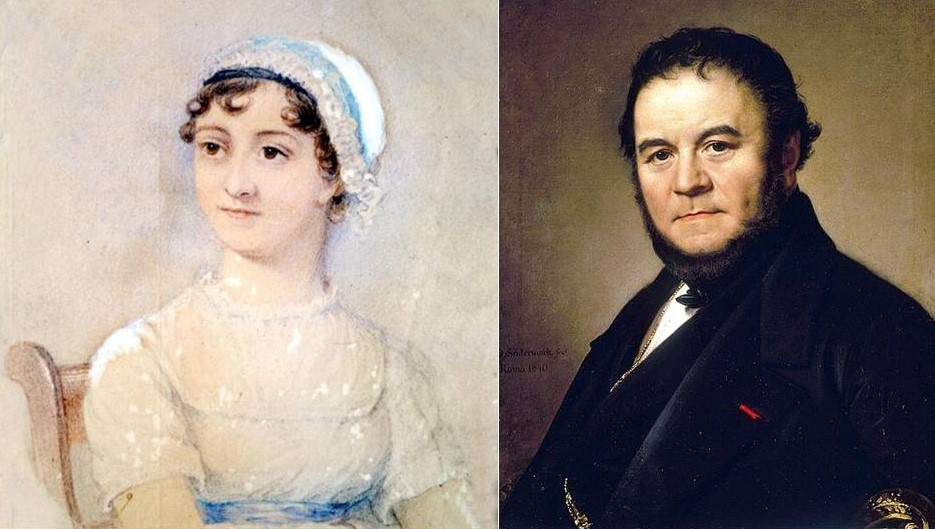
Why these two?
Jane Austen (1775–1817) and Stendhal (Marie-Henri Beyle, 1783–1842) are united by a shared, razor-sharp commitment to psychological realism and the unsparing dissection of social hypocrisy. Writing during an era of profound political upheaval and cultural transition, both authors turned their attention to the delicate, fraught mechanics of human desire, examining how individuals navigate the rigid expectations of society in their relentless search for personal happiness—what Stendhal famously termed la chasse au bonheur.
Although operating from vastly different social and political vantage points (Austen from the quiet drawing rooms of the English landed gentry, and Stendhal from the cynical, post-Napoleonic salons of Restoration France), both writers rejected the melodramatic excesses of the Romantic movement in favour of analytical clarity. Austen used biting irony and subtle social observation to expose the moral follies, financial anxieties, and quiet compromises of provincial courtship. Stendhal deployed a cool, almost journalistic detachment to chart the explosive collision between individual ambition, romantic passion, and class hierarchy.
Bringing them together reveals two distinct approaches to the same fundamental concern: how can an individual maintain emotional authenticity and moral integrity within a society governed by calculation, status, and self-deception?
Time, place, movement
Jane Austen (1775–1817) wrote against the backdrop of Regency England, a period marked by the Napoleonic Wars, industrial growth, and strict social stratification. As the daughter of a country clergyman living in Hampshire, Austen spent her life within the circumscribed sphere of the provincial landed gentry. Her world was outwardly stable, yet inwardly fraught with economic insecurity, particularly for women whose social survival depended almost entirely upon advantageous marriage.
Austen’s sharp social observations emerged from her deep familiarity with rural assemblies, parsonages, and country estates. Rather than engaging directly with the military conflicts raging across Europe, she focused on the domestic battlefield, transforming the subtle frictions of provincial life into a profound arena for moral and psychological examination.
Marie-Henri Beyle (1783–1842), who wrote under the pseudonym Stendhal, was shaped by the political chaos of post-Revolutionary Europe. A native of Grenoble, Stendhal served as an army administrator under Napoleon, witnessing first-hand the glory and disaster of the Italian campaigns and the retreat from Moscow. The fall of Napoleon and the subsequent restoration of the Bourbon monarchy left Stendhal and his generation stranded in a world of political cynicism, religious hypocrisy, and aristocratic mediocrity.
Writing in France and Italy during the 1820s and 1830s, Stendhal was intensely influenced by the Enlightenment rationalists and early psychological theory. He viewed literature as a mirror reflecting the realities of contemporary society, creating protagonists whose fierce ambitions and romantic ideals were constantly thwarted by the reactionary politics of Restoration Europe.
Both writers therefore emerge from the shadow of the Napoleonic era, using psychological observation to challenge the social vanities and moral compromises of their respective nations.
Core themes
A central concern for both Austen and Stendhal is the anatomy of self-deception and vanity (amour-propre). Austen repeatedly examines how vanity and social prejudice blind individuals to the truth of their own hearts and the character of others. In her novels, characters like Elizabeth Bennet and Emma Woodhouse must undergo painful processes of self-reckoning, dismantling their own intellectual arrogance before they can achieve genuine emotional maturity.
Stendhal approaches self-deception through the lens of psychological rationalisation and vanity. In his masterworks, characters constantly analyse their own feelings, confusing genuine passion with the desire to appear heroic or socially successful. Stendhal famously formulated the concept of crystallisation (the psychological process by which the imagination clothes a beloved object in fictional perfections), demonstrating how human beings fall in love with their own idealised constructs rather than reality.
Both authors are also deeply preoccupied with the conflict between individual desire and social constraint. For Austen, social conventions and financial prudence are real constraints that cannot be recklessly ignored, yet she insists that marriage without mutual respect and affection is a moral failure. Her heroines navigate a narrow path between social propriety and personal integrity. Stendhal portrays society as a arena of hypocritical gamesmanship where individual genius and passionate feeling must wear masks to survive, often forcing his heroes to choose between corrupt compromise and tragic defiance.
Finally, both writers explore the nature of genuine love and emotional authenticity. For Austen, true affection is grounded in mutual esteem, shared values, and moral growth over time. For Stendhal, authentic love is a rare, transcendent experience—an intense, sublime state of feeling that stands in radical opposition to the cold calculations of worldly ambition.
For both writers, psychological realism becomes a tool for exposing social falsehood and discovering what constitutes a meaningful life.
Style comparison
Austen’s style is immaculate, balanced, and celebrated for its revolutionary use of free indirect discourse. By seamlessly blending third-person narration with the internal thoughts and speech patterns of her characters, she allows readers to experience their rationalisations and growth from within. Her prose is characterised by dry wit, elegant symmetry, and a pervasive, masterly irony that exposes human folly without resorting to bitterness.
Stendhal’s style is energetic, concise, and intentionally unadorned. Stendhal famously claimed that he read pages of the French Civil Code every morning to set his tone, seeking a narrative voice free from Romantic flourish and poetic ornamentation. His writing moves with rapid psychological momentum, interspersing swift dramatic action with direct, analytical inner monologues that lay bare his characters’ calculations, doubts, and sudden emotional shifts.
Where Austen exposes social hypocrisy through delicate dialogue, quiet glances, and subtle breaches of etiquette, Stendhal exposes it through dramatic confrontations, political intrigue, and passionate psychological monologues. Austen builds her world through the detailed, claustrophobic intimacy of provincial social circles; Stendhal expands his narrative across military battlefields, royalist salons, and state prisons.
Both, however, share a fundamental commitment to narrative ironism. Neither author allows their characters—or their readers—to wallow in unexamined sentimentality, maintaining an intellectual distance that renders their psychological insights astonishingly modern.
While Austen reveals the soul through the quiet discipline of social conduct, Stendhal lays it bare through the turbulent clash of passion and ambition.
Key works
Austen’s major works include Sense and Sensibility (1811), Pride and Prejudice (1813), Mansfield Park (1814), Emma (1815), and the posthumously published Northanger Abbey (1817) and Persuasion (1817). They form a tightly unified canon examining the moral, economic, and emotional maturation of women in Regency society.
In Pride and Prejudice, Austen crafts her most famous psychological duel through Elizabeth Bennet and Fitzwilliam Darcy. The novel functions as a masterclass in epistemology: Elizabeth’s quick intelligence becomes her trap, as her initial prejudice against Darcy—and her foolish susceptibility to the charming George Wickham—blind her to true character. Darcy’s pride, born of aristocratic privilege, similarly insulates him from empathetic connection. Austen forces both characters through a process of rigorous self-examination, where Darcy’s humbling letter to Elizabeth acts as the catalyst for dismantling their mutual delusions.
Emma represents the peak of Austen’s narrative technique. In Emma Woodhouse, Austen created a heroine “whom no one but myself will much like,” a wealthy, clever woman who amuses herself by manipulating the romantic lives of her neighbours. Through immaculate free indirect discourse, the reader is drawn into Emma’s imaginative fabrications regarding Harriet Smith and Frank Churchill. Austen allows us to share Emma’s subjective errors while subtly signalling the objective reality she ignores, culminating in the painful humiliation of her self-discovery when she realises her love for Mr. Knightley.
Persuasion, Austen’s final completed work, offers a mature, elegiac contrast. Eight years after being persuaded by her godmother Lady Russell to break her engagement to the impecunious naval officer Frederick Wentworth, Anne Elliot lives as a neglected companion in her vain family’s household. Unlike Austen’s earlier heroines, Anne possesses self-knowledge from the start; her trial is one of endurance, patience, and silent emotional suffering. The novel documents the subtle shifting of social power from the decaying, land-obsessed aristocracy (represented by Sir Walter Elliot) to the meritocratic, duty-bound naval officers, culminating in Wentworth’s famous, impassioned letter declaring his unchanging devotion.
Stendhal’s principal masterworks include The Red and the Black (Le Rouge et le Noir, 1830), The Charterhouse of Parma (La Chartreuse de Parme, 1839), and the unfinished Lucien Leuwen (written 1834, published posthumously). They all explore the dilemma of the extraordinary individual trapped in an unheroic age.
In The Red and the Black, Stendhal creates in Julien Sorel the definitive anti-hero of nineteenth-century literature. An ambitious, highly intelligent carpenter’s son obsessed with the memory of Napoleon, Julien calculates every step of his social rise. Realising that military glory (“the red”) is closed to a peasant in Restoration France, he adopts the hypocrisy of the priesthood (“the black”). Stendhal charts Julien’s psychological oscillations as tutor to the de Rênal family and secretary to the Marquis de La Mole in Paris. Julien constructs his romantic liaisons with Louise de Rênal and Mathilde de La Mole as military campaigns, constantly inspecting his own feelings to ensure he is acting with proper Napoleonic firmness. Only when he shoots Madame de Rênal in a church after she exposes his opportunism—and faces execution in prison—does Julien strip away his hypocritical masks, achieving true emotional peace and discovering that his genuine love was always for Louise.
The Charterhouse of Parma shifts the scene to Italy, written with astonishing speed in just fifty-two days. The novel follows Fabrice del Dongo, an idealistic young Italian aristocrat who runs away to join Napoleon’s army, resulting in the famous, anti-romantic depiction of the Battle of Waterloo. Stendhal strips the battlefield of grand heroism: Fabrice wanders through smoke, confusion, and mud without ever understanding if he has taken part in a real battle. The novel then transforms into a labyrinth of court politics at the reactionary Duchy of Parma, managed by Fabrice’s formidable aunt, the Duchess Sanseverina, and her lover, Prime Minister Count Mosca. Through imprisonment in the Farnese Tower and his sublime, secret love for Clelia Conti, Fabrice abandons worldly ambition for the quiet contemplation of spiritual devotion, illustrating Stendhal’s belief that true happiness exists only in withdrawal from society’s corrupt arena.
Where Austen uses the domestic canvas to demonstrate how self-knowledge leads to moral integration within society, Stendhal uses the political and historical canvas to show how psychological authenticity requires a heroic, often fatal refusal to surrender to society’s demands.
Legacy and influence
Both Jane Austen and Stendhal fundamentally transformed the development of the modern novel, pioneering methods of psychological representation that anticipated the modern narrative arts.
Austen’s influence on English literature is immense. By perfecting free indirect discourse and elevating the domestic novel into a vehicle for profound moral philosophy, she established the foundation for nineteenth- and twentieth-century literary realism. Her works have achieved an enduring dual legacy: celebrated by literary scholars for their formal perfection and narrative technique, while remaining among the most widely read and adapted classics in global popular culture.
Stendhal’s legacy proved foundational for French realism and European modernism. Though largely neglected by his contemporaries (Stendhal famously dedicated his works to “The Happy Few” and predicted he would not be appreciated until 1880), he was later rediscovered and championed by figures such as Honoré de Balzac, Friedrich Nietzsche, and Leo Tolstoy (who credited Stendhal’s Waterloo scenes with inspiring his own battle descriptions in War and Peace). His analytical approach to emotion laid the groundwork for the modern psychological novel.
Together, both writers demonstrated that the novel could move beyond simple adventure or sentimental melodrama to become an unsparing, highly sophisticated investigation into human nature.
Final reflections
What is most striking in Jane Austen is the quiet perfection of her artistic control. Within the narrow boundaries of a country village, she captures the full complexity of human moral life, showing how self-knowledge and integrity can be forged amidst the ordinary pressures of daily social existence.
Stendhal approaches human existence with a more restless, expansive energy. His novels capture the dramatic friction of an individual spirit striving for greatness, beauty, and sublime passion in a world dominated by bureaucratic conformity and political cynicism.
Reading them together, the contrast becomes one of sphere rather than vision. Austen shows us how to achieve moral clarity and genuine affection within the structures of society; Stendhal shows us the exhilarating, dangerous beauty of trying to transcend those structures altogether.
Perhaps this is what defines their relationship. Austen asks us to examine our own hearts for the subtle vanity and prejudice that distort our judgement, while Stendhal asks us whether we have the courage to pursue true passion and happiness in a world that demands conformity.
If Austen turns the provincial drawing room into a theatre of profound psychological discovery, then Stendhal turns individual ambition into a mirror reflecting the moral state of an entire epoch.
Their works endure because neither writer offers easy answers or false consolations. Propriety, ambition, pride, and passion cease to be abstract concepts and become lived, urgent choices in the universal search for human fulfilment.
And somewhere between an English parsonage garden and a French Restoration salon lies the enduring realisation that the most difficult conquest is not society, but the mastery of oneself.
Part of the series: Exploring the Literary Giants
→ View all entries in this series
You may also like:
- J. R. R. Tolkien and C. S. Lewis → Read essay