

Part of the series: Exploring the Literary Giants, examining influential authors through paired comparisons of context, style, and enduring impact.
🔍 Meaning, suffering, and the problem of the absurd.
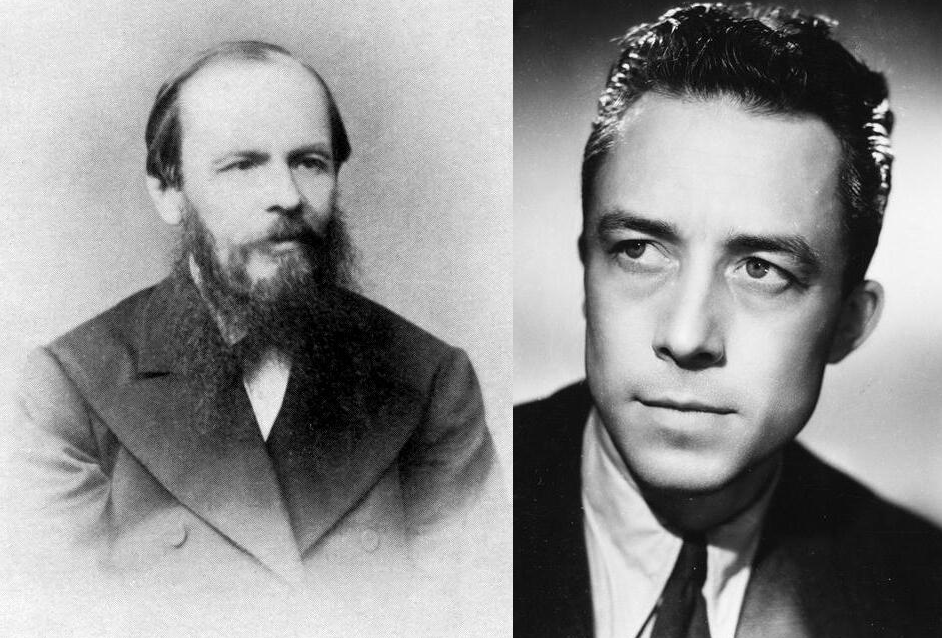
Photos: Public domain.
Why these two?
Fyodor Dostoevsky and Albert Camus are bound by a shared confrontation with some of the most difficult questions in human existence: the search for meaning, the presence of suffering, and the nature of moral responsibility. Though separated by time and philosophical outlook, both writers grapple with what it means to live in a world where certainty—whether religious or rational—cannot be taken for granted.
Dostoevsky writes from within a deeply religious and psychological framework, probing the consequences of faith, doubt, and moral choice. Camus, by contrast, approaches these same questions from a secular and philosophical perspective, most notably through his concept of the absurd. Bringing them together reveals not only a contrast in worldview, but a shared urgency in confronting the problem of meaning itself.
Time, place, movement
Fyodor Dostoevsky (Фёдор Миха́йлович Достое́вский, 1821–1881) wrote in nineteenth-century Russia, a period marked by social upheaval, intellectual ferment, and intense debates about religion, morality, as well as the future of Russian society. Often associated with literary realism, his work goes beyond social depiction, delving deeply into the psychological and spiritual struggles of his characters.
Albert Camus (1913–1960), writing in twentieth-century France and Algeria, is closely associated with existentialism, though he himself rejected the label. His work emerges in the aftermath of global conflict and disillusionment, shaped by the experience of war and the collapse of traditional systems of meaning. While their contexts differ significantly, both writers respond to moments of crisis (historical, moral, and philosophical) seeking to understand how individuals navigate a world in which certainty is either threatened or absent.
Core themes
At the centre of both writers’ work lies the question of meaning. Dostoevsky approaches this through the tension between faith and doubt, often suggesting that meaning is inseparable from spiritual belief. In novels such as The Brothers Karamazov, the struggle to reconcile suffering with faith becomes a central concern.
Camus, on the other hand, begins from the premise that the universe is indifferent to human longing. His concept of the absurd (the conflict between the desire for meaning and the silence of the world) defines much of his work. In The Myth of Sisyphus, he argues that meaning is not discovered but created through conscious rebellion against this absurdity.
Both writers also explore moral struggle. Dostoevsky’s characters are often torn between conflicting ethical impulses, their inner turmoil reflecting profound questions about guilt, redemption, and responsibility. Camus presents moral action in a world without ultimate justification, where choices must be made without the assurance of higher meaning.
Finally, both engage with suffering as a fundamental aspect of human existence. For Dostoevsky, suffering can lead to spiritual insight or redemption; for Camus, it is an unavoidable condition that must be confronted without illusion.
Style comparison
Dostoevsky’s style is expansive, intense, and deeply psychological. His novels are characterised by complex characters, philosophical dialogue, and emotional extremity. He often constructs narratives that place characters in situations of moral crisis, allowing their inner conflicts to unfold in dramatic and often chaotic ways.
Camus, by contrast, writes with clarity and restraint. His prose is precise, controlled, and often detached, reflecting his philosophical concerns. In works such as The Stranger, this simplicity becomes a stylistic expression of the absurd, mirroring the emotional distance of the protagonist.
Where Dostoevsky immerses the reader in the turbulence of the human psyche, Camus creates a more measured and contemplative space. One is driven by intensity and multiplicity; the other by clarity and reduction.
Key works
Dostoevsky’s major works include Crime and Punishment, The Idiot, and The Brothers Karamazov. These novels explore themes of guilt, redemption, faith, and moral responsibility through deeply developed characters and intricate narratives.
Crime and Punishment, in particular, exemplifies his exploration of moral struggle. Raskolnikov’s internal conflict following his crime becomes a profound examination of conscience, guilt, and the possibility of redemption.
Camus’s key works include The Stranger, The Plague, and his philosophical essay The Myth of Sisyphus. These texts articulate his vision of the absurd and the necessity of confronting it without recourse to false hope.
In The Stranger, the protagonist Meursault embodies the absurd condition, responding to life’s events with detachment that challenges conventional moral expectations.
Legacy and influence
Dostoevsky’s influence on literature and philosophy is immense. His exploration of psychology, morality, and faith has shaped existentialist thought and influenced writers such as Nietzsche and Sartre. His work continues to be regarded as foundational in the study of the human psyche and moral philosophy.
Camus’s impact lies in his articulation of the absurd and his insistence on confronting it directly. His work has influenced philosophy, literature, and political thought, offering a framework for understanding human existence in the absence of inherent meaning.
Together, they represent two responses to the same fundamental problem: how to live in a world where meaning is uncertain or absent.
Final reflections
What is most striking in Dostoevsky is the intensity of his moral vision. His characters are never allowed neutrality; they are driven towards extremes, forced to confront the consequences of their beliefs and actions.
Camus, by contrast, embraces a quieter confrontation. He does not resolve the question of meaning, but insists on facing its absence with clarity and defiance.
Reading them together, the contrast becomes deeply revealing. Dostoevsky seeks meaning through faith and moral struggle; Camus begins from its absence and constructs a response in spite of it.
Perhaps this is what defines their relationship. Dostoevsky asks how one might justify existence, while Camus asks how one might endure it.
If Dostoevsky searches for meaning within suffering, then Camus accepts suffering as the condition within which meaning must be forged.
Their lasting power lies not only in their brilliance, but in their ability to confront the enduring tensions of human life.
And somewhere between them lies the unresolved question of whether meaning is discovered or created.
Part of the series: Exploring the Literary Giants
→ View all entries in this series
You may also like:
• Franz Kafka and Marcel Proust → Read essay