
Part of the series: Exploring the Literary Giants, examining influential authors through paired comparisons of context, style, and enduring impact.
🔍 Social conscience, moral responsibility, and the human cost of inequality.
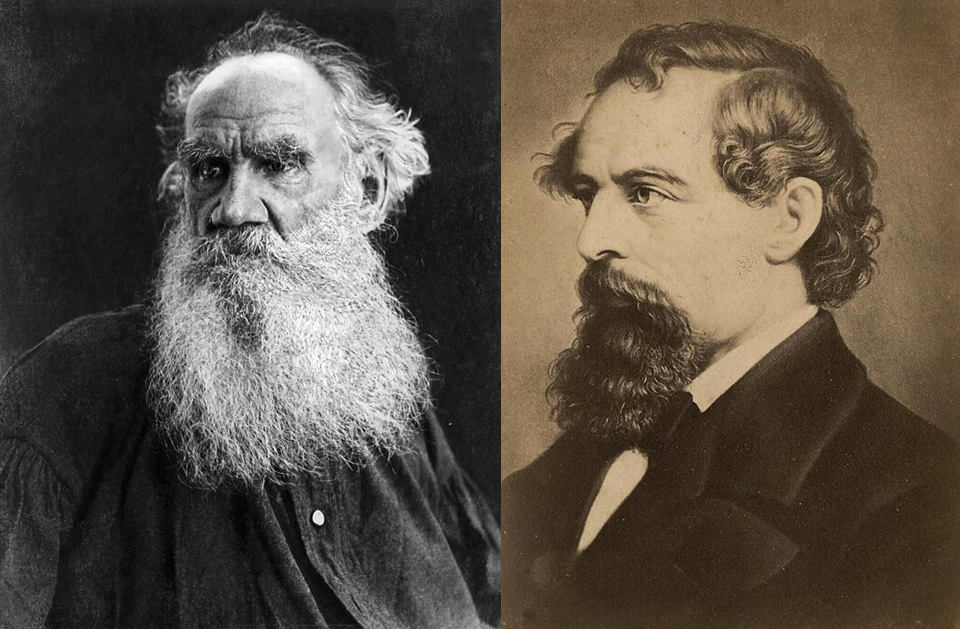
Why these two?
Leo Tolstoy (Лев Николаевич Толстой) and Charles Dickens are united by a profound concern with the moral conditions of human society. Both writers looked beyond individual experience to examine the structures, inequalities, and social expectations that shape people’s lives. Their works are populated by characters whose choices are influenced not only by personal circumstances, but by the societies in which they live.
Although Tolstoy wrote in nineteenth-century Russia and Dickens in Victorian England, both developed a powerful literary vision of social responsibility. Dickens often exposed poverty, exploitation, and institutional cruelty through vivid characters and sharply observed social environments. Tolstoy approached similar questions through a broader philosophical and moral framework, examining the relationship between wealth, privilege, family, conscience, and human responsibility.
Bringing them together reveals two different approaches to the same fundamental concern: what does society owe to the individual, and what does the individual owe to others?
Time, place, movement
Leo Tolstoy (1828–1910) wrote during a period of profound social and political change in nineteenth-century Russia. Born into the aristocracy, he had direct experience of both privilege and the inequalities that defined Russian society. His early works were influenced by realism, while his later writing became increasingly concerned with questions of morality, spirituality, social justice, and the possibility of living according to ethical principles.
Tolstoy’s position within the Russian aristocracy gave him an unusual perspective on social inequality. His novels frequently examine the tensions between wealth and poverty, privilege and responsibility, and personal desire and moral duty. As his thinking developed, he became increasingly critical of institutional authority and materialism.
Charles Dickens (1812–1870), writing in Victorian Britain, was similarly concerned with the consequences of social inequality. His childhood experience of financial hardship and his exposure to London’s rapidly expanding industrial society profoundly influenced his writing. Victorian Britain was undergoing enormous economic and social transformation, with industrialisation producing both unprecedented wealth and severe poverty.
Dickens is closely associated with Victorian realism and is particularly known for his depiction of London’s working classes, the urban poor, and the institutions that governed their lives. His fiction repeatedly exposes the gap between the ideals of a prosperous society and the reality experienced by those excluded from its benefits.
Both writers therefore emerge from societies undergoing major transformation, and both use literature to examine the moral consequences of inequality.
Core themes
A central concern for both Tolstoy and Dickens is social inequality. Dickens frequently portrays poverty as a consequence of social structures rather than individual failure. In Oliver Twist, the treatment of the poor exposes the cruelty and hypocrisy of institutions that claim to provide assistance while often deepening suffering.
Tolstoy approaches inequality from a more philosophical perspective. In Anna Karenina and Resurrection, questions of wealth, privilege, social expectation, and moral responsibility are closely connected. His characters are repeatedly forced to confront the consequences of living within systems that distribute power and opportunity unequally.
Both writers are also deeply concerned with moral responsibility. Dickens often places morally compromised institutions alongside characters whose compassion exposes their failures. Tolstoy goes further into the internal dimensions of moral choice, asking what it means for an individual to live authentically and responsibly in relation to others.
Family and social relationships provide another important point of connection. Dickens frequently uses families, friendships, and communities to demonstrate the effects of social conditions on individual lives. Tolstoy similarly examines marriage, family, and social expectations as forces that can either support or constrain moral and emotional development.
Finally, both authors explore the possibility of moral transformation. Dickens often allows compassion, generosity, or human connection to offer a form of redemption. Tolstoy’s later work becomes increasingly concerned with the possibility of moral awakening: the recognition that a different way of living may be possible.
For both writers, literature becomes a means of making suffering visible and asking what should be done in response to it.
Style comparison
Dickens’s style is expansive, vivid, and highly theatrical. His characters are often memorable and exaggerated, combining humour, sentiment, satire, and social criticism. He creates detailed urban environments and uses distinctive voices and personalities to bring social problems into immediate human focus.
Tolstoy’s style is more restrained and observational, particularly in his treatment of psychological and moral conflict. His narratives move between intimate personal experience and broad social observation, allowing individual lives to reflect larger questions about society and human behaviour.
Where Dickens often exposes social injustice through memorable characters and dramatic contrasts, Tolstoy tends to explore it through psychological depth and moral complexity. Dickens draws attention to the visible consequences of social inequality; Tolstoy is more interested in the internal consequences of the values and structures that produce it.
Both, however, rely on realism to achieve their effects. Their worlds are recognisable, socially detailed, and populated by characters whose lives are shaped by forces beyond themselves.
Where Dickens makes injustice visible, Tolstoy asks what it demands of the conscience.
Key works
Tolstoy’s major works include War and Peace, Anna Karenina, and Resurrection. War and Peace combines individual experience with a vast examination of Russian society and history, while Anna Karenina explores marriage, social convention, desire, and the consequences of moral and emotional choices.
Resurrection, Tolstoy’s final major novel, offers his most explicit examination of social injustice and moral responsibility. Through the transformation of its protagonist, the novel explores guilt, privilege, institutional cruelty, and the possibility of moral renewal.
Dickens’s most influential works include Oliver Twist, David Copperfield, Great Expectations, A Tale of Two Cities, and Hard Times. His novels repeatedly examine poverty, childhood, class, education, labour, and the institutions that shape individual lives.
Oliver Twist exposes the treatment of the poor and the failures of the workhouse system, while Hard Times offers a particularly sharp critique of industrial society and an educational philosophy that reduces human beings to economic usefulness.
Where Tolstoy often constructs a broad moral and philosophical world around his characters, Dickens uses the individual story to reveal the structures of society that surround them.
Legacy and influence
Both Tolstoy and Dickens transformed the possibilities of the realist novel. Their works demonstrated that fiction could entertain while also confronting profound questions of social responsibility and human morality.
Tolstoy’s influence extends far beyond literature. His later philosophical and moral writings influenced thinkers, writers, and political figures around the world. His exploration of non-violence, conscience, social inequality, and ethical responsibility contributed to wider debates about how individuals should live within unjust societies.
Dickens’s social influence is equally enduring. His vivid depictions of poverty and institutional cruelty helped shape public awareness of the conditions faced by children, workers, and the urban poor in Victorian Britain. Although literature alone cannot be credited with social reform, his novels became an important part of the cultural conversation surrounding poverty, education, labour, and inequality.
Both writers also demonstrated the power of empathy in literature. By bringing readers into the experiences of people separated from them by class, wealth, or circumstance, they made social problems personal rather than abstract.
Together, Tolstoy and Dickens demonstrate how literature can function as both moral inquiry and social observation.
Final reflections
What is most striking in Dickens is the immediacy of his social conscience. His injustices are often placed directly before the reader, embodied in children, workers, prisoners, and the poor whose suffering is made difficult to ignore.
Tolstoy approaches social morality from a more inward direction. His characters are repeatedly confronted with the gap between the lives they lead and the lives they believe they ought to lead. For him, social injustice is inseparable from the moral choices of individuals who benefit from it.
Reading them together, the contrast becomes one of emphasis rather than purpose. Dickens exposes the suffering produced by society; Tolstoy examines the conscience of those who participate in it.
Perhaps this is what defines their relationship. Dickens asks us to see injustice, while Tolstoy asks what seeing it requires of us.
If Dickens turns social suffering into a shared human experience, then Tolstoy turns moral awareness into a personal responsibility.
Their works endure because neither allows the reader to remain entirely outside the world they describe. Poverty, privilege, compassion, and responsibility cease to be abstract ideas and become questions of human behaviour.
And somewhere between them lies the enduring question of whether literature can merely reveal the injustices of society, or whether, by making us see them differently, it can also change the way we respond to them.
Part of the series: Exploring the Literary Giants
→ View all entries in this series
You may also like:
- Fyodor Dostoevsky and Albert Camus → Read essay