

Part of the series: Exploring the Literary Giants, examining influential authors through paired comparisons of context, style, and enduring impact.
🔍 Courage, isolation, and the moral darkness within.
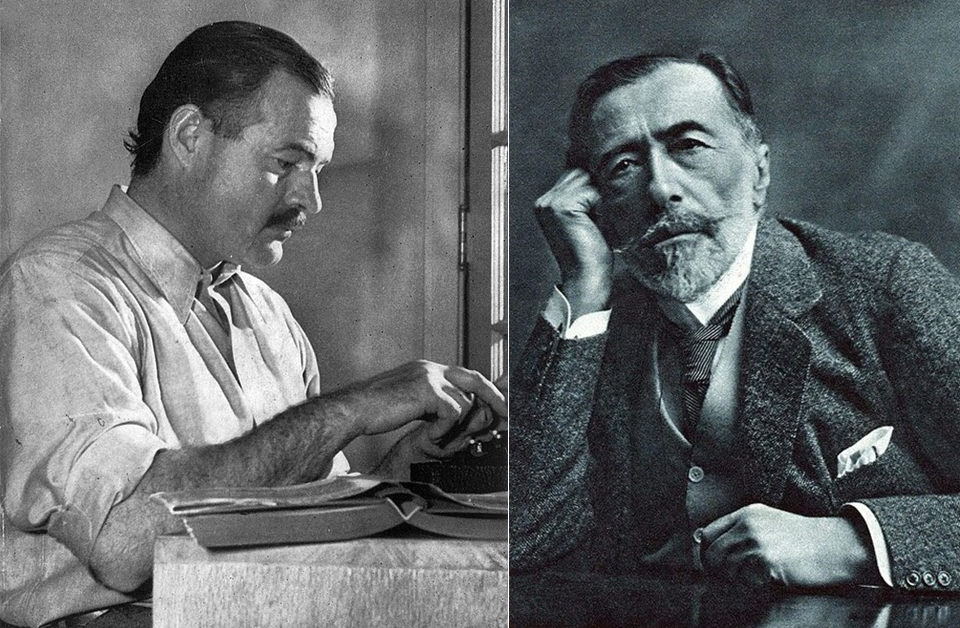
Some writers invent worlds. Others seem to have lived enough lives to make invention almost unnecessary. Ernest Hemingway and Joseph Conrad belong to the second category. They came from different generations, different cultures and radically different linguistic backgrounds, yet both transformed their experiences of danger, travel, war, masculinity and isolation into literature of extraordinary intensity.
Neither writer treated courage as a simple matter of being fearless, nor did either reduce human morality to an easy distinction between good and evil. Their characters are tested by circumstances, and it is often in those moments of testing that their true nature emerges.
There is, moreover, a direct literary connection between them. Hemingway admired Conrad deeply. In 1924, shortly after Conrad’s death, he published Conrad, Optimist and Moralist, a tribute that revealed just how seriously he regarded the older writer. Hemingway was not merely being compared with Conrad by later critics: he had read him, absorbed something from him and recognised him as a formidable literary predecessor.
And then there is the extraordinary linguistic paradox that separates them. Conrad became one of the great masters of English prose even though English was not his mother tongue. Hemingway, by contrast, became famous for apparently stripping his native English down to its simplest and most economical form. One acquired English and transformed it, while the other possessed it natively and transformed it through radical restraint.
Why these two?
The pairing of Hemingway and Conrad might initially seem obvious because both wrote about adventure, war, travel, violence and men confronted by extreme circumstances, but beneath those similarities lies something much more interesting.
Both writers were fascinated by what happens when human beings are removed from the familiar structures of civilisation and placed in situations where courage, loyalty, endurance and morality are tested. Both understood that physical danger is only one form of danger. The more profound threat may be psychological: the discovery of one’s own weakness, cowardice, vanity or capacity for cruelty.
Conrad’s life provided him with an extraordinary reservoir of experience. Born Józef Teodor Konrad Korzeniowski, he grew up speaking Polish and knew French from childhood before acquiring English in his twenties. He went on to become a British subject and spent many years at sea, experiences that would become fundamental to his fiction.
Hemingway’s life was similarly inseparable from his literary imagination. He worked as a journalist, travelled extensively, reported from wars and repeatedly sought out experiences involving physical danger and endurance. The mythology surrounding Hemingway sometimes threatens to obscure the writer himself, but the relationship between his life and his work is impossible to ignore.
There is a personal dimension to this for me, too. Hemingway’s relationship with war acquired a particular resonance when I remembered that he was awarded the Italian Croce al merito di guerra after being wounded while serving as an American Red Cross ambulance driver on the Italian front during the First World War. The John F. Kennedy Presidential Library holds the actual medal awarded to him.
My late father received the same recognition after returning from the Russian Front, one of a handful of survivors. That connection makes Hemingway’s experiences of war and survival feel very different to me from the perspective of simply reading about them in a biography.
The decoration itself was established in 1918 for military conduct deserving public commendation during wartime. But behind a medal there are always human beings, and behind the word survival there are experiences that can never be adequately conveyed by a military citation.
Perhaps this is one reason the pairing feels so compelling. Hemingway and Conrad were both preoccupied with what remains of a person when circumstances strip away pretence.
Time, place, movement
Conrad and Hemingway belonged to different literary generations, but both wrote from within a world undergoing enormous transformation.
Conrad was born in 1857 in the Russian Empire to Polish parents and came of age in a Europe still dominated by imperial structures. His years at sea took him through a colonial world whose inequalities, ambitions and violence would profoundly inform his fiction. The sea in Conrad is never merely scenery. It is a space in which civilisation becomes uncertain and human beings are confronted with isolation, danger and moral ambiguity.
His experience of the sea also gave him a perspective that was unusual for an English novelist. He was simultaneously inside and outside the culture about which he wrote: a Polish-born man who became a British citizen and one of the most distinguished writers of the English language.
Hemingway belonged to a later generation shaped by the First World War, the interwar years, the Spanish Civil War and the enormous upheavals of the twentieth century. His journalism and travels brought him into direct contact with political violence and social change. Spain, Italy, France, Cuba and Africa all became part of his imaginative geography.
Both men travelled extensively, but their relationship with travel was not that of tourists collecting impressions. Movement exposed them to unfamiliar societies and moral systems. Their characters cross geographical boundaries only to discover that the deepest conflicts accompany them.
Conrad’s sea voyages and Hemingway’s journeys through Europe, Africa and the Americas therefore became much more than biographical adventures. They became laboratories for examining human behaviour.
Core themes
Neither Hemingway nor Conrad equates courage with the absence of fear. For Hemingway, courage is defined as maintaining dignity and discipline in the face of suffering and death; his celebrated ideal of grace under pressure is powerful precisely because it is fragile, masking deep physical and emotional wounds. Conrad is equally fascinated by courage, but his moral landscape is often darker. His characters frequently begin with absolute confidence, only to discover that extreme isolation or danger exposes hidden frailties. The central question for both is not simply whether an individual is brave, but who they truly become when bravery is demanded of them.
Few subjects connect these two authors more strongly than the examination of masculinity, yet neither writer’s treatment of it is as straightforward as popular myth suggests. Hemingway’s men live by an internal code, preserving dignity through their response to inevitable defeat or trauma. Conrad’s men are more psychologically uncertain, repeatedly questioning heroic ideals and showing how easily confidence can curdle into arrogance. In both cases, the narrative exposes the vast distance between merely performing masculine toughness and possessing genuine moral strength.
Isolation serves as the primary arena where character is tested. For Conrad, the sea or the remote outpost becomes a closed environment where hierarchies, loyalties, and sanity are pushed to their limits. Hemingway’s isolation is often more psychological, as his characters frequently remain profoundly alone even in crowded rooms. In both instances, removing external distractions forces the individual into an unavoidable confrontation with the self.
This confrontation is further sharpened by their treatment of violence and the fragile veneer of civilisation. Hemingway understood modern warfare first-hand, while Conrad explored conflict through maritime, political, and colonial settings; yet both fiercely resisted the romanticisation of danger. Violence leaves permanent scars, and survival is rarely a clean victory. As Conrad demonstrated in Heart of Darkness and Hemingway showed in his post-war fiction, civilisation’s moral structures are exceptionally fragile, and the darkness human beings encounter in extreme situations is ultimately something they carry within themselves.
Style comparison
At first glance, Conrad and Hemingway could hardly appear more different.
Conrad’s prose can be elaborate, layered and philosophically searching. His narratives often move through uncertainty, delayed revelation and shifting perspectives. Meaning is rarely handed to the reader in a straightforward manner.
Hemingway’s prose, by contrast, is famously economical. He favoured short, declarative sentences and an apparently transparent vocabulary. Yet the simplicity is deceptive. His technique depends heavily on omission: what is not said can carry as much significance as what is said.
Conrad’s language can seem to surround an idea from several directions. Hemingway often approaches the same kind of emotional complexity by refusing to explain it.
And there is something extraordinary about the linguistic circumstances behind their achievements.
Conrad acquired English as an adult. His native Polish and his knowledge of French belonged to his early life, yet he ultimately produced some of the most distinctive English prose of the modern era.
Hemingway, meanwhile, took the English language he inherited and subjected it to an almost ruthless process of simplification.
Conrad’s English was acquired.
Hemingway’s English was stripped down.
Yet both demonstrate the same fundamental truth: mastery of language is not a matter of vocabulary alone. It is a matter of knowing precisely what language can make the reader feel.
Key works
For Conrad, several works are indispensable to understanding this exploration of experience, morality and human darkness, as his major fiction traces a relentless descent into the psychological and moral vulnerabilities of the human condition.
In Lord Jim (1900), Conrad interrogates the fragile architecture of personal honour, examining how a single split-second failure of character can haunt a lifetime and transform guilt into an unrelenting existential engine.
Heart of Darkness (1899–1902) stands as his most disturbing critique of Western imperialism, a journey upriver that relentlessly peels back the thin veneer of civilisation to expose the chilling, primordial darkness latent within the human psyche.
Broadening his canvas, Nostromo (1904) swells into a sweeping, tragic masterpiece on the mechanics of power, political revolution, and the insidious, corrupting pull of material interests on an entire nation.
Finally, turning his lens toward the urban landscape, The Secret Agent (1907) offers a dark, claustrophobic study of terrorism, state surveillance, and moral decay, dissecting secrecy and the deeply fractured nature of the modern self.
Hemingway’s major works similarly return to the themes of courage, violence, love, and mortality, tracing the fragile equilibrium between endurance and collapse.
The Sun Also Rises (1926) captures the aimless disillusionment of a generation spiritually scarred by war, adrift in search of an elusive moral code.
In A Farewell to Arms (1929), Hemingway draws upon his experience on the Italian front to transform the brutality of conflict into a devastating study of love, desertion, and existential vulnerability.
His scope expands in For Whom the Bell Tolls (1940), placing the individual squarely within the ideological violence and collective tragedy of the Spanish Civil War.
Decades later, The Old Man and the Sea (1952) distils endurance, dignity, defeat, and ultimate perseverance into a mythic, deceptively simple narrative of human struggle against nature.
Beyond the novels, his short fiction represents the concentrated pinnacle of his craft; masterworks such as The Killers, Hills Like White Elephants, The Snows of Kilimanjaro, and The Short Happy Life of Francis Macomber demonstrate how immense psychological pressure and tragic depth can be conveyed through rigorously restrained prose.
Legacy and influence
The relationship between Conrad and Hemingway is especially fascinating because it is not merely retrospective.
Hemingway was an enthusiastic reader of Conrad, and his 1924 tribute Conrad, Optimist and Moralist explicitly records his admiration. In it, Hemingway described Conrad not simply as a storyteller and stylist but as a profound thinker and philosopher.
The connection therefore becomes almost generational.
Conrad helped establish a form of modern fiction in which adventure could become philosophical investigation and external journeys could become journeys into the human psyche. Hemingway inherited some of that territory but transformed its language and atmosphere.
The influence is particularly interesting because Hemingway did not simply imitate Conrad. His prose moved in almost the opposite stylistic direction. Where Conrad could make a reader work through layers of language and uncertainty, Hemingway often removed everything he believed unnecessary and allowed silence to carry the burden.
Yet both writers understood that the strongest literature does not necessarily explain human experience. Sometimes it forces us to inhabit it.
Conrad’s influence can be felt throughout twentieth-century literature, particularly in writers concerned with colonialism, moral ambiguity, psychological darkness and the unreliable relationship between civilisation and violence. Hemingway’s influence on modern prose is equally enormous: his economy, dialogue, understatement and technique of omission transformed the possibilities of English-language fiction.
Both also helped create a literary image of the writer as active participant rather than passive observer: someone who does not merely sit outside the world describing it, but enters it, takes risks, experiences its violence and contradictions, and then attempts to transform those experiences into art.
That transformation is perhaps their greatest common achievement.
Final reflections
Ernest Hemingway and Joseph Conrad were separated by nationality, generation and temperament. One was an American who became the embodiment of a particular twentieth-century mythology of masculinity; the other was a Polish-born British writer who mastered a language that was not his own and became one of the great stylists of English literature.
Yet both understood that literature begins where experience becomes difficult to explain.
Their fiction examines men confronting danger, yet beneath the adventure lies a probing query into identity. War and physical violence frame their plots, but survival remains the true subject; codes of strength structure their worlds, yet fear, vulnerability, and the shadow of failure define their atmosphere. They travelled through distant landscapes, but their deepest journeys were always inward.
Conrad’s refusal of a British knighthood in 1924 is, in that respect, a wonderfully revealing final detail. By then he had become one of Britain’s most celebrated writers, yet he declined the honour offered to him by Prime Minister Ramsay MacDonald. His refusal was consistent with his reluctance towards official honours and institutions.
There is something fitting about that gesture. Conrad had spent much of his life negotiating questions of belonging: Polish by birth and cultural inheritance, French-speaking from childhood, English by literary choice and British by citizenship. He ultimately belonged, perhaps, nowhere quite completely, and therefore belonged to literature in a way that transcended national boundaries.
Hemingway, for his part, read Conrad and recognised something in him. That matters. It means that the conversation between these two writers was not created by us a century later. Hemingway himself entered it.
And perhaps that is the most compelling way to see them together: Conrad ventured into the darkness of the world and discovered the darkness within human beings; Hemingway entered many of the same territories and asked what dignity might remain when that darkness could no longer be ignored.
Both knew that courage does not mean defeating fear. Sometimes it means facing it, knowing that survival may come at a price, and refusing to look away.
Part of the series: Exploring the Literary Giants
→ View all entries in this series