

Part of the series Exploring the Literary Giants, examining influential authors through paired comparisons of context, style, and enduring impact.
🔍 Moral order and the instability of human judgement.
Note: This essay is a revised and expanded version of an earlier post, now adapted to fit the structure of the Exploring the Literary Giants series.
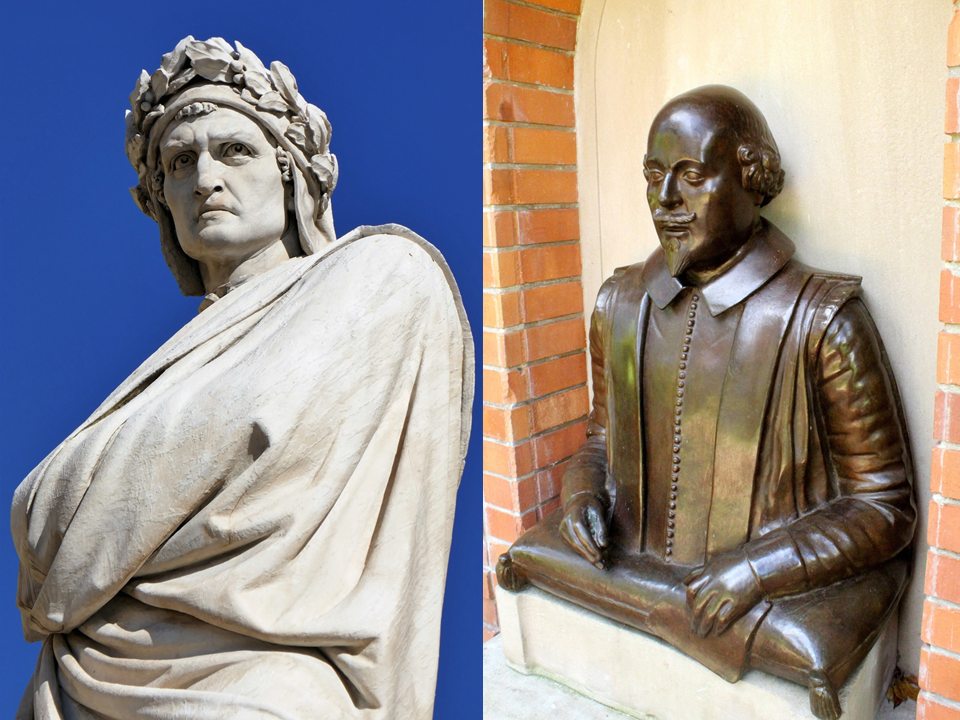
Why these two?
In the realm of literature, few names resonate as profoundly as William Shakespeare and Dante Alighieri. These two titans of the written word have left an indelible mark on world literature, each crafting works that continue to inspire, provoke, and captivate readers centuries after their creation.
While they hailed from different eras and cultures (Shakespeare from Renaissance England and Dante from medieval Italy), their works reveal both striking similarities and significant differences. Each writer stands as a pillar of literary history, not only for their artistic achievements but for their ability to articulate enduring truths about the human condition. Bringing them together allows us to explore how literature evolves across time while remaining rooted in universal concerns.
Time, place, movement
Dante Alighieri (1265–1321) lived during the Late Middle Ages, a period marked by political turbulence, religious fervour, and the early stirrings of the Renaissance. Born in Florence, Dante was directly involved in the conflict between the Guelphs and the Ghibellines, factions aligned with the Papacy and the Holy Roman Emperor respectively. His political engagement ultimately led to his exile, an experience that profoundly shaped both his worldview and his writing.
The medieval intellectual and cultural landscape was deeply influenced by Christian theology, and this is vividly reflected in Dante’s works. His writing presents a universe governed by divine justice, where sin, redemption, and moral order are central organising principles. This framework finds its fullest expression in The Divine Comedy.
William Shakespeare (1564–1616), by contrast, lived during the English Renaissance, a time of burgeoning exploration, scientific discovery, and renewed interest in classical learning. The Elizabethan era, named after Queen Elizabeth I, was characterised by relative political stability and a flourishing of drama and literature.
Shakespeare’s works, performed at venues such as the Globe Theatre, reflect the complexities of human nature and society. While religious ideas remain present, his writing is more secular in orientation, shaped by the humanist ideals of the Renaissance. His plays explore ambition, love, betrayal, and identity within a world defined less by divine order and more by human action and consequence.
Core themes
Despite the differences in their contexts, both Dante and Shakespeare engage deeply with themes that continue to resonate across centuries.
Morality and divine justice are central to Dante’s vision. In The Divine Comedy, every soul is placed according to a precise moral logic, reflecting a universe governed by divine authority. Shakespeare, however, presents morality as more fluid and often ambiguous. In plays such as Macbeth and Hamlet, questions of right and wrong are entangled with personal ambition, doubt, and circumstance.
Both writers offer profound explorations of the human condition. Dante does so through a spiritual journey of the soul, tracing its progression from sin to redemption. Shakespeare, by contrast, examines the inner lives of individuals, portraying psychological conflict and emotional complexity with remarkable depth.
Love functions differently in their works, yet remains central. Dante’s idealised love for Beatrice serves as a guiding force towards divine enlightenment. Shakespeare, however, portrays love in multiple dimensions (romantic, tragic, irrational, and transformative), as seen in plays such as A Midsummer Night’s Dream and Romeo and Juliet.
Finally, both writers address power and consequence. Dante situates power within a divine and moral hierarchy, while Shakespeare explores its corrupting influence within human society, particularly in works like Macbeth.
Style comparison
The stylistic differences between Dante and Shakespeare reflect their distinct literary aims and traditions.
Dante’s The Divine Comedy is an epic poem divided into three parts: Inferno, Purgatorio, and Paradiso. Written in Italian rather than Latin, his choice of the vernacular was revolutionary, making his work accessible to a broader audience. The poem employs terza rima, a highly structured rhyme scheme that contributes to its formal elegance and cohesion.
Dante’s writing is richly allegorical, using vivid and often striking imagery to convey theological and philosophical ideas. His narrative follows a clear, guided progression through the realms of the afterlife, combining personal experience with universal symbolism.
Shakespeare’s oeuvre, by contrast, includes 39 plays, 154 sonnets, and two long narrative poems. His works span multiple genres: tragedy, comedy, history, and romance. His language, characterised by iambic pentameter, inventive wordplay, and layered metaphor, has had a lasting influence on English.
Unlike Dante’s structured allegory, Shakespeare’s writing is more fluid and grounded in dramatic realism. His characters are complex and multifaceted, and his narratives unfold through dialogue, action, and interaction rather than guided exposition. His works were designed for performance, giving them an immediacy and dynamism distinct from Dante’s more contemplative style.
Key works
Dante’s most renowned work, The Divine Comedy, stands as one of the defining achievements of world literature. Through its three-part structure—Inferno, Purgatorio, and Paradiso—it presents an intricate vision of the afterlife, exploring themes of sin, redemption, and divine justice. Guided by the Roman poet Virgil and later by Beatrice, Dante constructs a journey that is both deeply personal and universally symbolic.
Shakespeare’s body of work is remarkable for its breadth and diversity. His tragedies, such as Hamlet, Macbeth, and King Lear, delve into the complexities of ambition, madness, and moral conflict. His comedies, including A Midsummer Night’s Dream, explore love and human folly, while his histories examine power and political legitimacy.
Where Dante builds a single, unified literary vision, Shakespeare offers a wide-ranging exploration of human experience across multiple forms and narratives.
Legacy and influence
Both Dante and Shakespeare have had a profound impact on their respective languages and literary traditions.
Dante is often referred to as the father of the Italian language. His decision to write in Italian rather than Latin helped establish the vernacular as a legitimate literary medium, shaping the future of Italian literature. His vision of the afterlife has also influenced countless writers, artists, and thinkers.
Shakespeare’s influence on the English language is equally significant. He is credited with coining numerous words and phrases that remain in use today. His works have been translated into countless languages and continue to be performed and adapted worldwide.
Both writers demonstrate an innovative use of language that expanded the expressive possibilities of literature, ensuring their enduring relevance.
Final reflections
What is most striking in Dante is the certainty of his vision. In The Divine Comedy, the universe is ordered, structured, and ultimately intelligible: every soul placed with purpose, every action carrying its defined consequence.
Shakespeare, by contrast, resists such clarity. His world is marked by ambiguity, where motives are uncertain, outcomes unstable, and meaning often emerges only through conflict and doubt.
Reading them together, the contrast becomes more than historical: it becomes philosophical. Dante presents a world governed by belief; Shakespeare presents one shaped by experience.
Perhaps this is what defines their relationship. While Dante offers the architecture of moral order, Shakespeare exposes the instability of human judgement within it.
If Dante maps the structure of the universe, then Shakespeare maps the difficulty of inhabiting it.
Their works endure not only because of their brilliance, but because they continue to speak to these fundamental tensions at the heart of human life.
And somewhere between them lies the enduring tension between certainty and doubt.
Part of the series: Exploring the Literary Giants
→ View all entries in this series
Comment on “Exploring the Literary Giants: William Shakespeare and Dante Alighieri”