

Part of the series: Exploring the Literary Giants, examining influential authors through paired comparisons of context, style, and enduring impact.
🔍 Society, identity, and the masks we wear.
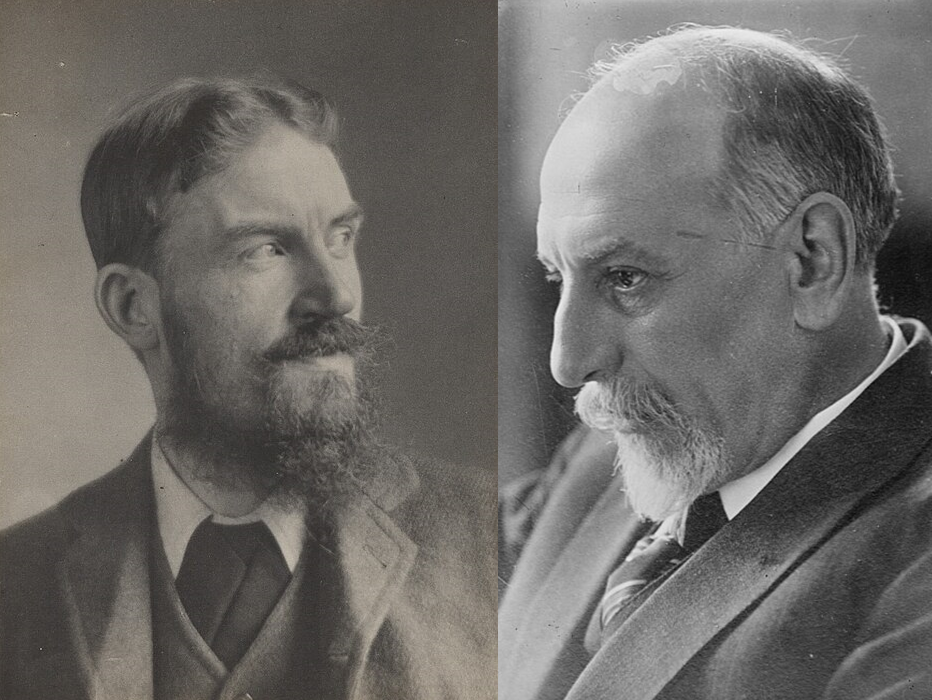
Why these two?
Two Nobel Prize winners (Shaw in 1925, Pirandello in 1934), and two revolutionaries of modern drama who refused to accept appearances at face value. George Bernard Shaw (1856–1950) and Luigi Pirandello (1867–1936) could hardly seem more different at first glance. Shaw was the great social provocateur, using comedy, satire, and fierce intellectual debate to expose the hypocrisies of class, convention, and gender in respectable society. Pirandello turned his gaze inwards towards the unstable territory of identity itself, questioning whether an objective reality or a single, authentic self exists beneath the masks we wear.
Yet these surface differences conceal a remarkable affinity. Both playwrights were radical theatrical innovators who transformed the stage into an arena of intellectual confrontation. Neither wanted audiences to sit comfortably in dark auditoriums watching predictable stories unfold. Shaw sought to provoke his public into reconsidering their political and moral assumptions, demonstrating that social structures are neither natural nor inevitable. Pirandello aimed to destabilise their very understanding of reality, illustrating how easily our perceptions can fracture under psychological pressure.
The contrast between them is stark, but it is precisely this tension that makes their pairing so compelling. Shaw dismantles social conventions from the outside, asking us to look at society and say: Why must we live this way? Pirandello dismantles the concept of a fixed identity from within, taking us somewhere even more unsettling to ask: Who, exactly, is the person who is living it?
Both dramatists leave their audiences with the uncomfortable suspicion that the world they take for granted is far less solid than it appears.
Time, place, movement
Shaw was born in Dublin in 1856 and spent much of his adult life in London, becoming one of the most prominent intellectual and theatrical figures of the late nineteenth and early twentieth centuries.
He belonged to an era of enormous social change: industrialisation, expanding political consciousness, debates about socialism, women’s rights, poverty, education and the organisation of modern society. Shaw did not stand outside those debates. He plunged directly into them.
His theatre consequently became a vehicle for ideas. But Shaw had an unusual gift: he could make an argument entertaining. A Shaw play can contain political, economic or philosophical ideas that might have filled an essay, yet the audience encounters them through characters arguing, flirting, deceiving, provoking and making fools of one another.
Pirandello, born in Sicily in 1867, came of age in a newly unified Italy and wrote during a period in which traditional certainties were increasingly being challenged. His work developed alongside the profound intellectual upheavals of the early twentieth century. The old confidence in fixed categories—reality and illusion, reason and madness, individual and society—began to look increasingly fragile.
But Pirandello transformed that instability into theatre. His characters do not simply inhabit a fictional world, but they can become conscious of their own fictional status. The theatre itself can become part of the drama: actors transform into characters, characters confront their creators, and the boundary between the stage and reality begins to disintegrate.
Rather than a mere theatrical trick, this marked a complete revolution in how the stage could reflect upon itself.
Core themes
Shaw’s great subject is society, particularly the absurd and often cruel conventions that human beings accept simply because they have endured for generations. In plays like Pygmalion, Eliza Doolittle’s transformation is ostensibly about phonetics, but beneath the wit lies a devastating critique of social class. Her accent determines her status: change her speech, and society instantly alters its perception of her worth. Shaw exposes an uncomfortable truth: society claims to judge individuals by their intrinsic character, yet constantly evaluates them through external, artificial markers.
Where Shaw examines the roles society assigns to us, Pirandello examines what happens when those roles become indistinguishable from identity itself. For Pirandello, identity is fluid and fragmented; we project different versions of ourselves in every relationship. The “mask” is not merely a disguise hiding a fixed, authentic self—the disturbing implication in Pirandello’s universe is that there may be no unified self underneath it at all. His characters become trapped by the perceptions of others, believing themselves to be one person while those around them see someone entirely different, turning social confusion into a profound existential terror.
This philosophical dilemma finds its ultimate form in Pirandello’s metatheatrical revolution. In Six Characters in Search of an Author, six fictional figures interrupt a rehearsal, demanding that their unfinished tragedy be staged. By placing actors who are playing characters in direct conflict with “real” fictional entities, Pirandello shatters the boundary between illusion and reality. He does not merely break the fourth wall; he questions whether the wall ever existed, turning the theatre into a self-conscious arena where the stability of truth, authorship, and objective reality is permanently undermined.
In plays like Right You Are (If You Think You Are), Pirandello denies the audience the comfort of a single, objective truth, asserting that reality is entirely dependent on perspective. Here, Shaw and Pirandello converge in their central enquiry: both dramatists ask whether human beings can ever escape the identities imposed upon them. Shaw championed social liberation driven by intellectual awakening and systemic reform. Pirandello, however, sees humanity caught in a psychological labyrinth where uncertainty is the only definitive answer.
Style comparison
Shaw’s argumentative, satirical method relies on an exuberantly verbal delivery. He thrived on staging aggressive debates, packing his dialogue with rapid, provocative intellectual fencing where every joke carries a hidden thesis. Pirandello’s sharp humour, by contrast, operates within an unstable, psychologically unsettling theatrical universe.
This divergence dictates how they disrupt the audience’s comfort. Shaw demands that we recognise the absurdity of external social conventions, challenging why we accept them in the first place. Pirandello forces us inwards, destabilising the very categories of reality and questioning whether we can truly know another person at all.
Despite these contrasting methods, both playwrights refuse passive spectatorship, compelling audiences to re-examine beliefs they might otherwise take for granted.
Key works
Shaw’s theatrical legacy is immense, spanning dozens of plays that systematically dissected Victorian and Edwardian pieties.
Pygmalion (1912) remains perhaps his most accessible and enduring masterpiece, wrapping a penetrating critique of class consciousness and social identity inside a razor-sharp linguistic comedy.
Man and Superman (1903) is considerably more ambitious philosophically, bringing together social criticism, ideas about evolution, gender and human development. Its famous “Don Juan in Hell” section becomes almost a play within the play, allowing Shaw to pursue philosophical questions through theatrical form.
Earlier works cut even closer to the bone. Mrs Warren’s Profession (1893) confronted the hypocrisy surrounding prostitution, poverty, and the economic subjugation of women with such candour that it was initially banned by the Lord Chamberlain.
Major Barbara (1905) launched a searing attack on capitalism and industrial philanthropy, forcing the audience to weigh moral purity against practical power.
And in Saint Joan (1923), Shaw reimagined the historical martyr as a champion of individual conscience, using her trial to expose the terrifying self-preservation of entrenched institutions.
Shaw’s extraordinary modernity explains why his work retains its vitality.
Beyond the theatre, he was also famously ahead of his time in his views on social reform, women’s emancipation, economics, animal rights, and ethical vegetarianism—viewing the latter not as a simple dietary preference, but as an essential element of a coherent moral life.
Moreover, his wit has survived almost as vigorously as his plays. Shaw possessed the rare gift of compressing an entire philosophical treatise into an aphorism sharp enough to draw blood.
Pirandello’s masterpieces are equally revolutionary, representing a total subversion of 20th-century drama.
Six Characters in Search of an Author (Sei personaggi in cerca d’autore; 1921) stands as the definitive monument of his metatheatrical vision, stranding unfinished fictional figures on a stage to demand an author for their grief.
Right You Are (If You Think You Are) (Così è (se vi pare); 1917) systematically dismantles the illusion of objective truth, demonstrating how gossip and human projection construct contradictory realities.
In Henry IV (Enrico IV; 1922), he delivers a chilling study of madness, identity, and the sanctuary (or prison) of historical performance.
His theatrical experimentations deepened with Each in His Own Way (Ciascuno a suo modo; 1924) and Tonight We Improvise (Questa sera si recita a soggetto; 1939), which shattered the traditional distance separating playwright, actor, character, and audience.
And his obsession with the splintered self was equally potent in prose: The Late Mattia Pascal (Il fu Mattia Pascal; 1904), though a novel rather than a play, remains essential for understanding his fascination with identity, fake deaths, and the ultimate possibility (or impossibility) of reinventing oneself.
Together, these works reveal a dramatist committed to deconstructing the very mechanics by which human beings construct their stories, identities, and realities.
Legacy and influence
Shaw changed modern drama by demonstrating that theatre could be simultaneously entertaining, political, philosophical and intellectually confrontational. He helped establish the modern “problem play” as a form in which social questions could be placed directly before an audience without sacrificing wit or theatricality. His influence extends far beyond the theatre. Pygmalion has itself been repeatedly adapted and reinterpreted, most famously as My Fair Lady, proving how enduring Shaw’s examination of language, class and identity has become.
Pirandello’s influence is perhaps even more radical in formal terms. Theatre after Pirandello could no longer regard the boundary between fiction and reality as unquestionable. His metatheatrical experiments anticipated and influenced later developments in modern and post-war theatre, including writers who would deliberately expose theatrical conventions and make the audience conscious of its position as an audience.
The deepest legacy of these playwrights lies in their shared refusal to accept appearances at face value. Shaw forced audiences to question the external social structures enclosing them, weaponising satire to destroy public complacency. Pirandello turned that same scepticism inwards, using paradox to dismantle psychological certainty. For both men, the stage was a space to create a distinct kind of discomfort through a mechanism designed to make an audience laugh, while instantly forcing them to interrogate the hidden assumptions behind that laughter.
Part of the series: Exploring the Literary Giants
→ View all entries in this series