County Administrative Boards are a Swedish anomaly that needs to be dismantled
A Deadly System Designed to Be Untouchable
My work as an animal‑rights advocate focuses on the legal mechanisms that shape how animals are treated within state systems. I have spent years examining Sweden’s administrative framework, only to discover how it has enabled the killing of thousands of companion animals: legally, administratively, and often without recourse.
This system is not hidden. It is not illegal. And it is not malfunctioning.
It is the Länsstyrelsen animal welfare enforcement regime, and it works exactly as designed.
Since 2009, responsibility for animal welfare enforcement has rested with the County Administrative Boards (Länsstyrelserna). These authorities operate through an administrative framework that is structurally insulated from the safeguards typically associated with criminal law.
This insulation is not incidental; it is the mechanism through which animals can be seized and euthanised without meaningful legal protection.
Dogs, cats, and other companion animals in Sweden can be seized and euthanised without criminal charges, without veterinary necessity, and without judicial adjudication. Their owners, or rather “pet parents”, are left powerless, not because they failed morally, but because the law offers them no meaningful protection.
To understand how this happens, we need to look at the legal framework that governs animal welfare enforcement in Sweden.
Administrative Power over Life and Death
At the core of the problem is the fact that animal welfare enforcement in Sweden operates almost entirely through administrative law, not criminal law.
This distinction is decisive.
Criminal law requires:
- Proof of intent or negligence
- Evidence of cruelty or harm
- Judicial oversight
- A presumption of innocence
Administrative law requires none of these.
When the County Administrative Boards (Länsstyrelserna) intervene in animal-related cases, they do not need to allege a crime. They do not need to prove abuse. They do not need to show suffering in any moral or medical sense.
They need only determine that there is non-compliance with welfare regulations, as interpreted by the authority itself.
Once that threshold is met, the consequences can be fatal.
Inspectors Who Are Not Veterinarians
Inspections are carried out by animal welfare inspectors employed or contracted by the Länsstyrelsen. These inspectors are not required to be licensed veterinarians.
This is not a minor procedural issue. It means that:
- Medical diagnoses are not required
- Clinical necessity is not decisive
- Disability can be treated as deficiency
- Age can be treated as failure
A blind animal, an elderly animal, or an animal deemed “unsuitable” can be classified as a welfare problem, even when a veterinarian does not consider euthanasia necessary.
In practice, administrative judgement overrides medical ethics.
Seizure Is Not a Trial
When an animal is seized, the decision is executive, not judicial.
There is:
- No court hearing before seizure
- No legal standing for the animal
- No independent advocate
- No requirement that euthanasia be a last resort
Appeals may exist on paper, but they do not suspend enforcement. Animals are frequently euthanised before appeals are heard, rendering any later legal review meaningless.
Once an animal is dead, the law considers the matter closed.
This is not justice delayed.
It is justice structurally denied.
The Financial Trap
The system is further insulated by an automatic financial mechanism.
Once inspectors are dispatched, costs are charged to the owner by default. These costs are not fines. They are not penalties. They do not require a finding of guilt.
They apply:
- Even if no cruelty is proven
- Even if the owner appeals
- Even if the authority’s decision is later questioned
This creates a chilling effect. Resistance becomes financially risky, while compliance, however devastating, is often the only survivable option.
The system funds itself through enforcement.
What the System Does Not Require
This is the most disturbing aspect of all.
The Länsstyrelsen system does not require:
- Intent to harm
- Criminal cruelty
- Moral wrongdoing
- Medical necessity
- A suffering animal
It requires only non-compliance, as defined by the authority.
Non-compliance may include:
- Failure to meet abstract welfare standards,
- Disagreement over assessments of care,
- Judgements based on age, disability, or perceived quality of life.
In other words, an animal does not have to be abused to be killed.
It does not even have to be suffering.
It simply has to fall on the wrong side of an administrative judgement.
Because animals are legally property and not rights-holders, there is no countervailing principle protecting their continued existence.
Animals as Property: The Root Cause
Why is this possible?
Because in Sweden, animals (including companion animals) are still legally treated as property.
They are protected by welfare rules, but they have:
- No legal subjectivity
- No right to life
- No right to continued existence
- No legal voice
Welfare without rights is not protection: it is regulation of use.
This is why Sweden can allow:
- Disabled pets to be euthanised
- Healthy hunting dogs to be killed for “unsuitability”
- Puppies and kittens to be killed by blunt force under official guidance
- Fur animals to be farmed for luxury
The logic is consistent.
The outcome is brutal.
When Public Outrage Replaces the Rule of Law
This structural reality explains a recurring pattern in Sweden.
Animals may be seized or slated for euthanasia under administrative authority. Legal appeals are slow and uncertain, and the law itself offers no inherent protection to the animal’s right to live.
Only external pressure (such as media scrutiny, international attention, public outrage, and political embarrassment) has proven capable of interrupting this process.
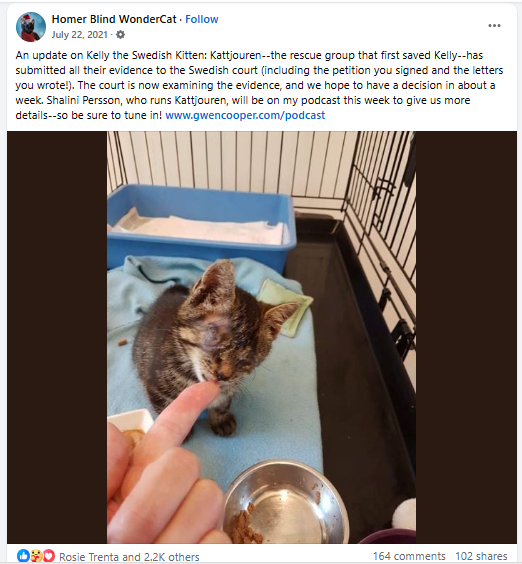
One such case is that of Kelly, a blind kitten whose situation gained international attention in 2021. The case was shared publicly by American novelist Gwen Cooper, best-selling author of Homer’s Odyssey and a well-known advocate for blind cats. Cooper’s lifelong work demonstrating that blind cats can live full, rich lives stands in stark contrast to the assumptions routinely invoked by Swedish authorities when justifying euthanasia. While it is impossible to prove a direct causal link, the sudden international scrutiny surrounding Kelly’s case coincided with a reversal of her fate. It is difficult to avoid the conclusion that this case was resolved not because Swedish law recognised a disabled animal’s right to life. It was resolved because public scrutiny made continued enforcement politically untenable.
When compassion enters only from outside the legal framework, the framework itself stands exposed, yet countless other animals, lacking visibility or international advocates, are never afforded such a chance.
Why This Is Not Just an “Animal Issue”
This is a rule-of-law issue.
A system that allows irreversible harm without intent, without adjudication, and without representation is not merely harsh: in fact, it is structurally unaccountable.
Today it affects animals, because animals are legally defenceless.
But the question it raises is broader:
What does “welfare” mean in a legal system where the subject of that welfare has no right to exist?
Until that question is answered honestly, Sweden’s claims of moral leadership in animal protection remain not just hollow, but also completely false.
The Gap between Policy and Reality
One of the most disturbing aspects of Sweden’s animal‑welfare system is that some of the harshest practices are not theoretical or anecdotal: they are documented. Reports from animal‑protection organisations describe cases in which municipalities have hired individuals to shoot stray cats. These actions are not framed as cruelty, nor as policy, but as administrative “solutions” to the legal classification of homeless cats as animals in suffering. The practice exists, yet it is rarely acknowledged publicly, and when questioned, authorities insist that such measures do not reflect official policy. This gap between practice and public narrative is a defining feature of the system.
This dynamic is reinforced by a broader pattern of plausible deniability. Power is exercised not through explicit directives, but through structures that allow controversial actions to occur while being disavowed at the same time. When advocates attempt to raise awareness, they often find that information disappears, discussions are shut down, and the polished international image of Swedish “high welfare” is protected at all costs. The result is a system that is difficult for outsiders to understand and nearly impossible to scrutinise.
The cultural dimension cannot be ignored. Many veterinarians working in Sweden come from countries where the ethical framework places a stronger emphasis on preserving life whenever possible. Their professional instincts often reflect traditions in which euthanasia is a last resort, not an administrative tool. In contrast, Sweden’s secular and highly procedural approach to animal welfare places far greater weight on regulatory compliance than on ethical deliberation. This difference in moral orientation becomes starkly visible in cases involving homeless or vulnerable animals, where the default administrative response is often euthanasia rather than rehabilitation or rehoming.
This has profound implications for international rescue organisations. Many operate under the assumption that Sweden’s reputation for animal welfare reflects reality. They have no reason to suspect that animals brought into the country may be subjected to a system that prioritises administrative efficiency over life‑preserving interventions. Because the public narrative is so tightly controlled, even thorough research may reveal nothing alarming. The result is a dangerous mismatch between perception and reality: organisations believe they are sending animals to a safe country, when in fact the structural framework offers them little protection.
For as long as the current system remains in place—one in which animals are treated as property, administrative bodies hold sweeping powers, and euthanasia is used as a routine management tool—no animal is fully safe. Those who rescue animals abroad should be aware of this reality. If the goal is to protect life, Sweden may not be the destination they imagine.
Documented Case Summaries: What Happens in Practice
To understand the structural consequences of the Länsstyrelsen system, real cases (even anonymised) are important. These are administrative decisions, not rare anomalies.
Case 1 — “Two Leverets” (2024 Administrative Decision)
In 2024, the County Administrative Board decided that two young hares (leverets) that had been hand-raised by a private individual must be euthanised immediately. The person had been feeding and nurturing them in an apartment for over a month.
The Board justified the order on three administrative grounds:
- The animals were wild and should not be kept in captivity.
- The captive feeding was “unnatural.”
- The animals allegedly lacked a chance of surviving independently in the wild.
The decision was implemented immediately without giving the caregiver an opportunity to respond to the evidence, citing “significant public interest” as justification. Appeals were possible but would not affect the already-executed euthanasia. Reddit
Despite this being not a fringe scenario involving obvious neglect, it was care that brought the animals close to tameness, yet the administrative logic treated their survival as irrelevant.
Case 2 — Widespread Companion Animal Seizures
According to a recent scientific analysis, 78 % of all animal welfare cases leading to animal seizures in Sweden involved dogs or cats. These seizures commonly result from complaints or welfare inspections that interpret deviations from ideal care as regulatory non-compliance, not criminal cruelty. Frontiers
This statistical pattern shows that pets, not just farm or wild animals, are routinely subjected to the same administrative process that can lead to euthanasia.
Case 3 — Public Accounts of Alleged Sparse Legal Recourse
Swedish pet owners frequently report (e.g., on social media and forum threads) that County Board decisions to take custody of animals are implemented immediately and that explanations or opportunities to present evidence are truncated or absent. One commenter described Länsstyrelsen as a “death trap,” alleging that reports of abuse justified euthanasia even when counter-evaluations existed. Facebook
While such accounts are not legal determinations in themselves, they illustrate a pattern of perception and experience among affected owners, consistent with documented administrative practice.
How Sweden’s Administrative Animal Welfare System Compares with the EU
Sweden’s enforcement framework, as embodied by the Länsstyrelsen system, is an outlier in scope and structural logic when compared with the animal welfare regimes of many other European countries, even within the EU or the broader European legal ecosystem.
1. EU Framework vs National Implementation
At the EU level, the legal baseline for animal welfare does not prescribe a uniform enforcement model. Key elements include:
- Council Directive 98/58/EC—minimum welfare for farmed animals (enforced variably). Food Safety
- EU legislation for specific species and contexts—including transport and slaughter standards. Food Safety
- Ongoing work on first EU rules specifically for the welfare of dogs and cats. European Parliament
Importantly, there is currently no EU-wide statute that creates rights for companion animals as distinct legal persons or dictates how euthanasia decisions must be judicially reviewed across Member States. Save the Dogs and other Animals ETS
This means each country interprets and implements welfare obligations quite differently.
2. European Convention for the Protection of Pet Animals
Sweden is a signatory to the European Convention for the Protection of Pet Animals, a Treaty of the Council of Europe that sets common welfare standards (e.g., humane treatment, prohibition of unnecessary procedures). However, ratification does not override domestic administrative procedures, nor does it grant animals’ legal subjectivity or prevent euthanasia conducted under welfare legislation. Wikipedia
Many other European countries have also ratified the Convention, but translate it into law with judicial safeguards and rights-based protections that Sweden lacks.
3. Comparative Domestic Legal Structures
Comparative research shows that legal frameworks for companion animals vary considerably across Europe:
- In countries like Germany, France, Spain, Austria, and the Netherlands, national laws often integrate Council standards with additional procedural protections, including:
- Requirements that euthanasia be based on veterinary diagnosis and necessity,
- Judicial review or oversight before irreversible actions,
- Restrictions on administrative seizure without prior notice and due process.
(General pattern based on comparative studies of EU pet welfare frameworks.) MDPI
- In contrast, Sweden’s enforcement model:
- Permits euthanasia orders without judicial adjudication,
- Allows administrative discretion without medical necessity as the decisive factor,
- Does not provide animals or owners with enforceable rights to contest life-ending decisions before they are implemented.
4. Animal Legal Status and Enforcement Culture
A key differentiator in many EU countries is the legal recognition of animals as sentient beings with intrinsic welfare values, which has been explicitly incorporated into domestic animal protection statutes.
Sweden’s domestic law, while imposing welfare duties on owners and authorities, still treats animals as property regulated by welfare standards rather than subjects with entitlements. This is a structural difference that shapes enforcement culture. globalanimallaw.org
In practice, this means that in some European jurisdictions:
- Companion animals cannot be seized without a court order,
- Veterinary necessity must be demonstrated before euthanasia,
- Appeals and prior hearing rights are built into the enforcement process.
These procedural protections are often absent or significantly weaker in Sweden’s administrative system.
5. Evolving EU Standards and Proposed Reforms
The EU itself is moving toward stronger, harmonised welfare standards. Recent provisional agreements on dog and cat welfare (e.g., mandatory registration, breeding rules, breeding trait limits) indicate a rising awareness of animal welfare as a policy priority. European Parliament
However, these reforms do not automatically alter national enforcement mechanisms, meaning that unless domestic legal systems adopt rights-based protections and revisited administrative procedures, enforcement will remain uneven.
A System That Must Be Dismantled
Sweden’s animal welfare enforcement system, particularly the way the Länsstyrelsen operates, cannot be considered merely an enforcement model: it is a structural regime.
It normalises administrative life-and-death decisions for animals without the procedural safeguards that many other European countries already have or are actively developing. It allows irreversible harm to occur without intent, adjudication, or representation.
This affects not only farmed animals and fur animals, but pets, disabled animals, elderly animals, and anyone who expects the rule of law to include basic proportionality and due process.
A system that can lawfully kill a healthy or treatable animal through administrative discretion alone is not a welfare system: it is a power system.
This regime did not always exist. Prior to 2009, responsibility for animal welfare enforcement rested with municipal authorities, embedded within local communities and subject to closer democratic accountability. The transfer of power to regional administrative boards created distance, opacity, and a financial model that externalised costs onto citizens while insulating decision-makers from consequences.
That system must be dismantled.
Not reformed at the margins.
Not cosmetically adjusted.
But fundamentally reconsidered.
However, dismantling is impossible without exposure.
The Länsstyrelsen system relies on obscurity: on language barriers, on administrative complexity, and on the assumption that outsiders will never look closely enough. That is why cases only change when public attention intervenes, and why silence allows the machinery to continue unchallenged.
Ignorance is no longer a justification.
Silence is complicity.
Only widespread awareness, in Sweden and beyond, can end this anomaly and force a reckoning with a system that should never have been allowed to govern life and death in the first place.
References
- Kelly, the Blind Kitten – Aftonbladet coverage and rescue foundation documentation showing how public advocacy and court intervention saved Kelly from euthanasia ordered by Länsstyrelsen. (aftonbladet.se), (skrivunder.com), (stiftelsenkattjouren.se)
(Homer Blind WonderCat | Facebook)
Cooper, G. (2021). An update on Kelly the Swedish kitten [Facebook post]. Facebook. (https://www.facebook.com/Homerblindcatfans) The Facebook post cited is preserved as a screenshot by the author, due to the platform’s limited archival accessibility. - Mille, Cecilia & Frejadotter Diesen, Eva. The Best Animal Welfare in the World? – An Investigation into the Myth about Sweden. Translation by Niki Woods, Djurens Rätt. Critically examines Sweden’s welfare claims versus documented practices, including administrative euthanasia and structural issues.
(best-animal-welfare-in-the-world.pdf)
- Swedish Animal Welfare Act (SFS 2018:1192). Official text outlining welfare requirements, property classification of animals, and administrative enforcement mechanisms. (https://www.globalanimallaw.org/downloads/database/national/sweden/animal-welfare-act-2018-english.pdf)
- Swedish Board of Agriculture (Jordbruksverket). Slakt och annan avlivning – annan avlivning [“Slaughter and Other Euthanasia – Other Euthanasia”]. Official guidelines including permitted methods for euthanasia of animals under certain conditions. (http://www.jordbruksverket.se/amnesomraden/djur/djurskydd/slaktochannanavlivning/annanavlivning.4.37cbf7b711fa9dda7a18000230.html)
- Frontiers in Veterinary Science, Administrative Animal Seizures in Sweden: Patterns and Implications, 2025. Statistical analysis of companion animal seizures and administrative enforcement outcomes. (https://www.frontiersin.org/journals/veterinary-science/articles/10.3389/fvets.2025.1575471/full)
- European Council, Council Directive 98/58/EC. Minimum welfare standards for farmed animals. (https://food.ec.europa.eu/animals/animal-welfare/eu-animal-welfare-legislation_en)
- The Swedish myth of the world’s best animal welfare | Astrids miljö- och samhällsblogg