
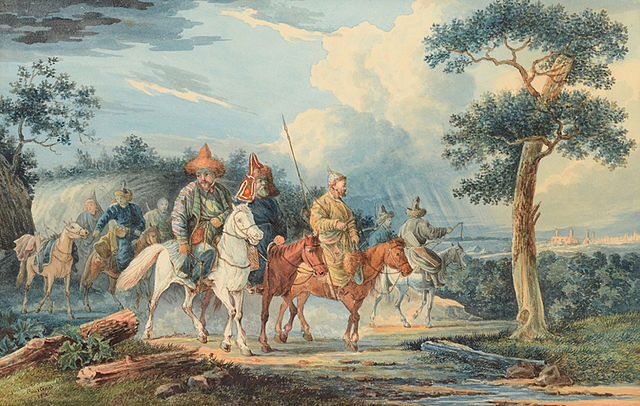
“Ат — башҡорттоң ҡанаты.”
At – başqorttoñ qanatı.
“The horse is the wings of the Bashkir.”
This proverb, simple yet soaring, encapsulates the essence of Bashkir identity: freedom, movement, and deep connection to nature. Just as the horse carries the Bashkir across the steppe, so too does their language carry centuries of memory, music, and meaning.
🌿 A Language Rooted in Earth and Sky
Bashkir is a means of communication as well a vessel of ancestral wisdom. Spoken by over a million people in the Republic of Bashkortostan and beyond, it belongs to the Kipchak branch of the Turkic language family, closely related to Tatar. Its sounds are soft yet strong, shaped by vowel harmony and agglutination, making it ideal for storytelling and song.
Historically written in Arabic, then Latin, and now Cyrillic, Bashkir has adapted across centuries while preserving its poetic soul. Its oral traditions—kubair (epic poetry), lullabies, and proverbs—are rich with imagery of mountains, rivers, horses, and stars.
🎶 A Melody of Memory
One beloved folk line goes:
“Урал тауҙары — минең терәгем,
Урман-ҡырҙары — минең йәнем,
Йырҙар — минең йөрәк тибешем.”
“The Ural mountains are my support,
The forests and fields are my soul,
Songs are the beat of my heart.”
This stanza reflects the Bashkir worldview: nature as kin, music as lifeblood, and language as a living rhythm.
✨ Why Bashkir Matters
In a world of rapid change, Bashkir remains a testament to cultural resilience. It is taught in schools, sung in festivals, and whispered in prayers. Yet like many minority languages, it faces several challenges, including urbanisation, assimilation, and digital neglect.
To speak Bashkir is to honour a lineage of poets, riders, and dreamers. To learn it is to step into a landscape where every word is a hoofbeat, every sentence a song.
The Bashkirs
The Bashkirs are a Turkic ethnic group native to the Southern Urals and surrounding regions, mainly within today’s Bashkortostan Republic in the Russian Federation. They are one of the many peoples of the larger Turkic family, which stretches across a vast area from Eastern Europe through Central Asia to Siberia and even parts of China and the Middle East.
Traditionally, Bashkirs were animists and practiced Tengriism, but with the spread of Islam in the 10th–14th centuries, they gradually became Muslim, and today the majority are Sunni Muslims. Known for their epic poetry (kubair), traditional music with instruments like the kurai (a reed flute), and equestrian culture. They also possess a rich tradition of decorative arts, intricate embroidery, and attire inspired by their nomadic heritage. Historically, they were semi-nomadic pastoralists, tending herds of horses, sheep, and cattle. Horses, in particular, hold a central place in their culture, as is common across many Turkic peoples.
The Turkic Peoples: A Tapestry of Diversity and Tradition
Diversity The Turkic world encompasses a remarkable array of peoples: Turks, Azerbaijanis, Kazakhs, Kyrgyz, Uzbeks, Turkmens, Tatars, Bashkirs, Chuvash, Uyghurs, Yakuts, and many others. Though their histories and geographies differ, they are united by deep linguistic and cultural ties.
Language Family Turkic languages form a continuum stretching from Anatolia to Siberia, with varying degrees of mutual intelligibility. They are distinguished by features such as vowel harmony, agglutination, and a rich tradition of expressive proverbs.
Shared Traditions
- Nomadism and horse culture – Horses hold a sacred place in Turkic lore, symbolising freedom and strength.
- Epic storytelling – Timeless narratives such as the Book of Dede Korkut and Manas preserve heroic ideals and ancestral wisdom.
- Music and dance – From throat singing in Siberia to long-songs in Central Asia and bardic ashik traditions in Anatolia and the Caucasus, music is a vital thread in the cultural fabric.
- Tengriism – The ancient sky-centred belief system, later interwoven with Islam or Buddhism depending on the region.
Why They Are Often Described as “Beautiful”
Physically The Bashkirs and other Turkic peoples exhibit a wide range of appearances, shaped by centuries at the crossroads of Europe and Asia. This diversity is frequently celebrated as part of their collective beauty.
Culturally Their languages, with their lyrical cadence and poetic depth, are often described as beautiful for the way they carry history, emotion, and identity.
Spiritually Core values such as hospitality, reverence for nature, and pride in ancestry remain central. The beauty of the land—steppe, mountains, rivers—is deeply entwined with their sense of self.
✨ Those who encounter Bashkir or broader Turkic cultures often come away with a lasting impression: a people both ancient and vibrant, proud yet warm, whose traditions of music, poetry, and resilience continue to inspire.
Beautiful people and language.