
Veterinary Hypocrisy and the Individual Choice to Heal
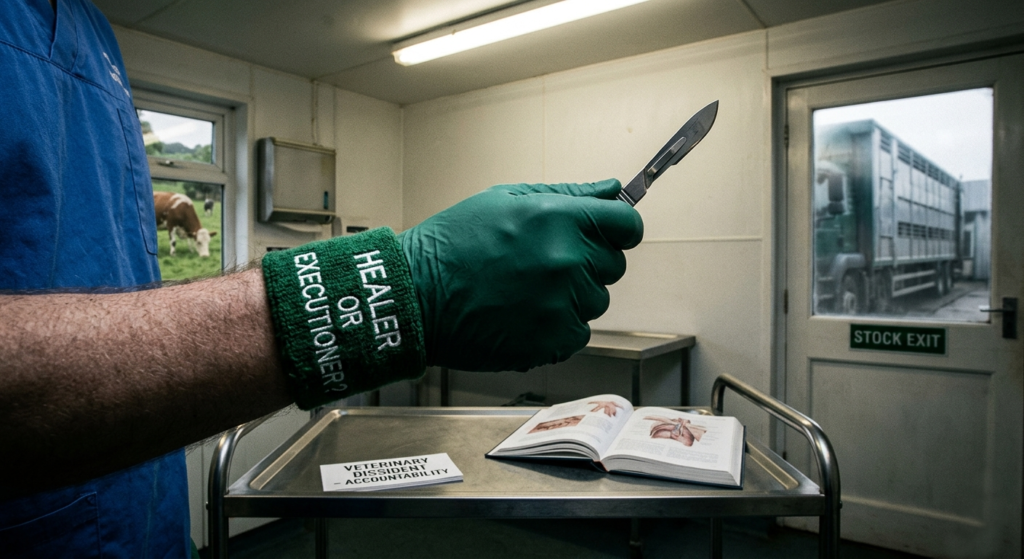
The prevailing discourse surrounding animal rights often seeks to absolve the individual by pointing the finger at “The System”. We are told that the industrialised slaughter of sentient beings is a vast, faceless machine, and that those working within it (specifically veterinarians) are merely cogs forced to turn by the weight of tradition and economics.
I disagree. A system is not a sentient entity, but is a collective of individuals making daily, conscious decisions to comply. To blame “the system” is a coward’s philosophy. It provides a convenient shroud for a profession that has, for too long, traded its ethical foundation for the comforts of social and financial status.
The Filter of Desensitisation
The betrayal begins at the university gates. Veterinary schools today act as a moral filter, designed to weed out those whose compassion is “too raw” for the industry’s requirements. From the very first year, students are subjected to a curriculum of desensitisation.
Through “terminal labs” and “production animal” rotations, the student is taught a dangerous form of compartmentalisation. They learn to view a dog as a family member deserving of every medical advancement, while viewing a pig—of equal or greater intelligence—as a unit of “livestock” whose value is measured only in weight and yield.
By the time a student reaches graduation, the “gatekeepers” (those senior, old-school professors) have rewarded them not for their empathy, but for their ability to silence it.
The Medical Double Standard
We would never accept a human doctor who felt compassion for one gender but not another, or who offered life-saving care to one race while facilitating the exploitation of another. A doctor is supposed to have a universal ethical foundation that transcends the identity of the patient.
Yet, in veterinary medicine, speciesism is the standard operating procedure. This is the only medical profession in the world where the practitioner is legally and socially permitted to eat their potential patients. This is not medicine; it is property maintenance. A veterinarian who is not vegan is essentially a loss-prevention officer for the meat and dairy industries, using their medical expertise to maximise the shelf-life of a commodity until the day of its execution.
The Myth of Greed and “Practicality”
The “deep hypocrisy” of the profession is often fuelled by a quiet, pervasive greed. There is a lucrative silence maintained by those who do not want to jeopardise partnerships with pharmaceutical giants or the agricultural lobby. They hide behind the “practicality” of the status quo, claiming they must work within the system to change it.
But as I witnessed during a recent CAAT (Centre for Alternatives to Animal Testing) webinar, the “system” is already cracking. While the old guard clings to outdated, cruel methodologies, a new generation of researchers is proving that individual will can force a paradigm shift. If researchers can move toward animal-free “New Approach Methodologies” (NAMs), then veterinarians can move toward an abolitionist ethic.
A Call to Accountability
If you are a veterinarian, your hands were meant for healing, not for facilitating slaughter. The moment you perform a procedure that benefits the owner’s wallet at the expense of the animal’s life, you have abandoned your oath.
The newest generation is starting to make an impact, but that impact only grows when individuals stop saying “I have to” and start saying “I won’t.” We must demand a veterinary education that is grounded in universal compassion, one where veganism is not a niche lifestyle choice, but the baseline requirement for anyone claiming to be a healer.
The system is no excuse. Accountability starts at the tip of the scalpel. You are either a healer for all, or you are a technician for a regime of death.
It is time to choose.