

Part of the series: Exploring the Literary Giants, examining influential authors through paired comparisons of context, style, and enduring impact.
🔍 The inner life as fragmentation and duration.
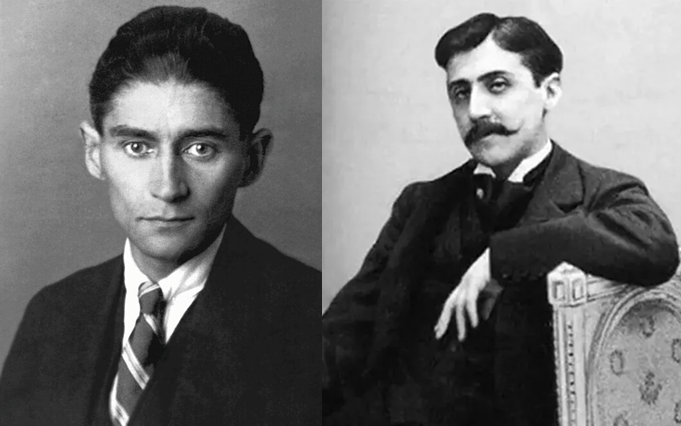
Photos: Public domain
Why these two?
At first glance, Franz Kafka and Marcel Proust appear to occupy very different literary worlds. Kafka’s writing is often stark, unsettling, and symbolic, while Proust’s is expansive, reflective, and deeply introspective. Yet beneath these stylistic differences lies a shared preoccupation with the inner life: how time, memory, and perception shape human existence.
Both writers turn away from external action and towards the internal landscape of thought and feeling. In doing so, they redefine the scope of the novel and short story, shifting the focus from what happens to how experience is understood. Their works, though distinct in tone and method, converge in their exploration of alienation, memory, and the elusive nature of selfhood.
Time, place, movement
Franz Kafka (1883–1924) wrote in the early twentieth century, within the context of the Austro-Hungarian Empire. A German-speaking Jew in Prague, Kafka occupied a complex cultural position, often described as one of displacement or marginality. His work is frequently associated with early modernism, though it resists easy categorisation, combining elements of realism with surreal and symbolic distortions.
Marcel Proust (1871–1922), writing in France during roughly the same period, is more firmly situated within literary modernism. His work reflects the cultural and social world of the French aristocracy and bourgeoisie, particularly in the years surrounding the turn of the twentieth century. Unlike Kafka’s often abstract settings, Proust’s world is richly detailed and socially grounded, even as it turns inward.
Both writers, however, are responding to a broader shift in literature: a move away from external narration towards the exploration of consciousness, memory, and subjective experience.
Core themes
A central concern for both Kafka and Proust is the nature of time. In Proust’s work, time is fluid and recoverable, most famously through involuntary memory (the sudden resurgence of the past through sensory experience). In Kafka, time often feels oppressive and inescapable, contributing to a sense of entrapment and inevitability.
Alienation is another defining theme. Kafka’s characters frequently find themselves estranged from society, authority, and even their own bodies. In The Metamorphosis, Gregor Samsa’s transformation into an insect serves as a powerful symbol of isolation and dehumanisation, a theme that has long fascinated readers for its stark portrayal of human alienation.
Proust, while less overtly symbolic, also explores forms of alienation, particularly social and emotional distance. His characters are often trapped within their own perceptions, unable to fully bridge the gap between themselves and others.
Both writers are deeply concerned with identity and perception. For Proust, identity is shaped and reshaped through memory, while for Kafka it is often unstable, imposed, or eroded by external forces. In both cases, the self is not fixed but contingent and elusive.
Style comparison
The contrast in style between Kafka and Proust is striking.
Kafka’s prose is typically concise, precise, and deceptively simple. His narratives often unfold in a matter-of-fact tone, even as they depict absurd or surreal situations. This restraint heightens the unsettling quality of his work, allowing symbolic elements to emerge with greater force.
Proust’s style, by contrast, is expansive and intricate. His sentences are famously long and complex, mirroring the processes of thought and memory they seek to capture. His writing is less concerned with narrative progression than with the detailed exploration of consciousness.
Where Kafka employs symbolism and distortion to reveal inner truths, Proust relies on introspection and accumulation. Kafka compresses experience into potent images; Proust extends it, unfolding it across pages of reflection.
Key works
Kafka’s most well-known works include The Metamorphosis, The Trial, and The Castle. These texts often depict individuals confronting incomprehensible systems of authority, navigating worlds that seem governed by obscure and inaccessible rules.
The Metamorphosis, in particular, exemplifies Kafka’s use of symbolism. Gregor Samsa’s transformation into an insect is never explained, yet it powerfully conveys themes of alienation, guilt, and the fragility of identity.
Proust’s monumental work, In Search of Lost Time, is a multi-volume exploration of memory, time, and consciousness. Through the narrator’s reflections, Proust examines how the past persists within the present, shaping perception and identity.
Where Kafka’s works are often fragmented and unresolved, Proust’s forms a vast, interconnected whole, unified by its exploration of memory and time.
Legacy and influence
Both Kafka and Proust have had a profound impact on modern literature.
Kafka’s influence is evident in the term “Kafkaesque,” now used to describe situations characterised by absurdity, oppression, and disorientation. His work has shaped existentialist and absurdist literature, influencing writers such as Albert Camus and Jean-Paul Sartre.
Proust’s influence lies in his redefinition of narrative form and his exploration of memory and consciousness. His work has had a lasting impact on modernist and postmodern literature, particularly in its treatment of time and subjective experience. Together, they represent two distinct yet complementary strands of modernism: one rooted in symbolic abstraction, the other in psychological depth.
Final reflections
What draws me most to Kafka is the clarity of his symbolism. There is something deeply unsettling about the way he renders inner experience as external reality, Gregor Samsa’s transformation into an insect in The Metamorphosis being perhaps the most striking example. It is not simply bizarre. It feels precise, as though alienation itself has been given a physical form.
Proust approaches the same inner world from the opposite direction. Rather than externalising experience, he lingers within it, tracing the subtle, often elusive ways in which memory and perception shape identity. Where Kafka confronts the reader with stark images, Proust invites a slower, more reflective immersion.
Reading them together, I find that neither approach feels sufficient on its own. Kafka reveals the intensity of alienation, but leaves it unresolved; Proust offers depth and continuity, yet diffuses that same intensity across time. Between them, however, something more complete begins to emerge.
Perhaps that is what makes this pairing so compelling. Kafka shows us what it feels like to be estranged from the world, while Proust shows us how we attempt to make sense of that estrangement. If Kafka gives alienation a form, then Proust gives it duration.
And somewhere between them lies the full weight of human inwardness.
Part of the series: Exploring the Literary Giants
→ View all entries in this series