

Part of the series: Exploring the Literary Giants, examining influential authors through paired comparisons of context, style, and enduring impact.
🔍 History, social conscience, and the struggle against injustice.
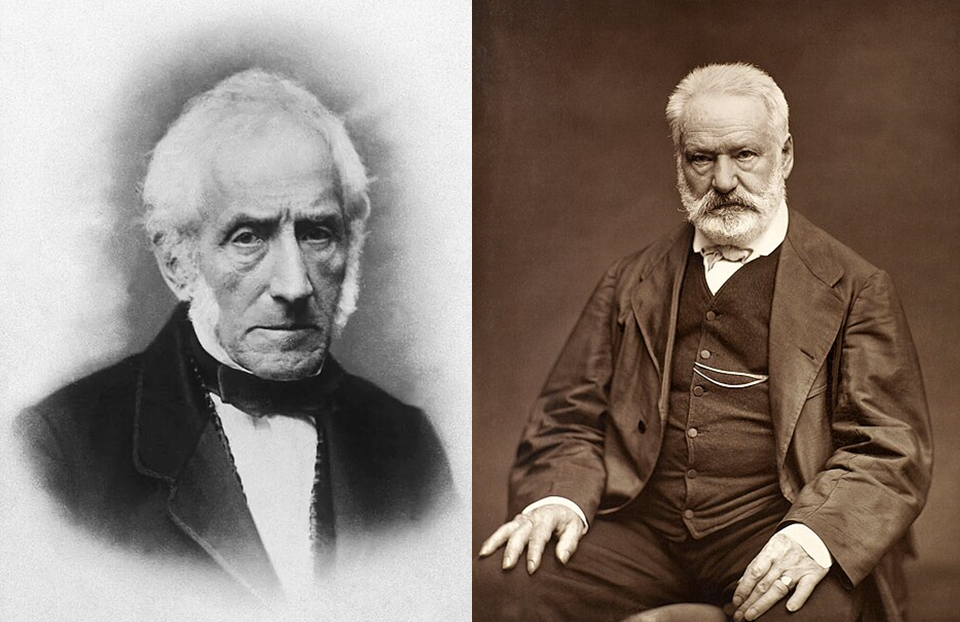
Why these two?
Alessandro Manzoni and Victor Hugo stand among the defining literary voices of nineteenth-century Europe. Both writers placed individual lives within the larger forces of history, politics, religion, and social change, creating works in which private suffering becomes inseparable from the societies in which it occurs.
Both were deeply concerned with morality and justice, yet neither reduced human beings to simple categories of good and evil. Their characters are shaped by weakness, ambition, compassion, fear, pride, and the possibility of redemption. History provides the setting, but human nature provides the drama.
Manzoni’s I promessi sposi and Hugo’s Les Misérables are particularly powerful examples of this approach. Both novels bring ordinary people into contact with political and social forces far greater than themselves, asking what individuals can do when confronted with injustice, poverty, oppression, and circumstances seemingly beyond their control.
Yet the two writers approach these questions differently. Manzoni’s vision is deeply rooted in Catholic morality and Providence, while Hugo’s is broader and more humanistic, driven by a passionate belief in compassion, social justice, and the possibility of moral transformation.
Their works demonstrate how the historical novel can become something much more than a reconstruction of the past: a means of examining the moral condition of society itself.
Time, place, movement
Alessandro Manzoni (1785–1873) wrote during a crucial period in Italian history, when the peninsula was undergoing profound political and cultural transformation. His life coincided with the Napoleonic era, the Risorgimento, and the eventual unification of Italy.
Manzoni’s work is closely associated with Italian Romanticism, although his relationship with Romanticism was shaped by his strong Catholic faith and his belief in literature’s moral and historical purpose.
I promessi sposi, set in seventeenth-century Lombardy during a period of Spanish domination, uses historical events to examine questions of power, injustice, faith, cowardice, courage, and human responsibility. Although the novel is set centuries before Manzoni’s own time, its concerns were profoundly relevant to nineteenth-century Italy.
Language was also central to Manzoni’s contribution to Italian culture. His revisions of I promessi sposi played an important role in the development of modern literary Italian, particularly through his decision to move towards the language spoken in Florence.
Victor Hugo (1802–1885), writing in France during an equally turbulent period, became one of the central figures of French Romanticism. His lifetime encompassed the aftermath of the French Revolution, the Napoleonic era, the Bourbon Restoration, the July Monarchy, the Second Republic, the Second Empire, and the establishment of the French Third Republic.
Hugo’s literature reflects this extraordinary political instability. His novels and poetry repeatedly return to questions of power, inequality, political oppression, social injustice, and the individual’s struggle against forces larger than themselves.
Les Misérables, published in 1862, brings together these concerns on an enormous scale. Through characters such as Jean Valjean, Fantine, Javert, Cosette, and Marius, Hugo explores the relationship between poverty, social exclusion, law, morality, and redemption. Both writers therefore transform history into a moral landscape. Manzoni looks at the past through the lens of Providence and Christian ethics; Hugo looks at society through the demands of human compassion and justice.
Core themes
Social injustice is central to both writers.
In I promessi sposi, the powerful frequently exploit the vulnerable. Don Rodrigo’s abuse of power, the cowardice of Don Abbondio, and the suffering of ordinary people reveal a society in which justice is unevenly distributed.
Hugo’s Les Misérables presents a similarly unequal society, but on an even broader scale. Poverty, imprisonment, prostitution, hunger, and social exclusion shape the lives of his characters. Jean Valjean’s transformation from prisoner to compassionate benefactor becomes an indictment of a society that condemns people for circumstances it has helped create.
Both writers are also fascinated by moral weakness.
Manzoni’s characters are memorable precisely because they are imperfect. Don Abbondio is not evil; he is frightened. His weakness makes him morally compromised, but also recognisably human. The Bravi embody violence and intimidation, while Don Rodrigo represents the abuse of privilege and power.
The Monaca di Monza is perhaps one of Manzoni’s most psychologically complex creations. Her tragedy lies not simply in wrongdoing but in the circumstances, pressures, and choices that gradually destroy her freedom.
Hugo similarly refuses to create a world of uncomplicated heroes and villains. Javert believes absolutely in the law, yet his rigid morality becomes destructive. Jean Valjean, meanwhile, begins as a convicted criminal but becomes one of the novel’s most compassionate figures.
Redemption therefore becomes another major point of connection.
Manzoni’s Catholic worldview allows redemption to exist within a larger framework of divine grace and Providence. Hugo approaches redemption through human compassion, sacrifice, and moral transformation.
Both nevertheless suggest that people are capable of becoming more than the circumstances that have shaped them.
History is also central. Neither writer treats history as a distant backdrop. Political decisions, wars, social structures, and religious conflicts enter directly into the lives of ordinary people.
Ultimately, both ask a fundamental question: how much control does an individual possess over his or her own destiny?
Style comparison
Manzoni’s style combines historical reconstruction with irony, psychological observation, and moral reflection. His narrative voice frequently addresses the reader directly, commenting upon events and characters while guiding us towards broader interpretations.
His descriptions of people are often remarkably perceptive. A character may be introduced through a physical detail, a habit, or a seemingly insignificant weakness, only for that characteristic to become central to our understanding of the person.
Manzoni’s humour is also important. Despite the novel’s serious themes, I promessi sposi contains irony and comic observation, particularly in its portrayal of human weakness.
Hugo’s style is considerably more expansive and rhetorical. Les Misérables frequently moves beyond the immediate narrative to provide historical, philosophical, political, or social reflections.
His descriptions can be enormous in scale, whether he is depicting the streets of Paris, the sewers beneath the city, the battlefield of Waterloo, or the desperate circumstances of the poor.
Where Manzoni often achieves power through observation and irony, Hugo achieves it through emotional and rhetorical intensity.
Manzoni brings the reader close to individual characters and their moral choices.
Hugo repeatedly pulls back to show the immense social structures surrounding them.
Yet both writers understand that history ultimately becomes meaningful through individual human experience.
Key works
Manzoni’s most celebrated work is I promessi sposi (The Betrothed; 1825-1827), one of the foundational novels of Italian literature.
Set in seventeenth-century Lombardy, the novel follows Renzo and Lucia as their attempts to marry are obstructed by Don Rodrigo and the social and political circumstances surrounding them. Their story unfolds against famine, war, plague, political instability, and religious crisis.
The novel’s extraordinary gallery of characters is one of its greatest strengths. The Monaca di Monza, Don Rodrigo, Don Abbondio, the Innominato, Fra Cristoforo, and the Bravi have become part of the cultural imagination of generations of Italian readers.
Each represents different aspects of human nature: fear, arrogance, violence, compassion, spiritual transformation, weakness, and moral courage.
Manzoni’s poetry is also important, particularly Il cinque maggio (“The Napoleonic Ode”; 1821), his famous ode written following the death of Napoleon Bonaparte. The poem became one of the works that generations of Italian schoolchildren were expected to study and memorise.
For me, Il cinque maggio is inseparable from the experience of studying Manzoni at school. His literature was not simply something we read; it was part of the cultural and educational tradition through which Italian literature was passed from one generation to the next.
Victor Hugo’s Les Misérables (1862) is his most enduring novel and one of the great works of nineteenth-century literature.
Through Jean Valjean’s life, Hugo examines imprisonment, poverty, social exclusion, compassion, justice, and redemption. Fantine’s tragic decline exposes the vulnerability of women living in poverty, while Javert represents the rigid application of law without compassion.
The novel also expands beyond individual stories to encompass the political and social history of France, particularly the June Rebellion of 1832.
Other major works include Notre-Dame de Paris (The Hunchback of Notre-Dame; 1831), which explores social exclusion, beauty, power, and fate, and Le Dernier Jour d’un condamné (The Last Day of a Condemned Man; 1829), an impassioned critique of the death penalty.
Legacy and influence
Manzoni’s importance to Italian literature extends far beyond I promessi sposi. He helped establish the historical novel as a major form in Italian literature while contributing profoundly to the development of modern literary Italian.
The novel became a cultural landmark in Italy, studied by generations of schoolchildren and repeatedly adapted for theatre, television, and other media. Its characters and expressions have become deeply embedded in Italian cultural consciousness.
The fact that I promessi sposi was adapted for television in the 1960s and 1970s, and later became the subject of successful parody, illustrates just how deeply the novel has entered popular culture.
Hugo’s influence has been similarly vast. Les Misérables has been repeatedly adapted for cinema, television, theatre, and musical theatre, while characters such as Jean Valjean and Javert have become almost universally recognisable.
His writing also helped shape the tradition of socially conscious literature. His insistence that literature could confront poverty, inequality, political oppression, and injustice anticipated concerns that would become increasingly important in later nineteenth- and twentieth-century literature.
Both writers demonstrate that historical fiction can simultaneously reconstruct a past world and speak directly to the concerns of the present.
Final reflections
My relationship with Manzoni began at school, as it did for generations of Italian students. I promessi sposi was compulsory reading, but for me it never felt like an obligation. I genuinely loved the novel, and I consistently received high marks when we studied it.
Manzoni was much more than another author on a school syllabus. He was central to Italian literary history, deeply rooted in the literary tradition of the country I was born in. His characters became almost legendary to me: the Monaca di Monza, with her tragic moral collapse; Don Rodrigo, embodying arrogance and the abuse of power; the weak and frightened Don Abbondio; and the Bravi, representatives of a world in which violence and intimidation could determine the fate of ordinary people.
What fascinated me was the way these characters could become metaphors for the strengths and weaknesses of the human soul. Manzoni’s greatness lies partly in his ability to make moral questions human rather than abstract.
Even Il cinque maggio belongs to those memories. We had to study and memorise it at school, and it became part of that shared cultural experience through which Italian literature was transmitted from one generation to the next.
I promessi sposi also lived beyond the classroom. Its television adaptation became part of Italian popular culture, and years later even a parody of the novel achieved considerable success. Few works demonstrate quite so clearly how a literary classic can become part of the collective imagination of an entire country.
My encounter with Victor Hugo was different. I read Les Misérables as a teenager, and I loved it. Its portrayal of human desperation and struggle was extraordinarily vivid and, at times, almost excruciating.
Jean Valjean’s life, Fantine’s suffering, Javert’s relentless pursuit, and the novel’s broader portrait of poverty and social injustice made a profound impression on me. It was engrossing reading, but it also carried a moral message that could remain imprinted on a young mind.
Reading Manzoni and Hugo together, I am struck by how deeply both writers believed that literature could make us look at suffering differently.
Manzoni finds moral order within history. Even when human beings are weak, frightened, corrupt, or cruel, his world remains governed by a larger spiritual framework.
Hugo is more restless. He looks at suffering and asks what society itself has done to create it. His compassion is directed not only towards the individual who suffers, but towards the structures that make suffering possible.
If Manzoni explores the weakness and redemption of the human soul within a moral universe, Hugo exposes the social forces that can crush that soul before it has the chance to redeem itself.
Yet both ultimately resist the idea that human beings are defined by their worst moments.
Perhaps that is what remains most powerful in both writers. They remind us that history is not simply made by kings, governments, wars, and revolutions. It is experienced by frightened individuals, oppressed individuals, compassionate individuals, and flawed individuals who must somehow find a way to live within it.
Manzoni gives us a world in which Providence ultimately remains possible.
Hugo gives us a world in which compassion must become an act of resistance.
And somewhere between them lies the enduring conviction that literature can do more than tell us about injustice. It can make us feel the human cost of it.
Part of the series: Exploring the Literary Giants
→ View all entries in this series