

Part of the series: Exploring the Literary Giants, examining influential authors through paired comparisons of context, style, and enduring impact.
🔍 Gothic repression, forbidden desire, and the darkness within.
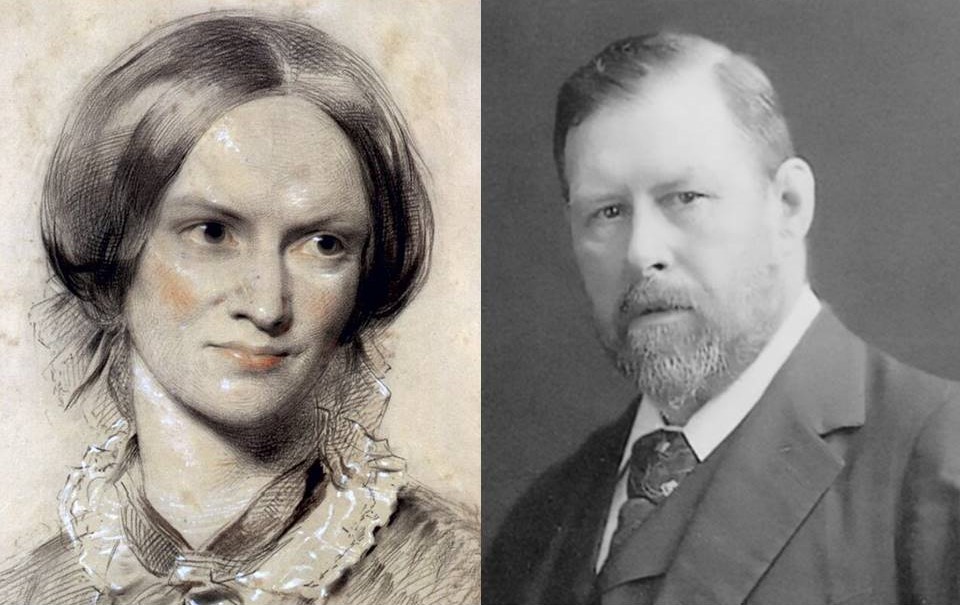
Why these two?
A locked room. A forbidden desire. A secret that threatens to destroy the carefully maintained appearance of respectability.
Charlotte Brontë (1816–1855) and Bram Stoker (1847–1912) understood that the most disturbing things are not always those that come from outside. Sometimes, they have been hidden inside the house all along.
In Jane Eyre, Brontë takes us into Thornfield Hall, where an apparently civilised household conceals a truth that threatens its master’s plans and the heroine’s future. The story draws much of its power from psychological conflict and moral independence. In Dracula, Stoker sends his characters into a world of ancient castles, nocturnal visitors and predatory forces that challenge the boundaries of Victorian society. He turns fear into supernatural horror.
Their artistic methods differ, but their themes overlap deeply. Both examine the price of psychological repression, the physical and moral vulnerability of women, the unequal distribution of social power and the uneasy relationship between respectable appearances and private realities.
Neither writer allows the domestic home to remain a place of absolute safety.
Time, place, movement
Charlotte Brontë was born in 1816 in Thornton, Yorkshire, and grew up in the village of Haworth. Her life was marked by personal loss, the restrictions placed on women and the limited opportunities available to those without wealth or social connections. She worked as a governess and teacher before establishing herself as a novelist. Brontë published Jane Eyre in 1847 under the male pseudonym Currer Bell. The novel challenged conventions surrounding female behaviour, class and marriage by giving its heroine a voice that was both emotionally direct and morally independent.
Abraham Stoker was born in Dublin in 1847, the same year Jane Eyre appeared. He worked as a civil servant before becoming the business manager of the celebrated actor Henry Irving at London’s Lyceum Theatre. His experience of the theatre, together with his interest in folklore and contemporary anxieties, helped shape his fiction. Published in 1897, Dracula emerged at the end of the Victorian era, when advances in science and technology existed alongside fears about degeneration, sexuality, immigration and the instability of established social boundaries.
Brontë wrote within the tradition of the Victorian novel, drawing on Gothic conventions while placing a woman’s inner life at its centre. Stoker inherited the Gothic tradition and transformed it into a modern horror narrative, using letters, diaries, telegrams and other documents to make the extraordinary appear disturbingly credible.
The decades separating them matter. Brontë questions the rules governing a woman’s life from within the household. Stoker imagines threats that appear to come from beyond its walls. Yet in both books, the boundary between safety and danger proves far less secure than the characters expect.
Core themes
A comfortable home is not always a safe place. In Brontë’s novel, Thornfield Hall looks perfect on the outside, but it hides a dark secret: Rochester’s first wife, Bertha, locked away in the attic. As a poor governess, Jane Eyre is trapped between being an educated woman and a servant. When Bertha is finally revealed, the shock exposes the raw cruelty of Victorian marriage laws. Stoker takes this fear even further. In Dracula, danger does not stay outside. The vampire breaks straight into private bedrooms, turning a safe home into a place of pure terror. Behind the closed doors of Thornfield Hall and Dracula’s castle, respectability is nothing more than a thin mask.
Desire and control form another major link, but the characters handle it differently. Brontë gives Jane the strength to speak her mind and defend her self-respect. When Jane finds out the truth, she refuses to become Rochester’s mistress. She demands to be his equal, not a servant. Stoker explores desire in a much darker way. His female vampires represent Victorian fears about women having sexual desires. Even the men who try to protect women like Mina Harker end up controlling them instead, terrified of what happens when women cross traditional boundaries.
This leaves the reader with one big question: who decides what is monstrous? Dracula is a literal monster, a foreign predator onto whom society projected its fears of change and invasion. Brontë, however, shows that real monsters hide inside normal society, like arrogant men, class prejudice and religious hypocrisy. The real danger in these stories is how society decides whose voices are heard, and whose suffering is completely ignored.
Style comparison
Brontë uses first-person narration to pull the reader straight into Jane’s mind. We experience the world through her perceptions, emotions and judgements. Her voice can be passionate, defiant and sharply observant, yet it is also capable of restraint. The Gothic atmosphere of Jane Eyre grows out of this intimacy: a mysterious laugh in the corridor, an unexplained fire, a strange presence in the night. Each incident unsettles the reader because it threatens the emotional and moral order Jane is trying to understand.
The novel’s supernatural suggestions eventually give way to a human secret, although its atmosphere never loses its power. Brontë rejects using ghostly tricks to simply scare readers. Instead, she uses them to highlight real-world questions about freedom and identity.
Stoker adopts a very different approach. Dracula is assembled from diaries, letters, newspaper reports, telegrams and other documents. Its multiple voices allow events to emerge piece by piece, creating suspense through gaps, contradictions and delayed revelations. The reader effectively becomes a detective, trying to piece the evidence together before the characters realise what they are up against.
These distinct techniques create two opposite forces. Brontë anchors her story in a single woman’s brain, providing a strong emotional spine. Stoker abandons that continuity to track a fragmented, collective struggle for survival. Concealment drives each narrative, but the momentum shifts in opposite directions. Brontë’s style pulls us inwards, focusing on a lonely woman’s battle to define herself. Stoker’s style races outwards, tracking a massive threat that could destroy an entire community.
Key works
Brontë’s most famous books—Jane Eyre (1847), Shirley (1849), Villette (1853), and her early novel The Professor (1857)—all explore how women survive loneliness and fight for their independence.
Jane Eyre is her undisputed masterpiece. It follows a poor orphan girl from a cruel childhood straight into her job as a governess at Thornfield Hall. When Jane discovers her employer, Edward Rochester, has hidden his first wife in the attic, she walks away into poverty rather than becoming his secret mistress. Their eventual reunion proves that true love can only exist between equals. Shirley shifts focus to the real world, tracking historical riots and industrial conflict in Yorkshire. By contrasting a shy girl with a wealthy heiress, Brontë shows that society unfairly locks women out of meaningful work regardless of their class.
Villette stands as her most haunting book. It follows Lucy Snowe, an emotionally guarded woman dealing with isolation and unrequited love while teaching at a girls’ school. Through Lucy’s shifting memories, Brontë paints a realistic picture of grief and psychological survival. The Professor, Brontë’s very first written book, takes the opposite view by using a male narrator trying to make his fortune as a teacher, setting up her lifelong focus on hard work and professional independence.
Bram Stoker’s writing career includes The Snake’s Pass (1890), his legendary horror novel Dracula (1897), and later dark thrillers like The Mystery of the Sea (1902), The Jewel of Seven Stars (1903), and The Lair of the White Worm (1911).
Dracula is the defining cornerstone of modern horror. It tracks an ancient vampire trying to invade London from his decaying Transylvanian castle. Stoker pieces the story together through letters and diaries, tapping into Victorian panics about science, superstition, and foreign invasion. Mina Harker acts as the true brains of the operation, using modern tools like typewriters and train timetables to track and destroy the predator. Stoker’s earlier romance, The Snake’s Pass, is set in Ireland and mixes local folklore, shifting bogs and buried treasure to explore his obsession with mysterious landscapes.
His later horror books dive deep into the occult. The Jewel of Seven Stars tells a creepy story about an archaeologist trying to revive a mummified Egyptian Queen, showing what happens when scientific curiosity crosses into dangerous obsession. The Mystery of the Sea tackles political intrigue and Spanish Armada treasure off the Scottish coast, while The Lair of the White Worm presents a bizarre tale of pagan survival and monstrous transformations.
The narratives in all of these stories handle danger from opposite angles. Brontë stays close to home, using domestic settings to show a lonely woman conquering cruelty through sheer moral courage. Stoker walks a much more aggressive path. He uses supernatural monsters to show how an entire community must unite to destroy the ancient forces threatening to consume it.
Legacy and influence
Charlotte Brontë and Bram Stoker permanently reshaped the cultural imagination, leaving legacies that extend far beyond nineteenth-century fiction. Brontë revolutionised the novel by asserting that an impoverished, plain woman could serve as a heroine of total moral and intellectual stature. Her creation of Jane Eyre inaugurated the psychologically complex female protagonist, directly influencing writers from George Eliot and Thomas Hardy to Virginia Woolf and Jean Rhys. Rhys’s famous novel Wide Sargasso Sea explicitly gave a voice to Bertha Mason, challenging Brontë’s colonial assumptions and sparking an ongoing debate about whose stories literature tells and whose it leaves in the shadows.
Today, this friction has taken on a contemporary dimension. In the United States, Jane Eyre has faced restrictions in some school districts amidst wider disputes over which books pupils should be allowed to read. Such restrictions are not a nationwide prohibition, and the circumstances vary. Still, the irony is striking: a novel that questions authority, gender expectations and the policing of female behaviour can itself become the subject of arguments about what young readers should be allowed to encounter. The controversy does not automatically settle every question about school curricula, but it reminds us that classics are not immune to present-day anxieties.
Bram Stoker’s cultural impact remains exceptionally powerful, establishing Count Dracula as one of the most enduring archetypes in world literature. The original 1897 novel effectively laid the blueprint for the modern vampire mythos, inspiring a vast wave of literary, theatrical, and cinematic adaptations across the twentieth and twenty-first centuries. The vampire has continually changed with the times, becoming a symbol of everything from forbidden desire to alienation and power. Yet Stoker’s original work remains compelling because the horror is never completely detached from the social anxieties that produced it. Beyond its iconic status in the horror genre, the novel serves as a vital text for decoding late-Victorian cultural anxieties, shifting gender politics, and the complex representation of the societal “Other.”
These novels stay relevant for reasons that go far deeper than a spooky backdrop or a memorable villain. They have staying power because they strip away the comfort of everyday life, making standard institutions like marriage, class and family feel suddenly strange and threatening. By exposing the invisible misery of keeping up appearances, they force a difficult question onto the reader: what happens to the people who refuse to play their assigned social roles?
Final reflections
Charlotte Brontë and Bram Stoker lead us into entirely different corridors of the Gothic imagination. Brontë anchors her story in the quiet rooms of a country estate, where a woman’s future depends upon facing dark secrets equipped only with her conscience and self-respect. Stoker walks an aggressively separate path, taking us into the shadow of a Transylvanian castle and the invaded homes of modern London, where a community must unite against an ancient predator who turns intimacy into a weapon. Yet, in the hands of these authors, the Gothic is never an escape from reality. It functions as a precision instrument designed to examine everyday life from an unsettling angle, exposing the violence, coercion, and hypocrisy that flourish behind respectable façades. The darkness is never quite where we expect it to be.
And somewhere between the locked attic of Thornfield Hall and the shadowed corridors of Dracula’s castle, between the woman fighting for her voice and the monster invading the night, the Gothic exposes a permanent truth: respectability can hide many things, but the truth will always demand to be known.
Part of the series: Exploring the Literary Giants
→ View all entries in this series