

Part of the series: Exploring the Literary Giants, examining influential authors through paired comparisons of context, style, and enduring impact.
🔍 Stream of consciousness and the transformation of narrative.
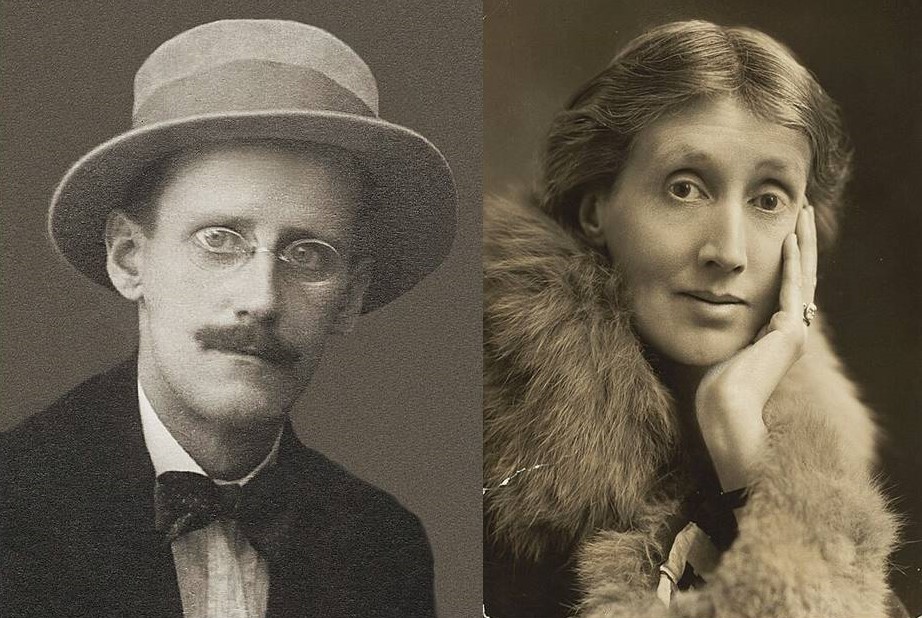
Why these two?
James Joyce (1882–1941) and Virginia Woolf (1882–1941) changed the way a novel could tell a story. Born in the exact same year, both were dissatisfied with the conventional nineteenth-century novel, which prioritised linear plot, external social mechanics, and omniscient narration. They refused to accept that a life could be summarised merely by describing where characters went, what they wore, or what happened to them. Instead, both sought to enter the elusive territory of human consciousness itself: the sudden interruptions of thought, memories resurfacing unexpectedly, sensory impressions altering perception, and the strange, non-linear connection between the present moment and all that had come before it.
Yet their methods for capturing this inner life diverged radically. Joyce approached consciousness as a linguistic and encyclopaedic construct, pushing the English language from the precise, restrained revelations of Dubliners to the multilingual, dream-state labyrinth of Finnegans Wake. Woolf pursued a fluid, lyrical, and transparent interiority, allowing thought, sensation and memory to flow seamlessly between different characters and moments.
Whilst Woolf sought a delicate, evocative fidelity to the mind’s movements (questioning how delicately prose could mirror human perception), Joyce subjected language itself to constant experimentation, dismantling words and syntax to see just how far language could be stretched. Woolf transformed the representation of consciousness; Joyce transformed the language through which consciousness could be represented.
Time, place, movement
Both authors were key figures in the early twentieth-century High Modernism, an era when the trauma of World War I, rapid urbanisation, and psychoanalytic theory shattered the certainties of the Victorian age.
Joyce was born in Dublin, and though he spent his entire adult life in self-imposed exile across Trieste, Zurich, and Paris, Dublin remained the sole imaginative geography of his fiction. His relationship with his native city was paradoxical: he abandoned it physically, yet immortalised every street, pub, and clock chime with obsessive, meticulous detail. In Dubliners, he portrayed the city through moments of spiritual paralysis, whereas in Ulysses, he elevated an ordinary day in Dublin to the status of an epic myth of modern existence.
Woolf was born into the intellectual upper-middle class of late-Victorian London and became a central figure of the Bloomsbury Group. Unlike Joyce’s permanent exile, Woolf remained anchored in the geography of England, from the urban pulse of London to the coastline of Cornwall, whilst running the Hogarth Press alongside her husband, Leonard Woolf.
Both writers were obsessed with time and memory, but treated them differently. Joyce could compress an entire Western literary and historical tradition into the span of eighteen hours on 16 June 1904. Woolf, conversely, could expand a single fleeting second until it contained decades of grief, regret, and love, or compress ten years of human absence into a brief, haunting interlude. For both, mechanical clock time was merely a superficial backdrop to psychological time, the subjective, elastic time we carry within us.
Core themes
At the heart of both writers’ work lies the fundamental question of perception: What does it mean to experience a single moment? How does memory alter the present? And how much of a human being’s inner life remains completely invisible to the outside world?
In Woolf’s novel Mrs. Dalloway, Clarissa Dalloway walks through London as she prepares for an evening party. On the surface, almost nothing of dramatic consequence occurs. Yet within the arc of that single day, Woolf moves fluidly through memory, social pressure, mental illness, trauma, ageing, and death. The external world (the striking of Big Ben, the spluttering of a car engine, a passing face) is constantly invaded by the interior one. In To the Lighthouse, Woolf turns time itself into a character, exploring how family dynamics, loss, and artistic creation endure against the inexorable decay of time.
In Joyce’s Ulysses, the ordinary becomes the heroic. Leopold Bloom’s banal day in Dublin is juxtaposed with Homer’s Odyssey, transforming everyday thoughts on food, sexuality, mortality, and anti-Semitism into a universal human comedy. Joyce demonstrates that the myth and the extraordinary reside directly within the mundane.
Where they diverge most dramatically is in their ultimate trajectory. Woolf remained dedicated to following the psychological movement of the human mind, using interior monologue to probe emotional vulnerability and existential isolation. Joyce, particularly in Finnegans Wake, transcended individual psychology to explore a collective, universal subconscious, abandoning traditional English in favour of a ‘night language’ made up of multilingual wordplay, portmanteau words and mythic cycles.
Style comparison
Stream of consciousness is often misunderstood as the unstructured transcription of random thoughts. In the hands of Joyce and Woolf, however, it was an extraordinarily disciplined and architectural technique.
Woolf’s prose is fluid, rhythmically flawless, and intensely attuned to light, sound, and emotional atmosphere. Her sentences glide effortlessly across the boundaries of time and perspective, shifting from one character’s mind to another’s without formal transitions. In works like The Waves, she abandons traditional dialogue altogether, composing the narrative through six interlocking soliloquies that mirror the ebb and fall of oceanic tides. The difficulty of her writing lies not in its vocabulary, but in the subtle, shifting complexity of its structural architecture.
Joyce’s style is chameleon-like, hyper-literary, and relentlessly innovative. He rarely settled on a single stylistic voice. A Portrait of the Artist as a Young Man begins with the infantile language of early childhood before evolving, alongside its protagonist, into dense and philosophical prose. Ulysses adopts a different literary style for each chapter, ranging from journalistic headlines and catechisms to a parody of the evolution of English prose itself. In Finnegans Wake, his prose becomes wholly polyphonic, requiring decades of collective decipherment, as famously illustrated by the reading group in Venice, California, which took twenty-eight years to read this circularly structured text.
Whilst Woolf wondered how prose might delicately trace the contours of human thought, Joyce tested the boundaries of the way in which language itself shapes human reality.
Key works
Among Joyce’s principal works are Chamber Music (1907), Dubliners (1914), A Portrait of the Artist as a Young Man (1916), Exiles (1918), Ulysses (1922), and Finnegans Wake (1939). Together, they trace an unprecedented trajectory, moving from naturalistic social realism to the total dismantling and reconstruction of the English language.
Chamber Music is Joyce’s first published book, a collection of thirty-six poems that reveals a very different, more lyrical aspect of his writing.
Dubliners is a collection of fifteen naturalistic short stories depicting moral and intellectual paralysis in turn-of-the-century Dublin. Culminating in the masterpiece “The Dead,” the collection introduced Joyce’s distinctive concept of the epiphany: a sudden, intuitive revelation arising from a seemingly insignificant gesture or sound.
A Portrait of the Artist as a Young Man is a semi-autobiographical Bildungsroman tracing Stephen Dedalus’s intellectual, religious, and artistic awakening as he rejects family, church, and nation to pursue art. Its continually evolving syntax directly mirrors the protagonist’s psychological growth.
Exiles is Joyce’s only surviving full-length play, exploring relationships, jealousy, freedom and emotional possession.
Ulysses is widely regarded as the quintessential high-modernist novel. Reimagining Homer’s Odyssey across eighteen hours spent in Dublin on 16 June 1904, the work follows Leopold Bloom, Stephen Dedalus, and Molly Bloom through a tour de force characterised by stylistic variety, psychological depth, and interior monologue.
Finnegans Wake is a monumental, experimental work written over the course of seventeen years. Set within the collective dream-logic of a single night, the text dismantles standard English in order to construct a dense, multilingual matrix of puns, mythology, and historical cycles.
The core of Woolf’s body of work includes Jacob’s Room (1922), Mrs. Dalloway (1925), To the Lighthouse (1927), Orlando (1928), and The Waves (1931), along with her landmark feminist treatise A Room of One’s Own (1929). Taken together, these works redefine narrative structure by prioritising subjective perception over chronological plot.
Jacob’s Room is Woolf’s breakthrough experimental novel, using impressionistic fragments, absent presence, and scattered perspectives to reconstruct the life and death of a young man killed in World War I.
In Mrs. Dalloway, Woolf weaves an intricate web of interior lives over a single June day in post-war London. This masterwork interlaces multiple streams of consciousness, juxtaposing Clarissa Dalloway’s preparations for a party with the tragic suicide of Septimus Warren Smith, a veteran suffering from psychological trauma caused by war.
To the Lighthouse transforms an autobiographical family portrait into a profound philosophical exploration of loss and artistic creation. Divided into three parts, the novel is a poignant, structurally brilliant exploration of the Ramsay family’s summer home in the Hebrides. The novel contrasts domestic dynamics and artistic creation against the destructive passage of time in its famous central section, “Time Passes.”
Orlando is a satirical, fantastical biography spanning three centuries, following a protagonist who changes gender from male to female while remaining timeless, serving as a brilliant critique of history, gender roles, and literary conventions.
The Waves is Woolf’s most formally radical novel, comprised entirely of dramatic soliloquies by six friends from childhood to old age, interspersed with lyrical descriptions of a coastal landscape from dawn to dusk.
Finally, A Room of One’s Own is a seminal text of feminist literary criticism, arguing that intellectual freedom and artistic creation require economic independence and a tangible private space.
An examination of their works therefore reveals how Joyce employs the vast epic framework of a city to demonstrate the way in which language constructs human consciousness. Woolf, by contrast, uses intimate domestic settings to show how prose can capture the fragile and ever-changing beauty of human perception before it slips away.
Legacy and influence
Joyce and Woolf permanently altered the parameters of narrative fiction. After them, the novel was no longer required to follow a linear timeline or depend upon major external plot twists to achieve dramatic weight. They demonstrated that the inner landscape of the human mind, during something as ordinary as a walk to the florist’s or the butcher’s, contained all the tragedy, comedy, and epic grandeur required for great art.
Their influence reverberates throughout modern and postmodern literature, shaping generations of writers: from William Faulkner, Samuel Beckett and Jorge Luis Borges to Gabriel García Márquez, Toni Morrison and W. G. Sebald.
Joyce demonstrated that language is not merely a transparent window through which reality is observed, but rather a malleable material capable of generating new forms of consciousness. Woolf established that the inner life, far from being a secondary distraction from external events, is the primary reality of human existence. Together, they established the core modernist principle that form and content are inseparable: a fragmented era demands a fragmented structure.
Final reflections
Placing James Joyce and Virginia Woolf side by side reveals the two definitive poles of the modern literary revolution. Both began with the ordinary, only to discover an infinite universe within it. For Woolf, a woman stepping out into the London air could carry an entire lifetime of memory and feeling within her stride; for Joyce, an ordinary advertising salesman wandering through Dublin could embody the timeless voyage of Odysseus.
Their ultimate destinations, however, highlight the endless possibilities of the modern novel. Woolf brought prose closer to the delicate, shimmering, and fragile currents of human emotion. Joyce pushed prose towards the outermost limits of language, where identity, myth, and wordplay merge into a vast cosmic dream.
And somewhere between Woolf’s streams of consciousness and Joyce’s linguistic labyrinth, the novel ceased to be a simple mirror held up to the external world. It became something far more daunting and profound: an illumination of the ever-changing inner world of human experience.
Part of the series: Exploring the Literary Giants
→ View all entries in this series