

Part of the series: Exploring the Literary Giants, examining influential authors through paired comparisons of context, style, and enduring impact.
🔍 Society, repression, and the quiet tragedy of ordinary life.
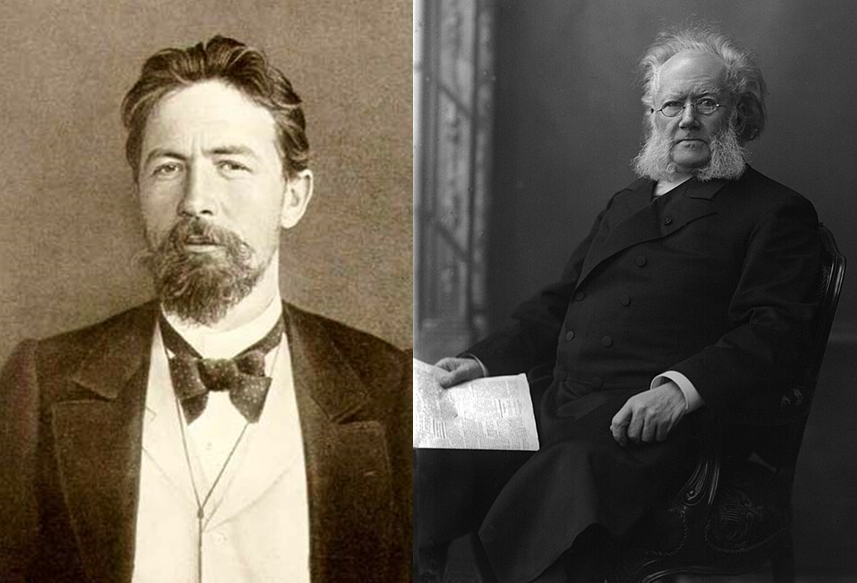
Why these two?
Anton Chekhov and Henrik Ibsen transformed modern drama by turning their attention away from melodramatic plots and larger-than-life heroes towards the complexities of ordinary human existence. Both writers examined the tensions concealed beneath respectable social appearances, revealing characters constrained by convention, frustrated desires, unfulfilled ambitions, and relationships that rarely provide the happiness they promise.
Yet their approaches are markedly different. Ibsen confronts social structures more directly, placing his characters in situations where questions of morality, gender, freedom and personal responsibility become impossible to avoid. Chekhov is more elusive. His characters often understand that their lives are unsatisfactory, yet remain unable to change them. Where Ibsen frequently builds towards confrontation, Chekhov allows disappointment, longing and resignation to accumulate almost imperceptibly.
My own encounters with these two writers also belong to very different periods of my life.
Chekhov was familiar to me long before I studied him formally. Russian literature was prominent in our household while I was growing up, and Chekhov was also part of the extraordinary theatrical culture I encountered in my youth. Italian television once regularly broadcast stage productions, bringing theatre into ordinary homes in a way that seems almost unthinkable today.
I remember watching Uncle Vanya, The Cherry Orchard, The Seagull and Three Sisters. One production that remains particularly vivid in my memory is Giorgio Strehler’s celebrated 1974 staging of The Cherry Orchard (Il giardino dei ciliegi), with Valentina Cortese as Liuba and the very young Monica Guerritore as Anja. The production was later recorded for television and broadcast by RAI in March 1978, and I remember watching it then. There was something remarkable about being able to encounter great theatre in this way, without having to be physically present in a theatre.
Ibsen entered my life much later, during my university studies in Scandinavian Languages and Literatures. I loved A Doll’s House, and I also remember seeing its stage adaptation on Italian television. Looking back, the two writers therefore represent different stages in my own relationship with literature: Chekhov belongs partly to the cultural world in which I grew up, while Ibsen belongs to the years when I began studying literature more formally.
Perhaps that is also part of what makes the comparison so compelling. Both writers examine lives that appear ordinary on the surface, yet beneath that surface are desires, frustrations and conflicts capable of transforming everything.
Time, place, movement
Anton Pavlovich Chekhov (Антон Павлович Чехов; 1860–1904) wrote during a period of profound change in Russia. The social structures of the Russian Empire were beginning to shift, while the old aristocratic order was losing its certainty and the country was moving towards an increasingly unstable modernity.
Chekhov’s plays are deeply rooted in this transitional world. His characters frequently belong to educated or landowning classes that are losing their social and economic security. They talk about change, dream of different futures and imagine that life will eventually begin somewhere else. Yet the anticipated transformation rarely arrives.
This sense of suspended change is central to his drama. In The Cherry Orchard, the threatened loss of the estate represents not merely a personal tragedy but the passing of an entire social order. In Three Sisters, the repeated longing to return to Moscow becomes almost a metaphor for the human tendency to imagine happiness as something that exists elsewhere.
Henrik Johan Ibsen (1828–1906), writing somewhat earlier, emerged from nineteenth-century Norway and became one of the principal figures in the development of modern European drama. His work challenged the conventions of the well-made play and confronted subjects that respectable society preferred to leave unexamined.
Marriage, sexuality, gender inequality, hypocrisy, inherited morality and individual freedom recur throughout his work. In A Doll’s House, the apparently respectable marriage of Nora and Torvald becomes a vehicle for questioning the assumptions underlying the family and society itself.
Both authors therefore belong to a period when European society was experiencing profound transformation. But they respond differently to it. Ibsen exposes the structures that constrain the individual, while Chekhov observes the people who remain caught within those structures.
Core themes
Society and constraint
Chekhov and Ibsen are equally fascinated by the ways society shapes individual lives.
Ibsen tends to make these pressures explicit. His characters confront social expectations concerning marriage, respectability, gender and morality. Nora’s awakening in A Doll’s House becomes a direct challenge to the role society has assigned her.
Chekhov’s characters are constrained more subtly. They are often trapped by class, economics, family obligations, geography or simply their own inability to act. They recognise their dissatisfaction but frequently lack the determination or circumstances necessary to escape it.
Unfulfilled lives
Few themes connect the two writers more strongly than the sense of lives that might have been different.
Chekhov’s characters frequently look backwards or forwards rather than living fully in the present. They remember what has been lost and imagine what might eventually happen. Yet the future they anticipate remains permanently out of reach.
Ibsen’s characters also confront the gap between the life they have and the life they imagined. The difference is that Ibsen is more likely to force that realisation into a decisive confrontation.
For each writer, however, the tragedy is rarely simply that people suffer. It is that they can see, at least dimly, the possibility of another life.
Marriage and relationships
Relationships in both Chekhov and Ibsen are rarely simple sources of happiness.
Ibsen examines marriage as a social institution, asking what happens when the roles imposed upon husband and wife become incompatible with individual identity. A Doll’s House remains powerful precisely because Nora’s crisis is not simply a marital disagreement: it is a confrontation with the structure of her entire existence.
Chekhov is less interested in making an explicit social argument. His relationships are filled with affection, disappointment, infidelity, loneliness and missed opportunities. People often love one another without being able to make one another happy.
Change and inaction
This may be the deepest distinction between the two writers.
Ibsen’s characters often reach a point where they must act. The consequences may be devastating, but the possibility of change remains.
Chekhov’s characters more frequently remain suspended between awareness and action. They understand that their lives are passing, but understanding does not necessarily produce change.
This difference gives the two bodies of work their distinctive emotional qualities.
Ibsen dramatises the moment when a person refuses to remain trapped. Chekhov dramatises the tragedy of remaining trapped despite knowing that one is.
Style comparison
Ibsen’s dramatic style is generally more direct and confrontational. His plays gradually reveal the hidden circumstances and moral compromises underlying apparently respectable lives. Information withheld from the audience is often eventually brought into the open, creating moments of revelation and confrontation.
His dialogue can therefore carry considerable argumentative force. Characters do not merely speak to one another; they defend beliefs, challenge assumptions and attempt to justify their behaviour.
Chekhov’s method is almost the opposite.
His characters talk constantly, but what matters is often what they fail to say. Conversations wander, memories intrude, jokes conceal pain and apparently insignificant observations reveal profound dissatisfaction.
The dramatic action in Chekhov is frequently internal rather than external. Someone leaves, someone arrives, a relationship changes, an estate is lost, but the greatest transformations often occur within the characters themselves.
This difference can be seen in their treatment of silence.
In Ibsen, silence can conceal a secret that will eventually be exposed.
In Chekhov, silence may simply remain silence: the space between what someone feels and what they are capable of expressing.
Their theatrical worlds therefore operate according to different rhythms.
Ibsen moves towards revelation. Chekhov moves towards recognition.
Key works
Chekhov’s four major plays—The Seagull, Uncle Vanya, Three Sisters and The Cherry Orchard—form the centre of his dramatic legacy, charting a radical shift from traditional plot-driven theatre toward subtext, mood, and indirect action.
The Seagull (Чайка; 1895-96) explores artistic ambition, unrequited love and the desire for recognition. Its characters are caught in complicated emotional relationships in which love and creativity repeatedly become sources of disappointment.
Set around a country estate, the play contrasts the theatrical idealism of the young writer Konstantin Treplev with the worldly success of the popular novelist Trigorin, and the romantic vulnerability of Nina with the narcissistic vanity of the actress Arkadina. Chekhov uses the recurring symbol of the dead seagull to underline how human beings routinely destroy what they fail to understand, while the play’s tragicomic tone emerges from the sharp contrast between grand artistic ideals and mundane human pettiness.
Uncle Vanya (Дядя Ваня; 1896) focuses on wasted potential and the painful realisation that life has not become what one once imagined. Its atmosphere of frustration and resignation is quintessentially Chekhovian.
Indeed, Uncle Vanya offers an extraordinary study in wasted potential, intellectual disillusionment, and quiet endurance.
Focusing on the quiet collapse of Vanya and his niece Sonya after the arrival of the pretentious retired Professor Serebryakov, the drama shifts the focus from grand tragedy to the slow suffering of daily life. The characters are defined by their inability to break free from their domestic inertia: Vanya’s rage against decades of pointless sacrifice eventually turns back into resignation, while Sonya’s poignant final invocation of ultimate rest underscores the play’s melancholic tension between unrequited love, physical exhaustion, and spiritual hope.
Three Sisters (Три сестры; 1900) expands Chekhov’s examination of temporal stagnation and psychological exile. Centred on Olga, Masha, and Irina Prozorov, whose constant yearning to return to Moscow functions as a desperate refuge from the dull reality of provincial military town life, the play measures the slow erosion of optimism across four acts. Moscow is never merely a geographical destination, but it represents an unattainable state of purpose and fulfillment. Through overlapping dialogue, sudden silences, and ambient offstage sounds, Chekhov reveals how these individuals are gradually displaced by the ruthless, unthinking vulgarity of the changing provincial society around them.
In The Cherry Orchard (Вишневый сад; 1903), personal nostalgia and macro-historical transition become completely intertwined. The impending sale and eventual destruction of the aristocratic estate’s famous orchard serve as an elegy for a dying social order, embodied by the gentle, financially irresponsible Lyubov Ranevskaya. Conversely, the rise of Lopakhin (the son of a serf who buys the estate to chop down the trees for suburban holiday cottages) signals the arrival of a pragmatic, commercial world. By defining the play as a comedy despite its tragic undertones, Chekhov captures a historical tipping point where traditional European hierarchy gives way to modern capitalism, leaving its characters stranded between a lost past and an uncertain future.
Ibsen’s major works—including Brand (1866), Peer Gynt (1867), A Doll’s House (Et dukkehjem; 1879), Ghosts (Gengangere; 1881), An Enemy of the People (En folkefiende; 1882), The Wild Duck (Vildanden;1884) and Hedda Gabler (1890)—systematically dismantled the conventions of the nineteenth-century “well-made play” to invent modern prose realism and psychological tragedy.
A Doll’s House remains perhaps his most famous play—as well as a foundational text of modern drama—precisely because it exposes the artificiality of bourgeois marriage and societal roles. Nora Helmer’s journey from a seemingly sheltered, infantilised wife to a woman who recognises that her life has been a constructed fiction culminates in one of the most famous theatrical endings in history. Her decision to leave her husband and children to discover her own identity was more than a mere social provocation, as it radically redefined dramatic structure by replacing the customary theatrical reconciliation with an uncompromising intellectual debate and a definitive slam of the door. In fact, it became one of the most controversial moments in nineteenth-century European theatre.
Ghosts confronts inherited guilt, sexual hypocrisy and the consequences of concealing uncomfortable truths.
The play deepens Ibsen’s relentless critique of social hypocrisy by examining inherited corruption, both biological and moral. Mrs Alving’s desperate attempt to protect her son Osvald from the legacy of his late father’s debauchery reveals how social convention forces individuals to live among dead beliefs and duty-bound illusions. Confronting taboo subjects such as congenital syphilis, euthanasia, and institutional corruption, the play illustrates how the suppression of truth inevitably rots the domestic foundation from within, leaving its characters powerless against the catastrophic arrival of light.
An Enemy of the People addresses the sharp collision between individual moral integrity and economic expediency within a democratic society. When Dr Thomas Stockmann discovers that the town’s lucrative public baths are contaminated, he expects gratitude for revealing the truth, but instead finds himself branded an enemy of the state by the political authority, the local press, and the majority of citizens who prioritise financial gain over public safety. Ibsen creates a fierce political parable that questions whether the majority can ever truly be right when confronted with uncomfortable scientific and ethical truths.
Hedda Gabler presents one of Ibsen’s most formidable psychological studies: an aristocratic woman with an intense desire for control over her own life, yet trapped in a stifling, conventional marriage to a pedantic academic, surrounded by narrow middle-class expectations.
Deprived of any meaningful outlet for her intellect and energy, Hedda resorts to manipulating the lives of those around her as a desperate attempt to exercise absolute control over human destiny. Her descent into destructive jealousy, culminating in her romanticised orchestration of Eilert Løvborg’s death and her final suicide, exposes the devastating consequences of a society that denies women genuine agency and self-realisation.
Together, these plays demonstrate how both dramatists transformed modern European theatre: while Ibsen drove the narrative engine forward through sharp ideological confrontations and dramatic disclosures, Chekhov dissolved traditional plot mechanisms to reveal the profound tragedy hidden beneath the surface of everyday life.
Legacy and influence
The legacy of Chekhov and Ibsen defined the trajectory of twentieth-century drama, establishing the foundational principles of modern realism through two distinct theatrical philosophies. Rather than merely reflecting everyday life on stage, both playwrights transformed realism into a mechanism for exposing the hidden psychological and structural forces governing human existence.
Chekhov revolutionised modern theatre by dismantling the traditional reliance on plot-driven conflict, pioneering a form of drama anchored in subtext, atmosphere, and indirect action. By treating a quiet silence, an interrupted conversation, or an offstage sound with the same dramatic weight as a violent climax, he redefined what constitutes theatrical action. His focus on the internal shifts within characters profoundly shaped modern performance and directing methodologies (most notably Konstantin Stanislavski’s system and the later evolution of Method acting), shifting the actor’s craft away from theatrical melodrama toward psychological authenticity.
Ibsen’s influence was equally seismic, transforming the stage into a vital arena for intellectual and ethical inquiry. By dismantling the artificial mechanics of the traditional “well-made play,” he demonstrated that serious social and moral critiques could be dramatised without diminishing narrative momentum. His willingness to confront institutional corruption, gender roles, and systemic hypocrisy fundamentally altered the expectations of European audiences, establishing theatre as a medium capable of challenging societal norms and provoking public debate.
Where Ibsen interrogates the broad ideological structures that constrain individual freedom, Chekhov observes the interior lives of those marooned within them. Together, their complementary approaches established modern drama as both a critique of society and an exploration of the human psyche.
Final reflections
What is most striking in Ibsen is his insistence that the individual must eventually confront the forces that have shaped their life. His characters may be frightened, compromised or mistaken, but they are repeatedly brought to moments when remaining unchanged becomes impossible.
Chekhov, by contrast, is fascinated by the painful distance between recognising one’s unhappiness and possessing the ability to overcome it.
His characters dream of change, speak about change and wait for change, yet time continues to pass.
Reading them together, the contrast becomes one of action as much as meaning. Ibsen asks what happens when a person breaks through the expectations imposed upon them; Chekhov asks what happens when a person remains imprisoned within them.
Perhaps this is what makes their relationship so compelling.
Ibsen gives discontent a voice. Chekhov gives it silence.
Ibsen’s theatre confronts the structures that prevent people from living freely. Chekhov’s reveals the quieter tragedy of people who understand their limitations but cannot escape them.
If Ibsen dramatises the moment when a life demands to be changed, then Chekhov captures the melancholy of knowing that change may never come.
Their significance endures because neither writer treats human unhappiness as something simple. Behind every frustrated life lies a complicated mixture of circumstance, choice, desire, fear and time.
And somewhere between them lies the unsettling truth that recognising the possibility of another life is not the same as having the courage (or the opportunity) to live it.
Part of the series: Exploring the Literary Giants
→ View all entries in this series
You may also like:
- Alessandro Manzoni and Victor Hugo → Read essay
Comment on “Exploring the Literary Giants: Anton Chekhov and Henrik Ibsen”