

Part of the series: Exploring the Literary Giants, examining influential authors through paired comparisons of context, style, and enduring impact.
🔍 Realpolitik vs idealism
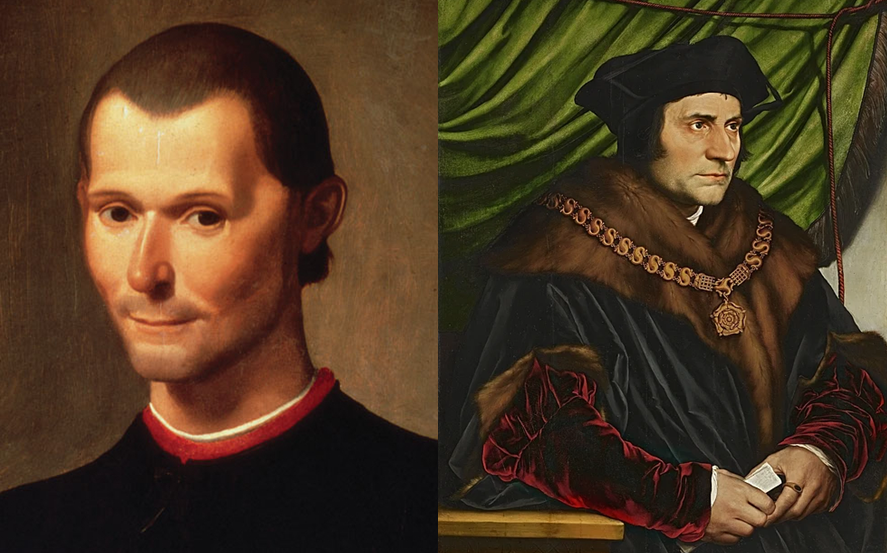
Why these two?
Niccolò Machiavelli (1469–1527) and Sir Thomas More (1478–1535) are united by a profound engagement with the nature of power, statecraft, and the ideal organisation of human society. Both writers looked beyond feudal medieval assumptions to examine the realities of political rule, the corruption of institutions, and the delicate balance between pragmatism and moral duty. Their works are populated by leaders, citizens, and political structures whose choices determine the stability, justice, and survival of the state.
Although Machiavelli wrote in Renaissance Florence and More in Tudor England, both developed a revolutionary literary vision of political philosophy. Machiavelli exposed the raw, unforgiving mechanics of power, arguing that political survival often demands actions separate from conventional morality. More, writing through a humanist lens, approached similar questions by imagining an alternative society, using satire and idealised structures to critique the greed, inequality, and tyranny of his contemporary Europe.
Bringing them together reveals two vastly different approaches to the same fundamental concern: how should human beings govern themselves, and can power ever be truly reconciled with virtue?
Time, place, movement
Niccolò Machiavelli (1469–1527) wrote during a turbulent era of foreign invasions, shifting alliances, and political instability in Renaissance Italy. Serving as a diplomat and civil servant for the Florentine Republic, he possessed direct experience with statecraft, war, and the fickle nature of political fortune. Following the fall of the republic and his subsequent exile, Machiavelli turned to writing, applying a rigorous, empirical realism to the study of history and human nature.
Machiavelli’s position within the diplomatic crucible of Italy gave him a deeply pragmatic perspective on leadership. His writings frequently examine the tension between political necessity (necessità) and moral virtue, challenging traditional Christian ethics in favour of stability, security, and civic strength (virtù).
Sir Thomas More (1478–1535), later canonised as Saint Thomas More, was similarly concerned with the exercise of authority and the ethics of public service in early Tudor England. A prominent lawyer, humanist scholar, and ultimately Lord Chancellor under Henry VIII, More was embedded in the highest circles of power. Renaissance Humanism was sweeping across Northern Europe, sparking intense debate over educational reform, governance, social inequality, and religious devotion.
More’s work reflects the tensions of a society transitioning out of the Middle Ages, marked by economic distress, royal absolutism, and religious conflict. His masterpiece, Utopia, exposes the stark contrast between the corruption of European court life and the rational, communal ideals of an imagined island state, culminating in his own ultimate clash between state allegiance and personal conscience.
Both writers therefore emerge from societies undergoing profound political and intellectual transformation, and both use literature to examine the moral consequences of holding power.
Core themes
A central concern for both Machiavelli and More is the nature of governance and political authority. Machiavelli views statecraft through the lens of effective management and survival, contending that a ruler must adapt to changing circumstances rather than rely on abstract ideals. In The Prince, authority is maintained through decisive action, strategic reputation, and an acute understanding of human self-interest.
More approaches governance from an idealised and structural perspective. In Utopia, the focus shifts from individual leadership to the design of institutions that promote the common good. By eliminating private property and restructuring social life, More suggests that systemic inequality and political corruption can be minimised through rational design rather than individual force.
Both authors are also deeply concerned with the relationship between virtue and expediency. Machiavelli radically redefines virtue, separating private morality from public duty and arguing that a leader must exercise virtù (boldness, intelligence, and adaptability) to master unpredictable circumstances (fortuna). More, conversely, wrestles with the dilemma of the philosopher in public life, asking whether one can serve a prince without compromising one’s soul, a question that runs through both his writing and his ultimate martyrdom.
Human nature and social order provide another key point of connection. Machiavelli views human beings as inherently fickle, self-interested, and easily led, requiring firm authority and laws to maintain order. More acknowledges human flaws but suggests that destructive traits—such as greed and pride—are cultivated by unjust social systems, particularly economic inequality and the concentration of wealth.
Finally, both authors explore the tension between reality and idealism. Machiavelli explicitly rejects imagined republics, focusing on the “effectual truth” (verità effettuale) of how leaders actually behave. More uses a fictional, idealised commonwealth—playing on the word’s dual Greek roots of eutopia (“good place”) and outopia (“no place”)—precisely to hold up a mirror to the failings of real-world European monarchs, while acknowledging that even an ideal society carries its own coercive shadows.
For both writers, literature becomes a tool to demystify power and ask how governance shapes human society.
Style comparison
Machiavelli’s style is direct, analytical, and uncompromisingly clear. Writing with the brevity of a diplomatic analyst, he uses historical examples, sharp aphorisms, and stark dichotomies to build his arguments. He strips away theological rhetoric to focus on cause, effect, and practical outcome, giving his work a modern, scientific tone.
More’s style is layered, ironical, and steeped in humanist dialogue. In Utopia, he employs a complex framing narrative, blending real historical figures with fictional characters such as the traveller Raphael Hythloday. His tone alternates between earnest reformism, sharp satire, and deliberate ambiguity, allowing him to critique contemporary politics while maintaining a degree of intellectual detachment.
Where Machiavelli exposes the inner mechanics of rule through direct advice and historical precedent, More explores political theory through imaginative architecture and satirical contrast. Machiavelli draws attention to the pragmatic actions required to preserve authority; More is more interested in the social arrangements required to foster justice and civic harmony.
Both, however, rely on a sharp observation of contemporary affairs to achieve their effects. Their works are grounded in an acute understanding of political rhetoric, human ambition, and the structures that sustain public order.
Where Machiavelli makes the harsh realities of power visible, More asks what a truly just society might look like in its place.
Key works
Machiavelli’s major works include The Prince (Il Principe, written 1513, published 1532), The Discourses on Livy (Discorsi sopra la prima deca di Tito Livio, written c. 1513–1519, published 1531), The Art of War (Dell’arte della guerra, 1521), The Mandrake (La Mandragola, c. 1518), and History of Florence (Istorie fiorentine, written 1520–1525, published 1532).
The Prince offers a concise, pragmatic manual on how political power is acquired, maintained, and lost, famously examining whether it is better to be loved or feared. The Discourses on Livy provides a broader examination of republican governance, liberty, civic duty, and the historical factors that allow republics to endure.
The Prince remains his most explicit critique of traditional political idealism, challenging medieval notions of the Christian ruler and emphasising the primacy of political survival and civic order, while his comedy The Mandrake applies that same sharp observation of deception and human desire to social life.
More’s most influential work is Utopia (1516), alongside his political and historical writings such as The History of King Richard III (written c. 1513–1518, published 1543) and A Dialogue Concerning Heresies (1529). Utopia is divided into two distinct parts: the first offers a biting critique of European social conditions, economic greed, and courtly sycophancy, while the second details the laws, customs, and communal organisation of the utopian islanders.
The History of King Richard III serves as a stark study in political tyranny and ambition, depicting the corruption of power and the erosion of legitimate rule in a manner that deeply influenced Tudor political thought and Elizabethan drama.
Where Machiavelli often constructs a practical framework around the exercise of individual power, More uses narrative and dialogue to examine the overarching structures of society.
Legacy and influence
Both Machiavelli and More transformed the trajectory of Western political thought. Their works demonstrated that literature and philosophy could directly engage with the mechanics of governance, reshaping how theorists and statesmen understood political power.
Machiavelli’s influence laid the groundwork for modern political science and the doctrine of Realpolitik. By separating ethics from statecraft, his writings sparked centuries of intense debate, earning him a reputation as both a cynical champion of tyranny and a clear-eyed defender of republican liberty. Concepts derived from his work continue to inform modern discussions on realism, international relations, and executive authority.
More’s legacy is equally profound. Utopia gave a name to an entire literary genre and intellectual tradition, inspiring centuries of social reform, political theory, and speculative fiction. His critique of private property and emphasis on social welfare resonated through early modern debates on justice, directly influencing later reformist and socialist movements. His eventual execution for refusing to compromise his conscience under Henry VIII led to his canonisation as a Catholic saint in 1935, solidifying his role in history as both a political thinker and a martyr for personal integrity.
Both thinkers also demonstrated the profound weight of political engagement. Machiavelli suffered imprisonment and exile for his republican allegiances, while More paid for his political and religious convictions with his life.
Together, Machiavelli and More demonstrate how political literature can function as both empirical analysis and radical imagination.
Final reflections
What is most striking in Machiavelli is the uncompromising realism of his political vision. His insights are presented directly to the reader, stripped of moral sentimentality and focused entirely on the fragile nature of human security and statecraft.
More approaches social morality from a radically imaginative direction. His writings force readers to confront the glaring disparity between the corrupt systems they inhabit and the rational, equitable alternatives that human reason might construct. For him, political failure is fundamentally linked to moral greed and structural injustice.
Reading them together, the contrast becomes one of perspective rather than underlying subject. Machiavelli reveals how power operates in the world as it is, while More challenges us to contemplate how society might be reconfigured in the world as it ought to be.
Perhaps this is what defines their relationship. Whereas Machiavelli asks us to see the world with unyielding clarity, More asks us to envision how it might be transformed.
If Machiavelli turns political authority into an art of survival, then More turns political imagination into a mirror for society.
Their works endure because neither permits the reader to remain comfortable in naive assumptions about governance. Power, justice, realism, and idealism cease to be abstract concepts and become urgent questions of human survival.
And somewhere between them lies the enduring question of whether political order must always rely on the cold calculation of power, or whether, through reason and moral courage, humanity can build a state founded on true justice.
Part of the series: Exploring the Literary Giants
→ View all entries in this series
You may also like:
- Émile Zola and Mikhail Bulgakov → Read essay