

Part of the series: Exploring the Literary Giants, examining influential authors through paired comparisons of context, style, and enduring impact.
🔍 Solitude, beauty, mortality, and the search for meaning.
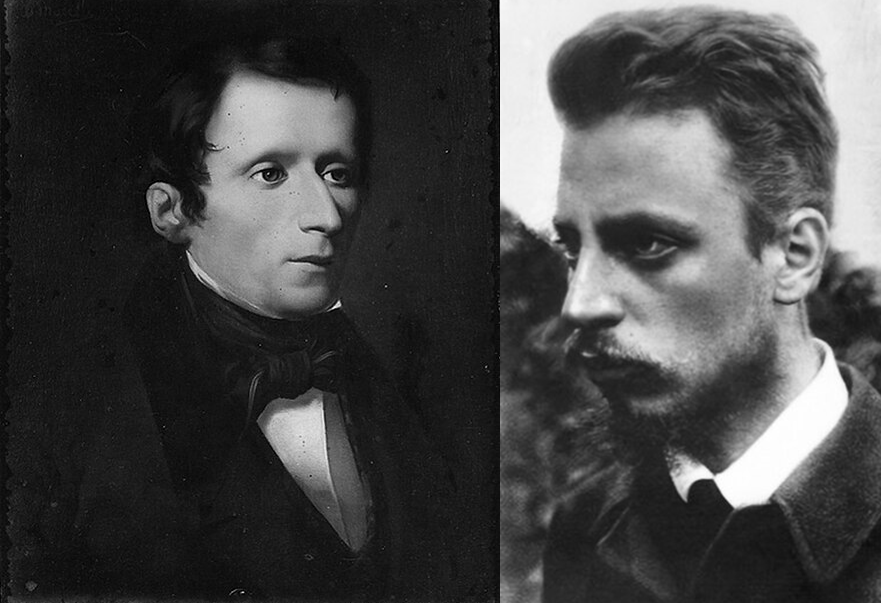
Why these two?
Giacomo Leopardi and Rainer Maria Rilke belong to different centuries, languages, and literary traditions, yet their poetry is united by an intense engagement with some of the most fundamental questions of human existence. Both writers confront solitude, mortality, longing, beauty, and the difficult relationship between human beings and the world around them.
Leopardi approaches these questions through a profoundly pessimistic vision. His poetry gradually moves from the loss of the illusions that once made happiness possible towards a darker recognition of the indifference of nature itself. Yet his pessimism is not simply despair: in his later work, particularly La ginestra, it becomes the basis for a powerful argument for human solidarity in the face of a hostile or indifferent universe.
Rilke, writing more than a century later, also places mortality and uncertainty at the centre of his work. His response, however, is markedly different. Rather than accepting death and suffering simply as evidence of life’s futility, he seeks to transform them through perception, beauty, and artistic expression. His poetry asks how human beings might embrace transience rather than escape from it. Bringing Leopardi and Rilke together therefore reveals two profoundly different responses to the same fundamental condition. One confronts the silence of the universe; the other searches for a language capable of transforming that silence.
Time, place, movement
Giacomo Leopardi (1798–1837) lived during a period of profound political, intellectual, and cultural change in Italy. Born in Recanati, in the Papal States, he grew up in an aristocratic family and developed an extraordinary intellectual life from an early age. His extensive studies of classical literature, philosophy, philology, and languages shaped his understanding of both the ancient and modern worlds.
Leopardi is associated with Italian Romanticism, although his relationship with the movement was complex. He remained deeply attached to classical literature and frequently questioned the Romantic celebration of progress and modern civilisation. His poetry and prose instead developed a distinctive philosophical vision in which the human desire for happiness comes into conflict with the limitations imposed by nature and existence.
His intellectual development is often discussed in terms of different stages of pessimismo. His early pessimismo storico suggested that civilisation and the loss of humanity’s natural illusions had contributed to modern unhappiness. This gradually developed into pessimismo cosmico, the much more radical recognition that suffering is not merely the product of historical circumstances but an intrinsic part of human existence, with nature itself indifferent to human happiness.
Rainer Maria Rilke (1875–1926) belonged to a much later period of European literature. Born in Prague, then part of the Austro-Hungarian Empire, he wrote primarily in German and became one of the most important German-language poets of the early twentieth century.
Rilke’s work developed across several literary and intellectual contexts, including symbolism, modernism, and the emerging cultural atmosphere of European modernity. His poetry reflects a world increasingly conscious of fragmentation, uncertainty, and the limitations of traditional religious and philosophical certainties.
His extensive travels, particularly his experiences in Russia, France, and Italy, contributed to his evolving artistic vision. His relationship with visual art, especially through his association with the sculptor Auguste Rodin, also influenced his development, encouraging his distinctive approach to objects, perception, and artistic attention.
Both poets therefore wrote during periods of intellectual uncertainty. Leopardi witnessed the erosion of older assumptions about humanity and progress; Rilke wrote in a Europe increasingly aware of the instability of its inherited certainties. Yet each transformed that uncertainty into poetry.
Core themes
The central theme connecting Leopardi and Rilke is mortality. Both understand that human existence is defined by transience, but they respond to this fact in fundamentally different ways.
For Leopardi, mortality is inseparable from the human desire for happiness. Human beings instinctively long for something infinite and permanent, yet existence can never satisfy that longing. Nature offers no guarantee of happiness and ultimately destroys the individual it has created. This tension between limitless desire and finite existence lies at the heart of his philosophical poetry.
Rilke also recognises mortality as unavoidable, but he resists treating death simply as the negation of life. In the Duino Elegies, death becomes part of a larger understanding of existence. Human beings are temporary, but precisely because life is temporary, experience acquires its intensity and value.
Solitude is another important connection. Leopardi frequently portrays the individual as isolated not only from society but from the universe itself. The famous solitude of L’infinito is both beautiful and unsettling: the mind reaches towards infinity precisely because the physical world is limited.
Rilke’s solitude is different. His poetry often presents solitude as a necessary condition for artistic and spiritual development. To withdraw from the noise of the world can allow the individual to encounter experience more intensely.
Nature occupies a particularly important but radically different position in their work. For Leopardi, nature ultimately becomes indifferent, even hostile, to human happiness. The landscape may inspire beauty and imagination, but behind that beauty lies an indifferent natural order.
Rilke, by contrast, often seeks communion with the natural and material world. Objects, animals, landscapes, and physical forms become occasions for heightened perception. His poetry attempts to see things so completely that they can be transformed into something inward and lasting. Both writers are therefore concerned with the human search for meaning. Leopardi repeatedly exposes the inadequacy of the consolations humanity creates for itself. Rilke does not offer an easy solution, but he suggests that attention, acceptance, and artistic transformation may allow human beings to inhabit uncertainty more fully.
Style comparison
Leopardi’s poetry combines extraordinary musicality with philosophical precision. His language can appear deceptively simple, particularly in poems such as L’infinito, yet beneath that apparent simplicity lies a complex meditation on perception, imagination, time, and infinity.
His landscapes are rarely merely descriptive. The natural world becomes a philosophical space in which the individual confronts the limits of knowledge and existence. A hill, a night sky, a village evening, or the call of a shepherd can open into questions about the entire human condition.
Leopardi’s style also depends heavily upon contrast: illusion and truth, youth and age, desire and reality, nature and humanity, infinity and limitation. His poetry often begins with an apparently intimate or ordinary experience before expanding into a much larger philosophical reflection.
Rilke’s poetry is similarly attentive to the relationship between the concrete and the metaphysical, but his method is different. He often begins with an object, creature, landscape, or physical experience and gradually transforms it into something symbolic and inward.
His celebrated Dinggedichte, or “thing poems”, demonstrate this approach particularly clearly. By concentrating intensely on an object, Rilke attempts to move beyond superficial observation and discover a deeper form of existence within it.
The Duino Elegies and Sonnets to Orpheus represent a more expansive and complex form of poetic expression. Their language is dense with metaphor and philosophical suggestion, continually moving between the visible and invisible worlds.
Where Leopardi often uses poetry to expose the gap between human desire and reality, Rilke uses it to explore whether that gap can itself become a source of transformation.
Leopardi’s poetry looks into the darkness and refuses consolation. Rilke looks into the same darkness and asks what might still be made visible there.
Key works
Leopardi’s most important poetic collection, the Canti, contains many of his greatest poems and traces the development of his thought and poetic voice. Among them, L’infinito explores the relationship between limitation and the imagination, transforming a solitary landscape into an experience of boundlessness.
Alla luna, A Silvia, Il sabato del villaggio, and Canto notturno di un pastore errante dell’Asia similarly combine intimate experience with profound philosophical reflection.
In A Silvia, the destruction of youthful hopes becomes a meditation on the loss of illusion and the disappointment inherent in human existence. Canto notturno places the human condition within an immense and indifferent universe, while Il sabato del villaggio explores the relationship between anticipation and happiness, suggesting that the expectation of pleasure may be more bearable than pleasure itself.
La ginestra, one of Leopardi’s final major poems, develops his pessimism into something more complex. Faced with the destructive power of nature, humanity has no reason to believe itself at the centre of the universe. Yet precisely because human beings share this vulnerability, Leopardi imagines the possibility of solidarity rather than competition and illusion.
Rilke’s major works include The Book of Hours, New Poems, the Duino Elegies, and Sonnets to Orpheus.
The Duino Elegies represent perhaps the fullest expression of his mature poetic vision. Written over many years, they confront death, beauty, suffering, love, transience, and the human desire to transform experience into something enduring.
The Sonnets to Orpheus, written with extraordinary intensity, continue many of these concerns through the figure of Orpheus, whose art becomes a symbol of transformation. Poetry does not abolish death or suffering, but it can give them form.
Where Leopardi’s poetry repeatedly confronts the impossibility of escaping the conditions of existence, Rilke’s work asks whether those very conditions can become the material from which a different understanding of life is created.
Legacy and influence
Leopardi’s influence on Italian literature is profound. He transformed philosophical reflection into poetry of extraordinary emotional and musical power, establishing himself as one of the central figures of the Italian literary tradition.
His pessimism also gives his work a philosophical significance extending beyond literature. His reflections on nature, happiness, illusion, progress, and human limitation have continued to attract philosophers, writers, and readers far beyond nineteenth-century Italy.
Rilke became one of the most influential poets of the twentieth century. His exploration of solitude, perception, mortality, art, and transformation has influenced generations of poets and writers across languages and cultures.
His work has also endured because it resists easy categorisation. It can be read as philosophical, spiritual, mystical, psychological, or purely poetic without being reducible to any one of these interpretations.
Both poets demonstrate the extraordinary ability of poetry to address questions that philosophy alone cannot resolve. Neither provides a simple answer to mortality or suffering. Instead, both transform uncertainty into language.
Yet their legacies ultimately point in different directions. Leopardi leaves us with the recognition that nature does not share our desire for happiness. Rilke leaves us with the possibility that recognising our mortality may deepen rather than diminish our capacity to experience life.
Together, they represent two powerful traditions of European poetry: one rooted in lucid confrontation with suffering, the other in transformation through perception and art.
Final reflections
Leopardi has a particular place in my own literary education. I encountered him as a young girl, through the Italian school curriculum, where studying his work was compulsory, as it was for generations of Italian students. I even visited Recanati on a school trip, encountering not simply the poet on the page but the place in which his imagination had developed.
At that age, I encountered Leopardi’s pessimism primarily as a literary and philosophical idea: the bleak recognition of human suffering, the indifference of nature, and the loss of the illusions that make happiness possible. I could understand the ideas, but I was encountering them from the perspective of youth.
Many years later, I encountered Rilke at university. By then, I was reading him from an entirely different point in my own life. The uncertainties were no longer those of adolescence, but they were uncertainties nonetheless, and his poetry spoke to them in a very different language.
Looking back, it is striking to me that these two poets entered my life at such different moments. Leopardi belonged to my earliest literary education; Rilke came much later, when I had a very different understanding of solitude, uncertainty, time, and mortality.
The poets have remained the same, but the reader has changed.
Perhaps that is part of what makes reading them together so compelling now. Leopardi confronts the human desire for happiness with a universe that offers no guarantee of it. His pessimism refuses easy consolation, but it does not necessarily end in silence. In La ginestra, the recognition of humanity’s vulnerability becomes an argument for solidarity: if nature is indifferent to us, then perhaps we have an even greater responsibility towards one another.
Rilke approaches the same fundamental uncertainty from another direction. He does not deny suffering or mortality, but searches for a way of transforming them through attention, acceptance, beauty, and art.
If Leopardi teaches us to look into the darkness without consolation, Rilke teaches us that looking itself can become a form of transformation.
Leopardi asks what we can expect from a universe that does not answer us. Rilke asks what we can become by learning to listen to its silence.
Perhaps that is what defines their relationship. Leopardi gives voice to the tragedy of wanting more from existence than existence can provide; Rilke searches for a language in which even transience can be embraced.
If Leopardi confronts the limits of human happiness, then Rilke explores what might still be possible within those limits.
And somewhere between them lies the enduring paradox of poetry: that it cannot defeat mortality, explain suffering, or make the universe answer us—yet somehow, by giving words to what cannot be resolved, it makes the uncertainty bearable.
Part of the series: Exploring the Literary Giants
→ View all entries in this series
You may also like:
- Aleksandr Pushkin and Johann Wolfgang von Goethe → Read essay