

Part of the series: Exploring the Literary Giants, examining influential authors through paired comparisons of context, style, and enduring impact.
🔍 Surveillance, conditioning, and the structure of power.
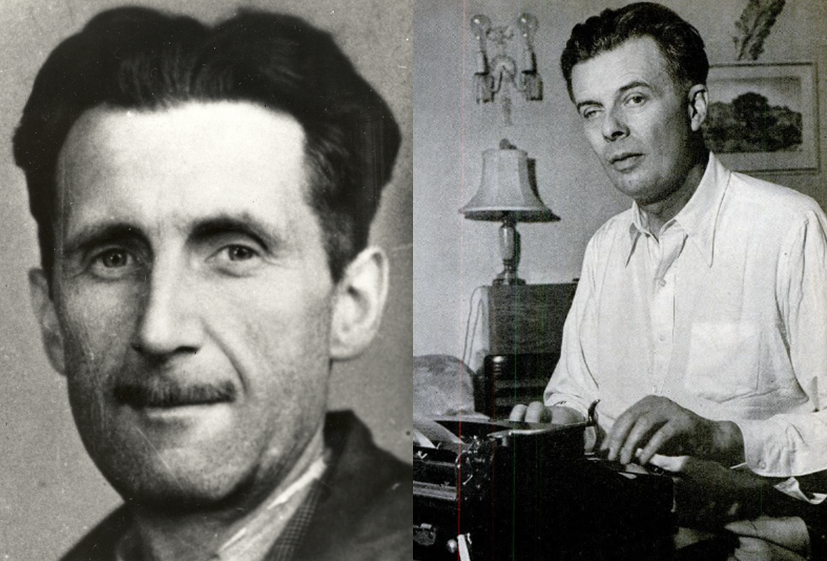
Why these two?
George Orwell and Aldous Huxley remain two of the most influential writers of dystopian fiction, each constructing a vision of society shaped by systems of control. Though their novels differ sharply in tone and method, both writers are fundamentally concerned with the relationship between power and human freedom, and with the ways political systems shape thought, behaviour, and identity.
Orwell imagines a world sustained through surveillance, repression, and fear, where truth itself becomes unstable under authoritarian control. Huxley, by contrast, presents a society governed less by coercion than by pleasure, distraction, and conditioning. Bringing them together reveals two distinct but deeply complementary visions of modern dystopia: one in which freedom is destroyed through force, and another in which it disappears through voluntary submission.
Time, place, movement
Aldous Huxley (1894–1963) wrote during a period shaped by rapid technological change, mass industrialisation, and growing anxieties about the future of modern society. Published in 1932, Brave New World emerged in the aftermath of the First World War and amid the rise of consumer culture, scientific management, and mass entertainment. Huxley’s dystopia reflects fears not only of authoritarianism, but of a society increasingly organised around efficiency, conformity, and pleasure.
George Orwell (born Eric Arthur Blair; 1903–1950), writing slightly later, was shaped more directly by the political crises of the mid-twentieth century: fascism, Stalinism, propaganda, and the experience of totalitarian rule. His work reflects deep concern with political language, state surveillance, and the manipulation of truth. Published in 1949, Nineteen Eighty-Four presents a society in which power is maintained through fear, censorship, and perpetual observation.
Both writers are associated with dystopian fiction, yet their works extend beyond speculative warning. Each responds to broader transformations in modern society, asking how political and technological systems alter human consciousness and social behaviour.
Core themes
A central concern for both Orwell and Huxley is the relationship between power and freedom. In Orwell’s work, freedom is suppressed externally through surveillance, violence, and ideological control. The state maintains authority by restricting language, rewriting history, and eliminating private thought.
Huxley, by contrast, explores a subtler form of domination. In Brave New World, individuals are conditioned from birth to accept social hierarchy and to pursue immediate gratification. Control operates not through fear, but through comfort and distraction.
Both writers also examine the manipulation of truth and reality. Orwell presents truth as something actively erased and reconstructed by political authority, while Huxley depicts a society in which truth becomes irrelevant because superficial pleasure has replaced critical thought.
Another shared theme is the erosion of individuality. Orwell’s characters struggle to preserve personal identity against oppressive systems of surveillance, while Huxley’s world produces conformity through psychological conditioning and social engineering.
Despite these differences, both writers suggest that modern systems of power extend beyond physical force, shaping perception, desire, and the boundaries of thought itself.
Style comparison
Orwell’s prose is direct, restrained, and deliberately clear. His writing avoids ornament in favour of precision, reflecting his belief that language must resist political distortion. This clarity gives works such as Nineteen Eighty-Four a stark immediacy, reinforcing the brutality and psychological pressure of the world he depicts.
Huxley’s style is more expansive and satirical. His writing combines intellectual commentary with irony and dark humour, often presenting disturbing ideas through exaggerated social and technological detail. Where Orwell creates tension through severity and realism, Huxley relies more heavily on contrast and exaggeration.
The structural differences between their novels also reflect their distinct visions of power. Orwell’s narrative moves towards increasing confinement and inevitability, while Huxley constructs a society that appears stable, efficient, and even superficially harmonious.
Where Orwell depicts oppression as visible and violent, Huxley presents it as internalised and seductive.
Key works
Orwell’s most influential works include Animal Farm (1945) and Nineteen Eighty-Four (1949). Animal Farm uses political allegory to critique authoritarianism and the corruption of revolutionary ideals, while Nineteen Eighty-Four explores surveillance, propaganda, and the destruction of objective truth.
In Nineteen Eighty-Four, concepts such as Big Brother, doublethink, and Newspeak have become enduring symbols of authoritarian control and political manipulation.
Huxley’s major works include Brave New World (1932), The Doors of Perception (1954), and Island (1962). Brave New World remains his defining dystopian vision, depicting a technologically advanced society organised around conditioning, consumption, and emotional regulation.
The novel’s use of genetic engineering, psychological conditioning, and pleasure as mechanisms of control distinguishes it sharply from Orwell’s darker and more overtly oppressive political world.
Legacy and influence
Both Orwell and Huxley have had a profound influence on political and cultural thought. Orwell’s work has shaped modern discussions of surveillance, propaganda, censorship, and authoritarianism. Terms such as “Orwellian” and “Big Brother” remain central to contemporary political language.
Huxley’s influence has grown increasingly significant in discussions of consumer culture, technological distraction, and mass entertainment. His vision of control through pleasure and passive conformity continues to resonate in debates surrounding media, technology, and social conditioning.
Together, Orwell and Huxley represent two enduring models of dystopian power: one based on coercion and fear, the other on comfort and compliance.
Final reflections
What is most striking in Orwell is the severity of his political vision. Power in Nineteen Eighty-Four is unmistakably oppressive, sustained through surveillance, punishment, and the deliberate destruction of truth.
Huxley approaches the same problem from a different direction. In Brave New World, control is rarely experienced as suffering. It is absorbed into pleasure, entertainment, and the management of desire itself.
Reading them together, the contrast becomes deeply revealing. Orwell fears the loss of freedom through force; Huxley fears its disappearance through comfort.
Perhaps this is what defines their relationship. Orwell imagines a society in which people are prevented from thinking freely, while Huxley imagines one in which they no longer wish to.
If Orwell presents power as something imposed upon the individual, then Huxley presents it as something internalised and willingly sustained.
Their works endure because they confront a question that remains unresolved within modern society: whether human beings are controlled more effectively through fear or through pleasure.
And somewhere between them lies the unsettling possibility that modern power depends on both.
Part of the series: Exploring the Literary Giants
→ View all entries in this series
You may also like:
- Giacomo Leopardi and Rainer Maria Rilke → Read essay