

Part of the series: Exploring the Literary Giants, examining influential authors through paired comparisons of context, style, and enduring impact.
🔍 Romanticism, artistic freedom, and the search for self.
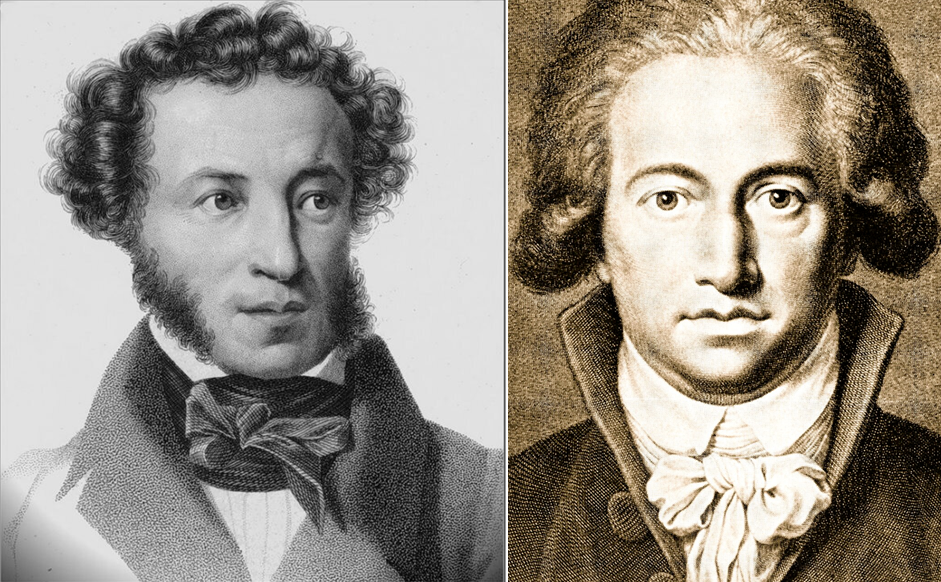
Why these two?
Aleksandr Pushkin and Johann Wolfgang von Goethe stand at two important points in the development of modern European literature. Although they belonged to different generations and wrote in different languages and cultural traditions, both transformed the possibilities of literature by bringing together poetry, philosophy, history, individual experience, and the search for artistic freedom.
Goethe helped shape the intellectual and literary culture of modern Europe, moving from the emotional intensity of Sturm und Drang towards the ideals of Weimar Classicism while profoundly influencing the Romantic generation that followed. Pushkin, influenced by European literary traditions yet deeply rooted in Russian culture, became a defining figure in the emergence of modern Russian literature.
Both writers were fascinated by the individual in pursuit of experience, knowledge, love, freedom, and self-understanding. Goethe’s work repeatedly confronts the limits of human knowledge and the restless desire to experience life in its fullest possible form. Pushkin explores similar tensions through characters caught between personal desire, social expectation, history, and fate. Bringing them together reveals more than a meeting between two literary giants. It reveals a dialogue between European literary traditions and the ways in which one generation can absorb, transform, and ultimately reinvent the influence of another.
Time, place, movement
Johann Wolfgang von Goethe (1749–1832) lived through one of the most transformative periods in European intellectual and cultural history. Born in Frankfurt, he became a central figure in German literature and spent much of his adult life in Weimar, where he worked alongside other major intellectual and artistic figures.
His early writing was associated with Sturm und Drang, a movement that emphasised emotion, individual expression, and resistance to conventional restraints. Works such as The Sorrows of Young Werther captured the intensity of this period. Goethe later moved towards the more balanced ideals of Weimar Classicism, drawing inspiration from classical literature and culture while continuing to explore the complexities of individual experience.
His journey to Italy between 1786 and 1788 was particularly important to his intellectual and artistic development. His encounter with Italian art, architecture, landscape, and classical culture profoundly influenced his understanding of beauty and form. Italy became not simply a geographical destination in Goethe’s life, but an essential part of his artistic imagination.
Aleksandr Segeyevich Pushkin (Алекса́ндр Серге́евич Пу́шкин, 1799–1837) belonged to a later generation and emerged within the cultural world of nineteenth-century Russia. Born in Moscow and educated at the Imperial Lyceum at Tsarskoye Selo, he developed a literary voice that combined European influences with Russian history, language, folklore, and social experience.
Pushkin is closely associated with Russian Romanticism, particularly in his earlier poetry and narrative works, although his writing ultimately transcends the boundaries of any single movement. His literary development coincided with a period of political and cultural change in Russia, including the aftermath of the Napoleonic Wars and the rise of new intellectual and political ideas. Both writers therefore stand at moments of literary transformation. Goethe helped expand the intellectual possibilities of European literature; Pushkin helped establish the foundations of a distinctly modern Russian literary language.
Core themes
A central concern for both Goethe and Pushkin is the individual and the search for freedom. Their characters often struggle against social expectations, conventional morality, or the limitations imposed by circumstance. Yet neither writer presents freedom as simple. Personal independence can bring isolation, conflict, or moral responsibility.
Goethe repeatedly explores the tension between human aspiration and limitation. In Faust, the desire for knowledge and experience becomes almost limitless, as Faust refuses to accept the boundaries imposed upon ordinary human existence. The work becomes a profound examination of ambition, desire, knowledge, temptation, and the consequences of seeking more than life appears capable of providing.
Pushkin approaches individuality through a more varied range of characters and forms. In Yevgeny Onegin, the title character’s detachment and inability to commit himself fully to life contrast with Tatyana’s emotional depth and moral development. Pushkin explores not only romantic love, but the relationship between individual temperament and the society that surrounds it.
Love and desire are similarly important to both writers, but neither treats them simply as romantic subjects. In The Sorrows of Young Werther, Goethe presents emotional intensity as both exhilarating and destructive. Pushkin’s works likewise explore love as a force capable of revealing character, creating conflict, and exposing the distance between desire and reality.
Both writers also engage with nature, art, and the imagination. Goethe’s relationship with nature extends into his philosophical and scientific interests, while Pushkin frequently draws upon landscape, folklore, history, and the natural world to enrich his poetic and narrative imagination.
Finally, both are concerned with the passage of time and the consequences of human choices. Their characters are rarely able to remain untouched by experience. The individual changes, sometimes through love, sometimes through suffering, and sometimes through the recognition that freedom itself carries responsibility.
Style comparison
Goethe’s literary style is remarkably varied, reflecting the breadth of his intellectual interests. He wrote poetry, drama, novels, autobiography, scientific works, and philosophical reflections. His writing can move from emotional intensity to intellectual contemplation, from lyrical simplicity to philosophical complexity.
Faust exemplifies this versatility. The work combines poetry, drama, mythology, philosophy, theology, symbolism, and social observation. Its mixture of forms allows Goethe to explore ideas that would be difficult to contain within a conventional narrative structure.
Pushkin was similarly versatile, working across poetry, prose, drama, historical writing, and narrative verse. His language is notable for its clarity, flexibility, musicality, and ability to move between elevated poetic expression and conversational directness.
Yevgeny Onegin is particularly distinctive in this respect. Written in verse, it combines narrative, lyrical reflection, irony, social observation, and psychological insight. Pushkin’s use of the Onegin stanza creates a highly controlled poetic structure while allowing remarkable freedom of tone and subject.
Where Goethe often expands literature towards philosophical and intellectual universality, Pushkin brings literary form closer to the rhythms of lived experience. Goethe seeks breadth and totality; Pushkin achieves extraordinary range through economy, elegance, and precision. Both, however, demonstrate an unusual freedom from rigid literary boundaries. Neither writer can be confined comfortably to a single genre, movement, or intellectual discipline.
Key works
Goethe’s most influential works include: The Sorrows of Young Werther (1774), Faust (Part I: 1808, Part II: 1832), Wilhelm Meister’s Apprenticeship (1795-1796), Elective Affinities (1809), and his poetry. The Sorrows of Young Werther became one of the defining literary works of its age, capturing the emotional intensity associated with the emerging Romantic sensibility.
Faust, however, represents the fullest expression of Goethe’s intellectual and artistic ambition. Begun when Goethe was young and developed over much of his lifetime, the work follows Faust’s pursuit of knowledge, experience, and meaning through his pact with Mephistopheles. It encompasses questions of morality, desire, religion, politics, society, and the limits of human understanding.
Pushkin’s major works include: Yevgeny Onegin (1833), The Captain’s Daughter (1836), The Queen of Spades (1834), Ruslan and Ludmila (1820), Boris Godunov (1831), and The Bronze Horseman (1837), alongside his extensive body of lyric poetry.
Yevgeny Onegin is perhaps his defining achievement. Through its verse narrative, Pushkin creates an extraordinarily nuanced portrait of Russian society while exploring love, identity, boredom, social convention, and missed possibilities.
The Captain’s Daughter combines historical fiction, romance, and political upheaval, while The Queen of Spades moves towards the mysterious and supernatural, exploring obsession, greed, chance, and fate. Ruslan and Ludmila draws upon folklore and fairy-tale traditions, demonstrating Pushkin’s ability to combine the fantastical with poetic invention. Where Goethe’s Faust attempts to encompass the vastness of human aspiration, Pushkin’s works repeatedly find the universal within the particular: a love that is not returned, a decision that cannot be undone, a society observed with irony, or a single moment in which fate changes the course of a life.
Legacy and influence
Goethe’s influence on European literature is immense. His works helped shape the development of Romanticism and influenced generations of writers, poets, philosophers, and artists. His exploration of individuality, emotion, nature, knowledge, and artistic freedom contributed to a broader transformation in European intellectual culture.
Faust in particular became one of the defining works of Western literature. Its central questions have continued to influence writers and artists long after Goethe’s death, while its treatment of ambition, knowledge, desire, and moral responsibility remains remarkably open to reinterpretation.
Pushkin’s influence on Russian literature is equally profound. He is widely regarded as a foundational figure in the development of modern Russian literature, particularly through his transformation of the Russian literary language. His ability to combine European literary influences with Russian traditions created a model for writers who followed him.
Writers such as Gogol, Turgenev, Dostoevsky, and Tolstoy inherited a literary culture that had been profoundly shaped by Pushkin’s achievement. His influence extended beyond individual works: he helped establish a literary language capable of expressing the complexity of modern Russian life.
Both writers also demonstrate the importance of cultural exchange. Neither developed in isolation. Goethe absorbed influences from classical antiquity and across Europe; Pushkin absorbed European literary traditions and transformed them within a Russian context. Together, they demonstrate that literary influence is not simply a matter of imitation. The most enduring influence occurs when one writer takes what has come before and transforms it into something new.
Final reflections
Pushkin has a particular place in my own literary life. I discovered him when I was about fourteen or fifteen, through The Captain’s Daughter, and I was immediately drawn into his world. Years later, after studying Russian and travelling to Russia (a country I have loved deeply my whole life), I was able to encounter some of his poetry in the original language. That experience gave a different dimension to a writer I had first discovered as a teenager.
The Queen of Spades and Ruslan and Ludmila became further favourites, alongside the work that stands at the centre of his achievement for me: Yevgeny Onegin. Returning to Pushkin through another language, and after having experienced something of the country and culture from which his writing emerged, made the connection feel less like literary admiration and more like a journey that had continued across decades.
My connection with Goethe is different, but there is another personal bridge here. Goethe’s profound love of Italy, and the importance of his Italian journey to his artistic and intellectual development, resonates particularly strongly with me. Italy was the country in which I was born, and there is something moving about encountering a writer for whom the same landscape, art, history, and culture became such an essential part of his understanding of beauty and creativity.
And then there is Faust.
To describe Faust merely as an influential work would be an understatement. Its questions about knowledge, ambition, desire, temptation, freedom, and the limits of human understanding reverberate through generations of writers who followed. The Sorrows of Young Werther, too, remains a work I have loved for its emotional intensity and its extraordinary portrayal of longing, vulnerability, and the turbulence of youth.
Reading Pushkin and Goethe together, I am struck by how differently two writers can transform the same restless impulse: the desire to experience more, understand more, and live more fully.
Goethe reaches towards the infinite. His imagination continually pushes against the boundaries of knowledge, experience, and human possibility. Pushkin, by contrast, seems to find infinity within the particular: the individual, the landscape, the fleeting emotion, the missed opportunity, the precise moment in which a life changes direction.
Perhaps this is what defines their relationship. Goethe expanded the possibilities of the European imagination; Pushkin took those possibilities and transformed them into something unmistakably his own.
If Goethe sought to embrace the totality of human experience, then Pushkin showed how that experience could be distilled into a new literary language.
Their significance endures not only because of what they wrote, but because of the freedom with which they wrote it. Both remind us that literature does not need to remain within the boundaries of a single nation, language, genre, or tradition. It can travel, absorb, transform, and return to us changed.
And somewhere between them lies the restless spirit of Romanticism: the belief that literature can cross borders, languages, cultures, and generations without ever ceasing to belong to the individual who reads it.
Part of the series: Exploring the Literary Giants
→ View all entries in this series
You may also like:
- Jorge Luis Borges and Italo Calvino → Read essay