

Part of the series: Exploring the Literary Giants, examining influential authors through paired comparisons of context, style, and enduring impact.
🔍 Fiction, reality, and the structure of narrative.
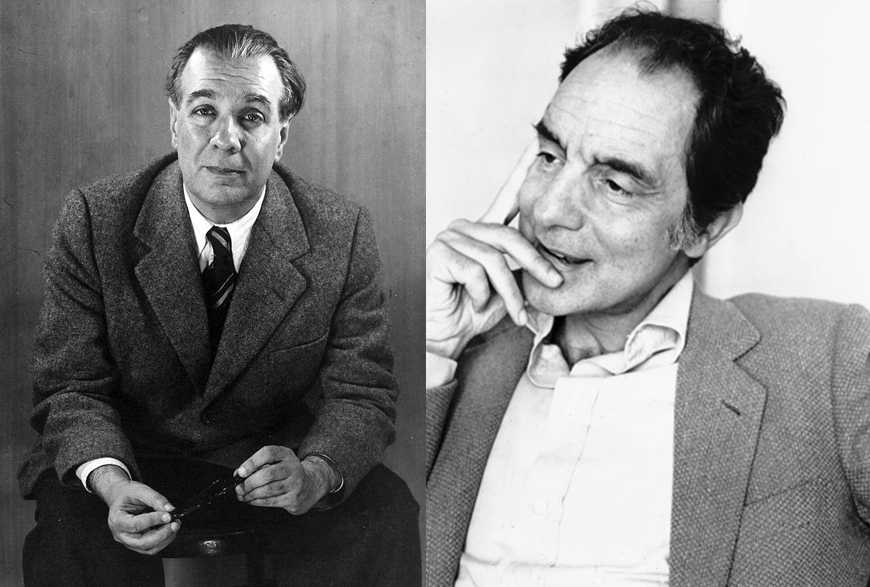
Why these two?
Jorge Luis Borges and Italo Calvino are united by a shared fascination with the nature of fiction itself. Both writers move beyond storytelling as mere representation, instead treating narrative as a space in which reality can be questioned, reshaped, and multiplied. Their works invite the reader not simply to follow a story, but to reflect on how stories are constructed, and what it means to construct them. While Borges often approaches these questions through philosophical abstraction and conceptual precision, Calvino engages them with a lighter, more playful inventiveness. Yet both are concerned with the same underlying problem: the relationship between imagination and reality, and the extent to which narrative defines the world we perceive.
Time, place, movement
Jorge Luis Borges (1899–1986) wrote primarily in Argentina during the early to mid-twentieth century. Associated with modernism and later with postmodernism, Borges developed a highly distinctive style that blends philosophy, literature, and metafiction. His work often draws on a wide range of intellectual traditions, from classical literature to contemporary philosophy, creating texts that feel at once erudite and deceptively concise.
Italo Calvino (1923–1985), writing in Italy in the post-war period, is more explicitly aligned with postmodernism. His early work reflects elements of realism and political engagement, but he later turned towards more experimental forms, exploring combinatory structures, metafiction, and the possibilities of narrative itself. Both writers emerge from periods of cultural and intellectual transformation, and both respond by questioning inherited forms of storytelling. In their work, narrative becomes not a stable medium, but an object of inquiry.
Core themes
A central concern for both Borges and Calvino is the nature of fiction. Borges frequently constructs stories that resemble philosophical puzzles, in which fictional worlds mirror, distort, or multiply reality. His famous images (labyrinths, infinite libraries, and recursive texts) serve as metaphors for the complexity and instability of knowledge.
Calvino, while equally concerned with fiction, approaches it through play and variation. In works such as If on a winter’s night a traveller, he foregrounds the act of reading itself, drawing attention to the relationship between text and reader. Narrative becomes interactive, fragmented, self-aware.
Both writers are also deeply engaged with infinity and limitation. Borges explores the idea of infinite structures (endless libraries, boundless texts) that overwhelm comprehension. Calvino, by contrast, often imposes constraints, using formal limitations to generate narrative possibilities.
Finally, both address the instability of reality. In Borges, reality often dissolves into abstraction, becoming indistinguishable from fiction. In Calvino, it is reshaped and refracted, presented through shifting perspectives and narrative frames.
Style comparison
Borges’s style is characterised by brevity, precision, and conceptual density. His stories are often short, yet they contain ideas that extend far beyond their length. He writes with an almost scholarly tone, frequently presenting fictional texts, authors, or references as though they were real, blurring the boundary between invention and citation.
Calvino’s style, by contrast, is more expansive and varied. While equally intelligent and controlled, his writing often carries a sense of lightness and clarity. He moves fluidly between narrative voices and structures, experimenting with form while maintaining readability and elegance.
Where Borges compresses narrative into tightly constructed intellectual forms, Calvino allows it to unfold through variation and pattern. Borges’s work can feel like a single, perfectly formed idea; Calvino’s like a system of interconnected possibilities.
Key works
Borges’s most influential works include Ficciones and The Aleph, collections of short stories that exemplify his approach to metafiction and philosophical narrative. Stories such as “The Library of Babel” and “The Garden of Forking Paths” explore themes of infinity, time, and the multiplicity of reality.
In “The Library of Babel,” the universe is imagined as an infinite library containing all possible books, a concept that simultaneously fascinates and destabilises. It is a powerful illustration of Borges’s ability to transform abstract ideas into vivid, enduring images.
Calvino’s major works include Invisible Cities, If on a winter’s night a traveller, and Cosmicomics. These texts demonstrate his versatility and his interest in narrative experimentation.If on a winter’s night a traveller, in particular, exemplifies his playful approach to fiction. Structured as a series of interrupted narratives, it foregrounds the act of reading, turning the reader into a participant in the construction of the text.
Legacy and influence
Borges’s influence on modern and postmodern literature is profound. His exploration of metafiction, intertextuality, and philosophical narrative has shaped countless writers and thinkers. Concepts such as the labyrinth and the infinite text have become central to discussions of literature and knowledge.
Calvino’s legacy lies in his ability to combine intellectual depth with imaginative play. His work has influenced postmodern narrative techniques, particularly in its use of structure, fragmentation, and reader engagement. He demonstrates that experimentation need not come at the expense of clarity or enjoyment.
Together, Borges and Calvino expand the possibilities of what literature can do. They challenge the assumption that narrative must reflect reality, instead presenting it as a tool for reimagining it.
Final reflections
What is most striking in Borges is the precision of his imagination. His stories do not simply tell narratives, but they construct ideas, reducing vast philosophical questions to concise and often unsettling forms.
Calvino, by contrast, approaches imagination as a field of play. He does not compress reality into singular images, but opens it out into patterns, variations, and possibilities.
Reading them together, the contrast becomes one of method as much as meaning. Borges seeks to distil the infinite into a single, defining structure; Calvino seeks to explore it through multiplicity and change.
Perhaps this is what defines their relationship. Borges reveals the conceptual limits of narrative, while Calvino explores its generative potential.
If Borges dissolves reality into infinite possibilities, then Calvino reshapes it into forms we can momentarily grasp.
Their significance endures in the way they give form to the tension between structure and boundlessness.
And somewhere between them lies the suggestion that narrative is not a mirror of reality, but one of its most intricate inventions.
Part of the series: Exploring the Literary Giants
→ View all entries in this series