

Part of the series: Exploring the Literary Giants, examining influential authors through paired comparisons of context, style, and enduring impact.
🔍 Adventure, exploration, and the imagination of the unknown.
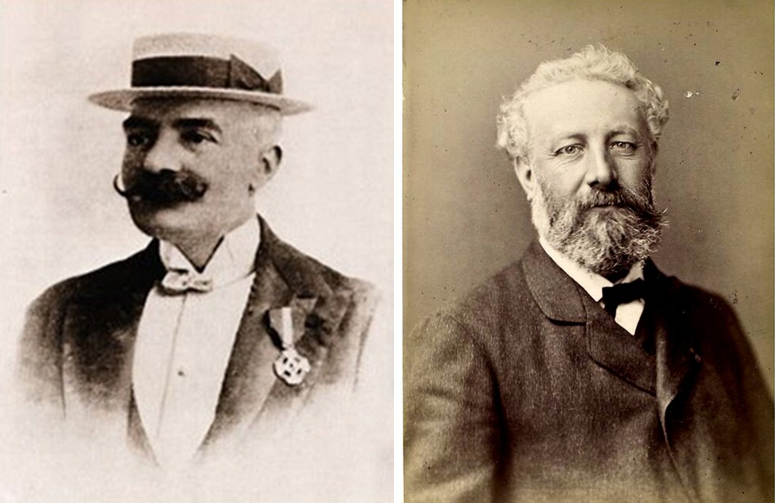
Why these two?
Emilio Salgari and Jules Verne belong to one of the great traditions of nineteenth-century literature: the literature of adventure, exploration, discovery, and the unknown. Both writers opened distant worlds to generations of readers, transforming geographical distance and technological possibility into sources of wonder.
At first glance, their approaches appear quite different. Verne is associated with scientific adventure and the possibilities offered by technological progress, while Salgari created worlds of pirates, rebels, explorers, warriors, and forbidden territories. Yet both shared a remarkable belief in the power of imagination to carry the reader beyond the boundaries of everyday experience.
Their literary relationship is also significant. Verne was the older writer, and his imaginative approach to science, exploration, and adventure formed part of the literary environment in which Salgari developed. Yet Salgari did not simply imitate him. He transformed the adventure novel into something more romantic, more character-driven, and often more concerned with freedom, loyalty, resistance, and human passion.
Both writers also possessed an extraordinary ability to make the unfamiliar feel real. Verne drew upon contemporary science and geography to imagine journeys that seemed impossible; Salgari constructed detailed worlds of distant lands that he himself had never visited.
Reading them together therefore allows us to explore a fascinating question: how can literature make the unknown feel as though it belongs to us?
Time, place, movement
Jules Verne (1828–1905) was born in Nantes, France, and wrote during a period of extraordinary scientific, industrial, and technological change. The nineteenth century witnessed the expansion of railways, steamships, telegraphy, industrial production, geographical exploration, and new scientific discoveries. Verne transformed this rapidly changing world into the imaginative foundation of his fiction.
His work is closely associated with the development of science fiction, although his novels also belong firmly to the traditions of adventure literature, travel writing, and the nineteenth-century novel. His Voyages extraordinaires brought together geography, science, technology, and adventure, allowing readers to travel across oceans, through the Earth’s interior, beneath the sea, and even into space.
Verne’s fascination with scientific progress was not simply a celebration of invention. His novels also ask questions about the consequences of human ambition and the relationship between technological power and responsibility. The extraordinary machines he imagined could liberate, explore, or destroy.
Emilio Carlo Giuseppe Maria Salgàri (1862–1911), writing in Italy several decades later, belonged to the same broad culture of nineteenth-century fascination with distant lands and adventure. His novels transported readers to Malaysia, India, Africa, the Caribbean, and other parts of the world, creating an enormous imaginative geography.
Yet Salgari’s relationship with these places was extraordinary. Unlike many travel writers, he had not personally visited the exotic locations that provided the settings for his novels. Instead, he conducted extensive research using books, maps, travel accounts, newspapers, geographical works, and other sources available to him. The Treccani encyclopaedia notes that he constructed an extensive working collection of geographical, scientific, zoological, botanical, and travel information, using this material to create his fictional worlds. (Treccani)
In other words, Salgari travelled primarily through books and imagination.
That is particularly remarkable when we remember the period in which he was writing. There was no Internet, television, Google Maps, documentary film, or instant access to photographs from distant parts of the world. Yet his descriptions were sufficiently vivid to convince generations of readers that he had personally experienced the places he described.
Both writers therefore transformed information into imagination. Verne extrapolated from the scientific knowledge of his time; Salgari transformed geographical and travel literature into adventure.
Core themes
Exploration lies at the heart of both writers’ work, but they understand exploration differently.
For Verne, exploration is often connected to knowledge. His protagonists travel because there is something to discover, measure, understand, or overcome. The unknown becomes an intellectual and scientific challenge.
Salgari’s explorers inhabit a more romantic world. His characters travel because they are pursuing freedom, revenge, love, justice, treasure, or adventure. The journey is as much a test of character as a discovery of geography.
Freedom is particularly important in Salgari’s fiction. Sandokan, his most famous creation, is presented not simply as a pirate but as a rebel fighting against colonial powers and defending native territories. In The Tigers of Mompracem, Sandokan and his followers oppose Dutch and British colonial power, while later novels continue his struggles against colonial domination.
This gives Salgari’s adventure fiction a political dimension that can be surprisingly contemporary. Sandokan is a figure of resistance: courageous, passionate, loyal, and unwilling to accept the loss of his homeland and freedom.
Love also plays an important role. Sandokan’s relationship with Lady Marianna Guillonk, the European woman known as the Pearl of Labuan, crosses the cultural and political boundaries established by the colonial world in which the story takes place. Their relationship adds another dimension to Salgari’s fiction, placing love across a divide that the surrounding society treats as significant.
Verne’s treatment of human relationships is generally less central than his fascination with exploration and scientific possibility. His major concern is often the relationship between human beings and the physical world: the sea, the Earth, the atmosphere, space, and the technological environment created by human ingenuity.
Science and technology therefore become central themes in Verne. His imaginative extrapolations sometimes appear astonishingly prescient. From the Earth to the Moon, for example, imagined a journey to the Moon more than a century before the Apollo programme, while Twenty Thousand Leagues Under the Seas presented a technologically advanced submarine long before such a vessel became a practical reality. Some of Verne’s other imagined technologies, including forms of video communication and electronically transmitted news, also bear striking similarities to technologies that emerged decades later.
Yet Verne was not simply predicting the future. His remarkable foresight came from his ability to observe contemporary scientific developments and extrapolate from them imaginatively.
Both writers ultimately share a belief in the transformative power of curiosity. The world is not a closed space. There are places to explore, boundaries to cross, and possibilities that have not yet been imagined.
Style comparison
The stylistic differences between Salgari and Verne reflect their different conceptions of adventure.
Verne’s writing frequently combines narrative with scientific and geographical information. His novels can pause the action to explain a technological process, geographical phenomenon, scientific principle, or historical detail. These passages are not merely decorative: knowledge itself is part of the adventure.
His prose therefore often creates a tension between factual information and imaginative speculation. The reader is invited to believe that the extraordinary journey might actually be possible because it is surrounded by apparently reliable scientific detail.
Salgari’s method is more immediate and dramatic. His novels are driven by action, danger, character, emotion, and vivid descriptions of unfamiliar landscapes. His exotic vocabulary and detailed descriptions create the sensation of entering another world.
This is particularly impressive given that Salgari constructed these environments without first-hand experience. His research was extensive enough to allow him to create the impression of geographical authority, transforming information gathered from books and travel accounts into scenes of adventure.
Where Verne often makes knowledge itself part of the narrative, Salgari makes the experience of adventure the centre of the narrative.
Verne asks the reader to wonder: What might human beings discover?
Salgari asks: What kind of person will dare to enter the unknown?
One is driven by scientific imagination; the other by romantic imagination.
Yet both understand that a convincing imaginary world depends upon detail. The reader must believe in the world before being able to lose themselves within it.
Key works
Jules Verne’s most influential works include Voyage au centre de la terre (1863, expanded 1867; Journey to the Centre of the Earth), Vingt mille lieues sous les mers (1870; Twenty Thousand Leagues Under the Seas), Le Tour du monde en quatre-vingts jours 1873; Around the World in Eighty Days), De la terre à la lune (1865; From the Earth to the Moon), L’Île mystérieuse (1874-75; The Mysterious Island), and Michel Strogoff (1876; Michael Strogoff: The Courier of the Czar).
Twenty Thousand Leagues Under the Seas is perhaps the clearest expression of Verne’s fascination with technological possibility. Captain Nemo and the Nautilus allow the reader to explore the oceans from an entirely new perspective, while the novel combines adventure with scientific curiosity.
From the Earth to the Moon demonstrates his extraordinary ability to transform contemporary scientific speculation into an apparently plausible adventure. The novel’s lunar journey anticipates elements of the later space age, even though its scientific assumptions were necessarily limited by nineteenth-century knowledge.
Around the World in Eighty Days, meanwhile, demonstrates another aspect of Verne’s imagination. The novel transforms the technological developments of the modern world—railways, steamships, and global transportation—into a race against time.
Michel Strogoff offers a different kind of adventure. Set against the vastness of the Russian Empire, it follows a courier entrusted with an urgent mission across an enormous and dangerous landscape. Courage, endurance, loyalty, and duty take precedence over scientific invention, bringing Verne closer to the traditional adventure novel.
Salgari’s enormous body of work includes the Sandokan novels, the Black Corsair series, and numerous other adventure stories set across different parts of the world.
Le tigri di Mompracem (1883; The Tigers of Mompracem) introduced readers to Sandokan, the Tiger of Malaysia, and his struggle against colonial power. The novel established the central relationship between Sandokan, his loyal companion Yanez, and Lady Marianna, while creating the fictional world of Mompracem as a symbol of freedom and resistance.
Other important works include I pirati della Malesia (1896; The Pirates of Malaysia), I misteri della jungla near (1895; The Mystery of the Black Jungle), Il Corsaro Nero (1898; The Black Corsair), and La regina dei Caraibi (1901; The Queen of the Caribbean).
Where Verne created an interconnected imaginative universe of scientific exploration, Salgari created an equally expansive world of adventure, populated by memorable heroes whose struggles revolve around freedom, loyalty, love, and resistance.
Legacy and influence
Jules Verne’s influence on science fiction and popular literature is enormous. He helped establish a literary tradition in which scientific knowledge and technological speculation could become the foundation for imaginative storytelling.
His influence extends beyond literature. Generations of scientists, engineers, explorers, and astronauts have acknowledged the imaginative importance of his work. His novels helped popularise the idea that scientific progress could itself become an adventure.
His legacy also lies in his ability to make scientific ideas accessible to readers. He demonstrated that information need not be separated from entertainment: curiosity could be the driving force of a story.
Salgari’s influence is particularly profound in Italy and throughout the Spanish-speaking world, where his novels have been read by generations of young readers. Sandokan became far more than a fictional character. He entered popular culture through adaptations in film and television, including the hugely popular Italian television series Sandokan.
For an Italian child encountering Salgari, the world of Sandokan could therefore exist simultaneously in books and on screen.
His legacy also deserves reconsideration beyond the label of children’s adventure fiction. His stories engage with colonialism, resistance, cultural difference, loyalty, freedom, and the conflict between powerful empires and people defending their own lands.
Both writers also demonstrate something fundamental about literature: you do not necessarily have to experience a place physically in order to make readers experience it imaginatively.
Verne travelled through science.
Salgari travelled through books.
Both took their readers with them.
Final reflections
I first encountered both Salgari and Verne as a child, at an age when adventure literature could still make the world seem limitless. But their worlds did not remain confined to books. They also arrived in our homes through television.
In 1975, when I was eight years old, I watched the television series Michel Strogoff, directed by Jean-Pierre Decourt. The following year came Sandokan, Sergio Sollima’s celebrated adaptation of Salgari’s novels. We watched and loved both series, and their heroes became part of the shared imagination of an entire generation of Italian children.
Sandokan, in particular, fascinated me. I loved the idea of a hero who stood against the powers that sought to dominate others, defending native peoples and fighting for freedom. He was courageous, passionate, loyal, and uncompromising in his sense of justice. To me as a young reader, he was a figure of integrity and resistance.
There is also a curious personal circle in my relationship with Sandokan. I first encountered him through Sergio Sollima’s television series, with Kabir Bedi’s charismatic portrayal making the character unforgettable. Many years later, I had the opportunity to meet Bedi in person. I remember him as a remarkably charming and elegant man, with the presence of an accomplished artist.
There was something rather wonderful about meeting, as an adult, the man whose face had been so closely associated with one of the heroes of my childhood.
Looking back now, I find something remarkably contemporary about Salgari’s work. He was writing at a time when European colonialism was at its height, yet his most famous hero is a man fighting against colonial power and defending his homeland. His love for Marianna also crosses cultural and racial boundaries that were anything but insignificant in the world in which the story is set.
And then there is Salgari himself. He created detailed worlds in Malaysia, India, Africa, and elsewhere without having travelled to most of the places he described. In an age without television, the Internet, or instant access to images from distant countries, his ability to construct such convincing worlds through research and imagination is extraordinary.
Verne offered me a different kind of liberation. His books suggested that there were still oceans to cross, depths to explore, technologies to imagine, and boundaries to challenge. What seemed fantastical to a nineteenth-century reader has, in some cases, come remarkably close to the world we inhabit today.
Reading them again as an adult, I see something I could not have fully appreciated as a child. Their adventures are not simply escapes from reality. They are ways of asking what lies beyond the boundaries imposed upon us—by geography, technology, political power, social conventions, or even our own imagination.
Verne imagined what human beings might achieve by pushing beyond the limits of contemporary science. Salgari imagined what might happen when people refuse to accept the limits imposed by political power.
If Verne opened the door to the future, Salgari opened the door to worlds of freedom and resistance.
Both writers understood that literature could take us places before we had any possibility of going there ourselves.
Perhaps that is why their books remain so powerful. They did not simply entertain young readers. They taught us to imagine a world beyond the boundaries we could see.
And somewhere between them lies one of the oldest and most enduring powers of literature: before we can explore the unknown, we must first learn to imagine it.
Part of the series: Exploring the Literary Giants
→ View all entries in this series