

Part of the series: Exploring the Literary Giants, examining influential authors through paired comparisons of context, style, and enduring impact.
🔍 The grotesque, satire, and the masks of society.
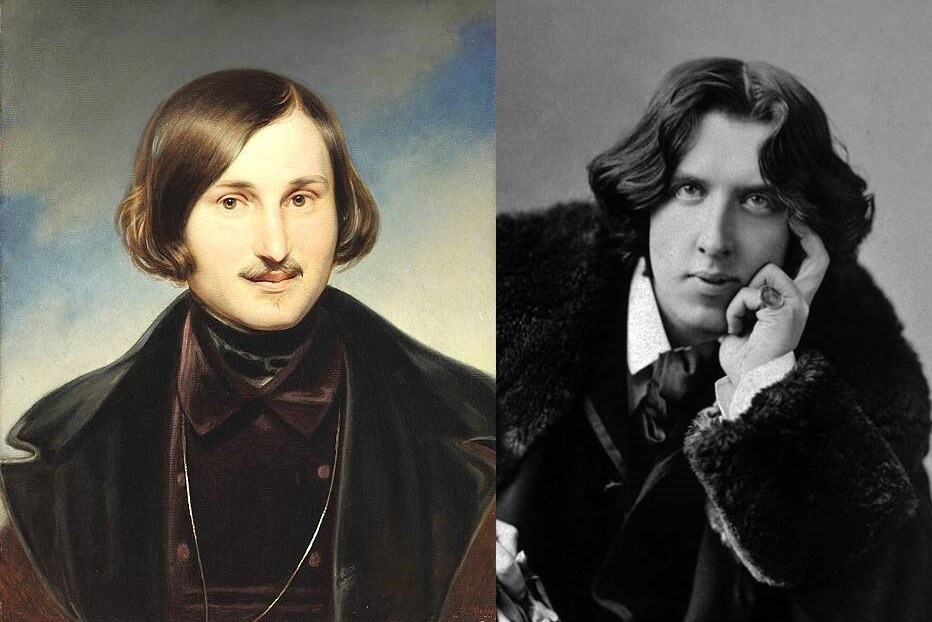
Why these two?
Nikolai Gogol (1809–1852) and Oscar Wilde (1854–1900) came from different worlds, wrote in different languages and approached comedy from opposite directions. Gogol found absurdity in the machinery of Russian society: its bureaucracy, its rigid hierarchies and its obsession with rank. Wilde turned his attention to Victorian respectability, where a polished appearance could conceal almost anything, provided one had the right manners and a respectable address.
Yet both understood something unsettling about human behaviour. People do not always become ridiculous because they lack intelligence. Sometimes, they become ridiculous because they care too much about how others see them.
Gogol’s comedy begins with the mundane and tilts towards the terrifying grotesque, leaving a chill in the throat. His characters chase status, money, recognition and the smallest scraps of authority. Wilde’s comedy glitters with effortless wit, exposing social hypocrisy while making the audience smile at the indictment. His characters chase admiration, pleasure and social approval. One gives us bureaucrats who mistake their positions for their identities; the other gives us fashionable people who treat identity itself as a performance.
They leave us with the uncomfortable realisation that the roles society expects us to perform can easily empty us of our humanity. Their comedy makes us laugh, then the laughter catches in the throat.
Time, place, movement
Gogol (Николай Васильевич Яновский) was born in 1809 in what is now Ukraine, then part of the Russian Empire. He moved to St Petersburg, hoping to establish himself as a writer, and became one of the sharpest observers of imperial Russian society. His fiction drew on folklore, everyday life and the absurdities of officialdom, gradually moving towards the uncanny. In his work, the ordinary can turn strange without warning. A nose can acquire a higher social rank than its owner. A dead soul can become an item of commercial interest. A modest clerk can be destroyed by the loss of a coat.
Wilde, born in Dublin in 1854, belonged to a different century and a different social order. A leading figure in the Aesthetic movement, he championed art, beauty and the cultivation of style. His public persona was itself a work of art: witty, theatrical and carefully composed. But behind the glitter lay a formidable critic of conventional morality, social hypocrisy and the rules by which respectable society decided who deserved admiration.
Gogol wrote under an autocratic regime in which official rank and bureaucratic power shaped daily life. Wilde wrote in a society place great importance on moral appearances, whilst often tolerating private contradictions. Neither writer needed to invent absurdity, but they had plenty to observe.
Core themes
The ridiculous rules of social status and the desperate acts people use to keep up appearances emerge as central targets of satire in their works. Gogol’s characters are completely crushed by hierarchy. They are driven mad by the desire to climb the social ladder, or utterly terrified of falling down it. Wilde’s characters take a different route, using charm, polished manners and deception to manipulate their standing. In each case, a person’s social position completely replaces their actual moral character. It shows just how easily human beings trade their true selves for social approval.
To expose this emptiness, each author distorted reality in his own way. Gogol used the grotesque, creating uncomfortable, nightmarish stories where he exaggerated physical features and institutions until their absurdity became obvious. A stolen coat or a missing nose is enough to derail his entire social order. Wilde did the exact opposite. He used beautiful, glittering exteriors to hide a decaying interior, forcing the reader to look at what happens when a lovely surface conceals an ugly truth.
These social systems force people to act out a role at the expense of genuine morality. In Gogol’s world, the mindless routine of government bureaucracy strips away a person’s humanity, reducing men to mere paperwork and titles. In Wilde’s world, the rigid rules of Victorian politeness destroy true ethics, turning virtue into nothing more than a good public reputation. Both systems survive for one simple reason: people keep playing their assigned parts, even when those parts have become ridiculous and completely absurd.
Style comparison
Gogol’s comedy frequently begins with the mundane and ends somewhere near madness. His prose can be digressive, oddly intimate and deliberately disproportionate. A trivial object acquires enormous significance; an insignificant official behaves as though he carries the weight of the entire empire on his shoulders. The gap between a character’s self-image and the reader’s perception of them is often a source of humour.
Moreover, Gogol’s work also slips between realism and fantasy with remarkable ease. The supernatural does not necessarily arrive as a dramatic interruption. It may simply weave itself into the everyday details of urban life, leaving the reader to decide whether the world has suddenly become strange or was always strange to begin with.
Wilde’s chief weapon is dialogue. His plays move through polished exchanges, reversals and sharp paradoxes, with every character determined to have the final word. This wit serves as a tool to expose the absurd logic beneath accepted ideas, rather than functioning as decorative excess. A sentence can begin as a compliment and end as an indictment.
The emotional texture of their satire is equally distinct. Gogol’s comedy leaves a distinct chill behind because the characters experience real suffering within a cold, uncaring institutional world. By contrast, Wilde’s stage is brighter, more elegant and more knowingly theatrical. Yet that sparkle does not make his criticism harmless, as the laughter bites just as sharply. The methods differ, but the target remains the same: a society that prizes appearance over authenticity.
Key works
Gogol’s most famous works include The Government Inspector (Ревизо́р; 1836), The Nose (Нос; 1836), The Overcoat (Шине́ль; 1842), and his epic masterpiece Dead Souls (Мёртвые ду́ши; 1842). Together, these stories deliver a brutal takedown of Russian institutional life and human vanity.
The Government Inspector is a brilliant comedy about bureaucratic panic. The story kicks off when corrupt town officials mistake a penniless, travelling clerk for a secret government inspector. Their sheer terror drives them to offer bribes, confess to their own crimes, and spin elaborate lies. Their own paranoia and obsession with authority completely ruins them, without an outside detective ever lifting a finger. At the very end, the famous mute scene, where the characters freeze like statues upon learning the real inspector has just arrived, instantly turns a hilarious farce into a terrifying moment of reckoning.
The Nose is a brilliant piece of surreal, satirical comedy. Major Kovalyov, a vain government clerk in St Petersburg, wakes up one morning to find that his nose has completely vanished from his face. To his total horror, he later spots his own nose strolling through the city, dressed up in the uniform of a State Councillor, a civil service rank higher than his own. When Kovalyov tries to confront the runaway organ, the nose snubs him, saying a common clerk has no business talking to a high-ranking official. Through this absurd setup, Gogol exposes a society so obsessed with bureaucracy and rank that a severed body part can get more respect and authority than the human being it belonged to.
The Overcoat is Gogol’s most moving story about human suffering in a cold, uncaring bureaucracy. Akaky Akakievich, a poor copying clerk, is completely ignored by society until he finally saves up enough money to buy a new overcoat. The coat briefly wins him some warmth and social acceptance. However, when it is stolen on his way home, his desperate pleas to a high-ranking official are met with cold, administrative fury. Akaky dies of a fever brought on by sheer despair. In a supernatural twist, his ghost begins to haunt St Petersburg, stripping overcoats off wealthy officials. Gogol turns this humble clerk’s tragedy into an eerie ghost story that condemns a world where rank matters more than human life.
In Dead Souls, Gogol takes a much wider look at the moral decay of the entire country. The main character, Chichikov, travels through the Russian countryside buying “dead souls.” These are deceased serfs who are still listed on the official tax registers. He plans to use this fake list of property as collateral for a bank loan. These bizarre deals work perfectly because imperial society has already reduced human beings to legal entries, paperwork, and financial assets. Through Chichikov’s meetings with a series of bizarre, greedy landowners, Gogol paints a sprawling, satirical picture of a society that has lost its soul to administrative nonsense.
Oscar Wilde’s main literary legacy rests on his Gothic novel The Picture of Dorian Gray (1890), followed by his famous West End society plays, including Lady Windermere’s Fan (1892), A Woman of No Importance (1893), An Ideal Husband (1895), and his masterpiece, The Importance of Being Earnest (1895).
In The Picture of Dorian Gray, Wilde looks at the dangers of separating beauty from moral responsibility. The young, handsome Dorian Gray wishes that his portrait would age in his place so he can stay young forever. Under the influence of Lord Henry Wotton, Dorian plunges into a life of cruelty and selfishness. While his actual body stays completely perfect, the hidden portrait transforms into a hideous, decaying monster that records his sins. Wilde uses this creepy double life to mirror Victorian society, showing the awful mental cost of trading your conscience for a good appearance.
Lady Windermere’s Fan and A Woman of No Importance form a pair of sharp comedies about reputation and social double standards. In Lady Windermere’s Fan, the mysterious Mrs Erlynne gives up her own chance at social acceptance to save her daughter from a ruinous mistake. This move shows how people labelled “disreputable” are often much kinder than the self-righteous elite. A Woman of No Importance sharpens this point by attacking the hypocrisy of sexual double standards. It contrasts the honesty of Rachel Arbuthnot (a woman cast out by society for having a child out of wedlock) against the polished, predatory charm of Lord Illingworth, an aristocrat protected entirely by his rank.
An Ideal Husband takes this critique into politics, blackmail, and corruption. Sir Robert Chiltern, a highly respected and seemingly perfect politician, faces total ruin when a blackmailer threatens to reveal that his wealth started with a corrupt political deal. Through Sir Robert’s crisis and the help of his friend Lord Goring, Wilde shows that society’s demand for perfection in public figures forces good people into dangerous lies. He argues that true morality comes from forgiveness, not rigid judgement.
The Importance of Being Earnest is Wilde’s funniest and most famous work. Jack Worthing and Algernon Moncrieff invent fake alter egos, “Ernest” and “Bunbury”, to escape their boring social duties and chase romance. Through brilliant jokes, mistaken identities, and the terrifying Lady Bracknell, Wilde turns Victorian courtship and family lineages into a ridiculous farce. Underneath the effortless wit lies a basic truth: in a world where marriage is just a business deal, lying becomes the most sensible option.
Legacy and influence
Gogol and Wilde permanently altered the landscape of literary satire and narrative fiction. Nikolai Gogol fundamentally shaped the Russian literary tradition, opening up brand-new possibilities for writers like Fyodor Dostoevsky, Franz Kafka, and Mikhail Bulgakov. His unique blend of social observation, psychological unease, and the grotesque proved that fiction could seamlessly mix reality with the fantastic. Most notably, The Nose served as a direct conceptual blueprint for Kafka’s The Metamorphosis. Just as Major Kovalyov wakes up to find his nose missing and acting as a high-ranking official, Gregor Samsa wakes up transformed into a giant insect, with his immediate anxiety centred around pleasing his employer. Both authors used an unexplained, absurd transformation to expose how modern systems reduce human identity to mere economic utility. Today, this bureaucratic nightmare feels remarkably familiar. We still live in a world where paperwork determines a person’s fate, yet no individual seems willing to accept any real responsibility.
Wilde’s influence reaches far beyond the Victorian stage. His comedies remain popular because their targets have not disappeared. Reputation still matters. Hypocrisy still flourishes. People still use wit, charm and carefully managed appearances to evade uncomfortable truths. His writing also challenged the boundaries between art and morality, insisting that aesthetic beauty and conventional respectability were not the same thing.
Neither writer offers an easy escape from the society he criticises. Gogol’s absurdities can be terrifying precisely because they emerge from recognisable institutions. Wilde’s elegant deceptions work because his audience understands the conventions being mocked. Their worlds are exaggerated, but their human weaknesses are not.
Final reflections
Gogol and Wilde reveal the strange theatre of social life, where people become trapped by the roles they perform. The official clings to his rank, as he fears losing his place in the hierarchy. The fashionable gentleman clings to his reputation as he fears losing the admiration of the audience.
Their methods differ. Gogol bends reality until it reveals its own absurdity. Wilde uses beauty, wit and theatrical artifice to expose the absurdity hidden beneath respectable appearances. Yet both understand that society’s rules can become ridiculous when people mistake them for moral truth.
And somewhere between the bleak, cold streets of Gogol’s St Petersburg and the bright, scented drawing rooms of Wilde’s London, the masks of status and respectability inevitably begin to slip. What remains underneath is not always pretty, but through the laughter and the cold realisations they inspire, it is unmistakably and profoundly human.
Part of the series: Exploring the Literary Giants
→ View all entries in this series