

Part of the series: Exploring the Literary Giants, examining influential authors through paired comparisons of context, style, and enduring impact.
🔍 The Romantic hero and the struggle for freedom.
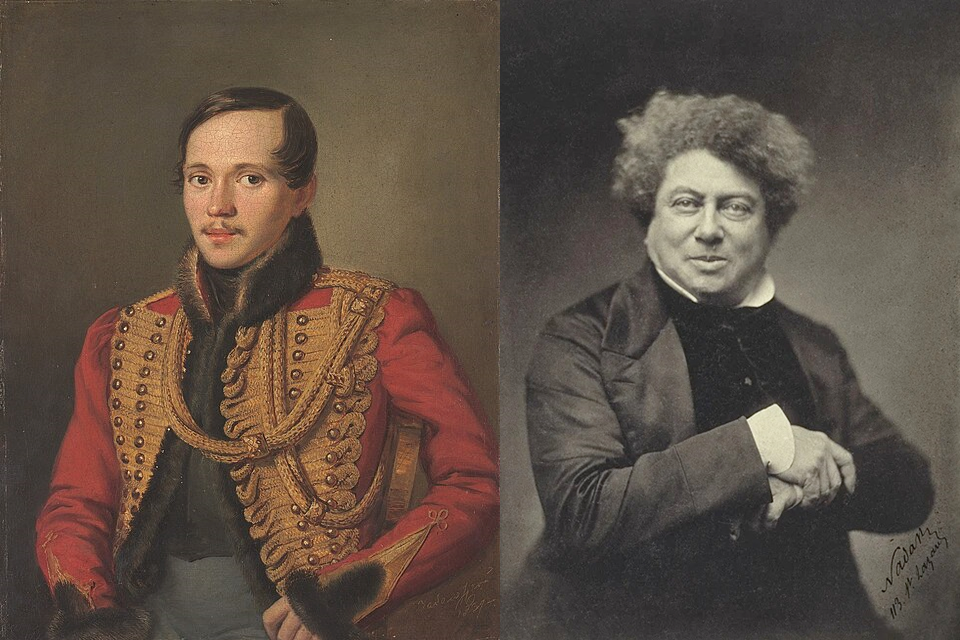
Public Domain.
Why these two?
Mikhail Lermontov and Alexandre Dumas belong to the great tradition of nineteenth-century Romanticism, yet they represent remarkably different expressions of it. Both writers were fascinated by the individual who refuses to fit comfortably within the world around him, and both created characters whose lives are shaped by freedom, rebellion, passion, honour, and conflict.
Lermontov’s Romanticism is introspective and psychologically intense. His characters are often restless outsiders, alienated from society and from themselves. Dumas, by contrast, transforms Romanticism into action: his heroes travel, fight, love, form friendships, challenge authority, and pursue justice or revenge.
The contrast is particularly revealing. Lermontov turns the Romantic hero inward, exploring the consequences of freedom without purpose. Dumas turns him outward, creating characters who respond to an imperfect world through action and adventure.
Both writers therefore ask variations of the same question: what does it mean to be free in a world that seeks to impose its own rules upon the individual?
Time, place, movement
Mikhail Yuryevich Lermontov (Михаи́л Ю́рьевич Ле́рмонтов, 1814–1841) was one of the most important figures of Russian Romanticism. He wrote during a period of political repression, intellectual ferment, and profound tension between the individual and the Russian imperial state.
Born into the Russian aristocracy, Lermontov was deeply influenced by the Romantic tradition, particularly by the figure of the Byronic hero: charismatic, intelligent, emotionally restless, and alienated from conventional society. His writing reflects this fascination with individuals who possess extraordinary qualities but struggle to find meaning or belonging.
Lermontov’s career was remarkably brief. His poetry established his reputation, while A Hero of Our Time, published in 1840, became one of the defining works of Russian Romantic prose. The novel combines adventure, psychological observation, and philosophical reflection, creating a protagonist whose contradictions anticipate later developments in psychological fiction.
Alexandre Dumas (1802–1870), writing in France during the same broad Romantic period, developed a very different literary world. The son of General Thomas-Alexandre Dumas, he grew up in the aftermath of the French Revolution and the Napoleonic era, and history, political upheaval, and social transformation became central elements of his fiction.
Dumas is particularly associated with the historical novel and adventure fiction. His works frequently place fictional characters against real historical events, allowing personal stories of friendship, betrayal, love, revenge, and ambition to unfold against a much larger political landscape.
Where Lermontov focuses increasingly on the psychological consequences of Romantic individualism, Dumas turns Romanticism into dramatic narrative. His characters move through history rather than simply contemplating their place within it.
There is also a poignant connection between Lermontov and Pushkin, to whom Lermontov was regarded as a literary successor. Both became defining figures of Russian Romanticism, and both died remarkably young as a result of duels. Pushkin was killed in 1837 and Lermontov in 1841. Both were only thirty-seven years old. Their deaths contributed to the mythology surrounding Russian Romanticism: brilliant writers whose lives were cut short at the very moment when their literary influence was becoming profound.
Core themes
Freedom is central to both Lermontov and Dumas, but their understanding of it differs considerably.
For Lermontov, freedom can become a burden. His characters possess the ability to act according to their own desires, yet this freedom does not necessarily bring happiness or meaning. Instead, it can produce restlessness, boredom, alienation, and self-destruction.
This tension is embodied most powerfully in Pechorin, the protagonist of A Hero of Our Time. He is intelligent, perceptive, courageous, and capable of understanding both himself and others, yet he repeatedly uses these qualities destructively. His freedom becomes almost indistinguishable from emptiness.
Dumas presents a much more optimistic version of individual freedom. His heroes face restrictions imposed by political power, social hierarchy, betrayal, or circumstance, but they respond through action.
D’Artagnan in The Three Musketeers is ambitious, impulsive, and sometimes reckless, yet his friendships with Athos, Porthos, and Aramis give his freedom direction. Loyalty becomes a form of moral identity.
Edmond Dantès in The Count of Monte Cristo offers another version of the Romantic outsider. Wrongfully imprisoned, stripped of his identity and separated from the life he should have lived, he emerges transformed and devotes himself to revenge. His story raises more troubling questions about justice, power, and the consequences of assuming the role of judge.
The two authors are therefore fascinated by individuals who stand outside ordinary social structures. Yet Lermontov asks what happens when such an individual cannot find a meaningful relationship with the world, while Dumas asks what he might accomplish by challenging that world.
Honour and loyalty are also central to Dumas. His characters are often defined by the bonds they form with others. Far from being merely sentimental, friendship is a source of strength, identity, and moral obligation.
Lermontov’s characters, by contrast, are frequently isolated even when surrounded by other people. Pechorin is capable of intimacy but repeatedly destroys the possibility of genuine connection.
Love follows a similar pattern. In Dumas, love can motivate action, loyalty, sacrifice, betrayal, and revenge. In Lermontov, love often becomes another arena in which emotional detachment and destructive behaviour are exposed.
Ultimately, both writers explore the contradiction at the heart of Romantic individualism: the desire to be completely free while simultaneously longing for meaning, recognition, and human connection.
Style comparison
The stylistic contrast between Lermontov and Dumas is striking.
Lermontov’s prose is relatively concise, controlled, and psychologically focused. A Hero of Our Time is constructed from several interconnected narratives and perspectives, gradually revealing Pechorin through the observations of others before allowing the reader direct access to his own thoughts.
This fragmented structure is important. Pechorin cannot simply be explained by a single narrator. He is contradictory, and the reader is forced to assemble an understanding of him from different perspectives.
Lermontov also combines Romantic imagery with a growing psychological realism. The landscapes of the Caucasus are vivid and dramatic, but they are frequently reflected through the emotional states of the characters who inhabit them.
Dumas’s prose is far more expansive and theatrical. His novels are driven by action, dialogue, suspense, coincidence, and dramatic reversals. Chapters frequently end at moments of heightened tension, encouraging the reader to continue.
His characters are larger than life, and his narratives embrace the pleasures of storytelling. Sword fights, disguises, escapes, secret identities, political conspiracies, imprisonment, revenge, and unexpected revelations are all part of his literary vocabulary.
This is not to suggest that Dumas lacks psychological depth. Rather, he communicates character through action. We discover who his heroes are by watching what they do when confronted with danger, betrayal, or injustice.
Lermontov, by contrast, frequently asks us to examine why a character behaves as he does.
Where Dumas makes the reader see the story unfolding, Lermontov makes the reader interpret the person at its centre.
That distinction helps explain why Dumas’s novels were so visual to me as a child. His narrative energy almost seems to project the action beyond the page, allowing the reader to enter the world of the story.
Lermontov’s power lies elsewhere. His characters remain in the mind long after the action has ended because the questions they raise about identity, freedom, and human motivation remain unresolved.
Key works
Lermontov’s poetry includes some of the most celebrated works of Russian Romanticism, while A Hero of Our Time (Герой нашего времени; 1840) remains his best-known prose work.
The novel centres on Grigory Pechorin, a complex and deeply contradictory young officer stationed in the Caucasus. Through a series of interconnected episodes, the reader encounters a man who is intelligent enough to understand the consequences of his actions but repeatedly incapable of resisting destructive impulses.
Pechorin has often been interpreted as a continuation of the Romantic and Byronic hero, yet Lermontov gives the figure a distinctly Russian and psychologically complex form.
The novel’s fragmented structure is equally significant. Different narrators and perspectives gradually construct Pechorin’s character, while his own journal provides a more intimate and disturbing account of his thoughts.
Dumas’s enormous literary output includes The Three Musketeers (Les Trois Mousquetaires; 1844), Twenty Years After (Vingt ans après; 1845), The Vicomte de Bragelonne (Le Vicomte de Bragelonne; 1848), The Count of Monte Cristo (Le Comte de Monte-Cristo; 1844-1846), Queen Margot (La Reine Margot; 1845), and many other novels.
The Three Musketeers remains one of the great adventure novels of world literature. D’Artagnan’s arrival in Paris and his friendship with Athos, Porthos, and Aramis create a narrative driven by loyalty, courage, political intrigue, and adventure.
The Count of Monte Cristo explores a darker form of Romantic individualism. Edmond Dantès is transformed by injustice and imprisonment, and his subsequent quest for revenge raises profound questions about whether personal vengeance can ever become genuine justice.
Queen Margot demonstrates another dimension of Dumas’s historical fiction. Set during the religious and political conflicts of sixteenth-century France, the novel combines historical figures and events with romance, intrigue, violence, and betrayal. Dumas transforms a turbulent period of French history into a richly dramatic narrative, once again placing individual lives within the larger forces of political and social upheaval.
Where Lermontov compresses the Romantic hero into a psychological study, Dumas expands the Romantic imagination across enormous narrative landscapes.
Legacy and influence
Lermontov’s influence on Russian literature is profound despite the extraordinary brevity of his life. His poetry helped shape Russian Romanticism, while A Hero of Our Time anticipated important developments in psychological and realist fiction.
Pechorin became an influential model of the alienated protagonist: intelligent, self-aware, dissatisfied, and unable to translate his abilities into a meaningful life.
Lermontov’s influence also lies in the tension he created between Romantic idealism and psychological realism. His characters inhabit a world of dramatic landscapes and intense emotions, yet their motivations are often unsettlingly recognisable.
Dumas’s influence has been equally extensive, particularly on popular literature and the historical adventure novel. His works have been translated, adapted for stage and screen, and repeatedly reimagined across generations.
Characters such as d’Artagnan and Edmond Dantès have become part of the shared cultural imagination, existing beyond the pages of the novels in which they first appeared.
Dumas also demonstrated the extraordinary possibilities of the serialised novel. His ability to combine historical events with suspense, adventure, and memorable characters helped establish narrative techniques that continue to influence popular fiction.
Together, Lermontov and Dumas demonstrate two very different ways in which Romantic literature can centre the individual.
Lermontov examines the individual who cannot find a place in society.
Dumas celebrates the individual who refuses to accept the place society has assigned to him.
Final reflections
Dumas and Lermontov both hold a distinctly personal place in my life, albeit for very different reasons.
Lermontov entered my life later, as an adult, though in a sense he was the missing piece in a literary landscape I had known since childhood. I grew up reading Russian literature. My mother was an enthusiastic reader of Tolstoy and Dostoevsky, and our home library contained their major works, so Russian literature was already part of my intellectual and imaginative world from an early age.
I eventually discovered Lermontov while studying Russian language and literature at the University of Westminster in London between 1996 and 1998. A Hero of Our Time captivated me precisely because it offered something so different from the Russian literature I already knew. Pechorin was not simply a hero to admire or condemn. He was a profoundly contradictory human being, intelligent enough to understand himself and yet incapable of escaping his own destructive patterns.
A few years later, in 1999, I travelled to Russia, a country I had already come to love through its language and literature. By then, Lermontov belonged not only to my university studies but to a much larger personal relationship with Russian culture.
With Alexandre Dumas, by contrast, the connection reaches back to childhood. I read his novels when I was young, and The Three Musketeers captured my imagination completely. I would even fantasise about being one of the characters, stepping into that world of friendship, sword fights, danger, intrigue, and adventure.
Dumas’s novels were extraordinarily visual to me. As I read the words, they seemed to project images directly into my mind, turning the page into an alternate reality that I could almost inhabit. Rather than merely reading about d’Artagnan and the Musketeers, for a while, I was there with them.
Reading Lermontov and Dumas together, I am struck by how differently they approach the same Romantic impulse.
Dumas makes freedom exhilarating. His heroes seize opportunities, form alliances, cross borders, challenge authority, and fight their way through adversity.
Lermontov makes freedom troubling. Pechorin possesses extraordinary freedom but finds no purpose worthy of it. His ability to act becomes another source of emptiness.
Dumas made me want to live inside a novel.
Lermontov made me want to understand the person living inside it.
Perhaps that is what makes the pairing so compelling. Dumas turns the Romantic hero towards the world, while Lermontov turns him towards himself.
If Dumas asks what a courageous individual might achieve when confronted with an unjust world, Lermontov asks what happens when that individual discovers that the greatest obstacle may be within himself.
One offers the exhilaration of action, while the other exposes the loneliness beneath it.
And somewhere between them lies the enduring figure of the Romantic hero: restless, rebellious, imperfect, and unwilling to accept the world simply as it is.
Part of the series: Exploring the Literary Giants
→ View all entries in this series
You may also like:
- Emilio Salgari and Jules Verne → Read essay
Comment on “Exploring the Literary Giants: Mikhail Lermontov and Alexandre Dumas”