

Part of the series Exploring the Literary Giants, examining major writers through paired comparisons of context, style, and enduring impact.
🔍 Imagination, rebellion, and the subversive power of children’s literature.
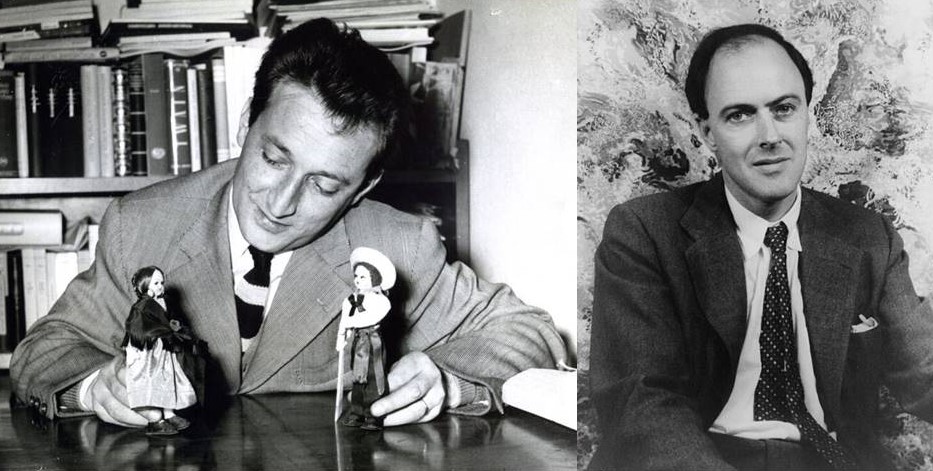
Why these two?
Children know when adults are being ridiculous. They notice unfairness, recognise hypocrisy and ask questions that grown-ups would rather avoid. Give them a little imagination, and the whole established order may begin to wobble.
Gianni Rodari (1920-1980) and Roald Dahl (1916-1990) understood this perfectly. Their stories are populated by impossible inventions, mischievous children, foolish adults and authority figures who are far less impressive than they imagine themselves to be. Neither writer believed that children’s literature had to be gentle, predictable or confined to teaching good manners.
Yet their approaches were strikingly different.
Rodari, the Italian writer, journalist and educator, treated imagination as a way of understanding and changing the world. Words could be taken apart, ideas combined in unexpected ways, and ordinary situations transformed into extraordinary adventures. Beneath the humour lay a belief in education, equality and independent thought.
Dahl, the British author, favoured a more biting style. His stories delight in grotesque characters, outrageous punishments and plot twists. Cruel headteachers, selfish adults and greedy businessmen discover that children are not always as powerless as they seem.
Rodari invites young readers to imagine a better world. Dahl lets them enjoy watching a bad one turn against its own masters. Both, however, take children seriously. They trust their intelligence, their sense of justice and their capacity to question the rules.
Time, place, movement
Gianni Rodari was born in 1920 in Omegna, northern Italy. He trained as a teacher, worked as a journalist and became one of the most influential Italian writers for children. His political convictions, including his commitment to communism, informed his interest in social inequality and the relationship between education and freedom. But his writing was never simply a vehicle for political messages. He was above all an experimenter, fascinated by the possibilities of language and the unexpected paths a story might take.
His international reputation developed remarkably early in the Soviet Union. The Adventures of Cipollino, first published in Italy in 1951, appeared in Russian translation in 1953 and became enormously popular. Gelsomino in the Land of Liars and Telephone Tales also found enthusiastic readers. Rodari’s books reached children across the Soviet republics and became part of a much wider cultural exchange.
What makes this history particularly interesting is what happened afterwards. The collapse of the Soviet Union in 1991 did not bring Rodari’s Russian publishing history to an end. His books continued to appear in the Russian Federation, and his stories retained a place in children’s literary culture and education. His works, including Gelsomino nel paese dei bugiardi and Le favole al telefono, feature in Russian educational reading recommendations and teaching materials. His popularity therefore cannot be explained solely by the political circumstances that first helped it flourish.
Roald Dahl was born in Wales in 1916 to Norwegian parents. After working abroad and serving as a Royal Air Force pilot during the Second World War, he began writing for adults before turning to children’s fiction. His first major children’s book, James and the Giant Peach, appeared in 1961, followed by a succession of stories that established his distinctive reputation.
Dahl’s fictional worlds were often dark, even disturbing. He did not spare young readers cruelty, humiliation, danger or death. Instead, he combined these elements with comic exaggeration and a strong sense that the powerful should not escape the consequences of their behaviour. His children are rarely passive victims. They observe, devise plans and, given the opportunity, fight back.
Rodari and Dahl belonged to different literary cultures, but both emerged during a century in which ideas about childhood and education were changing. Neither assumed that writing for children required a simpler imagination. If anything, children offered the perfect audience for literary experimentation.
Core themes
For Rodari, imagination begins with the freedom to ask, What if? What if a town became an island overnight? What if a boy had a voice so powerful that it could shatter glass? What if a telephone call could open a door into an entirely different world? These questions are not merely amusing diversions. They are ways of escaping habitual thought and discovering possibilities that conventional reasoning might overlook.
In Telephone Tales, a travelling salesman phones his daughter each evening and tells her a story. The tales are brief, inventive and often delightfully absurd, yet they reveal how much can be done with a simple idea. Rodari makes the ordinary strange and the impossible feel natural. His imagination has no need for grand settings or elaborate explanations; a small twist can be enough to set an entire story in motion.
This approach becomes more explicit in The Grammar of Fantasy, his influential exploration of storytelling and creative education. Rodari offers techniques for generating stories through word associations, unexpected combinations and playful challenges to logic. He does not present imagination as a mysterious gift reserved for a fortunate few. It is something children can practise, develop and use to think for themselves.
Dahl also begins with the impossible, but his fantasy frequently has a target. In Matilda, a brilliant young girl is neglected by her parents and terrorised by the monstrous headmistress Miss Trunchbull. Matilda’s intelligence becomes a source of independence, and her extraordinary abilities allow her to challenge adults who mistake authority for entitlement.
The parallels with Rodari are clear, but the difference in tone matters. Rodari often invites children to invent new ways of seeing the world. Dahl offers the satisfaction of seeing a cruel world turned upside down. His stories can be gleefully vindictive. Bullies are humiliated, greedy people are punished and adults who abuse their power discover that their victims have resources of their own.
Both writers understand the appeal of rebellion. Yet neither suggests that children must simply replace adults at the top of the hierarchy. Rodari’s fiction more often points towards solidarity and social change, while Dahl concentrates on the dramatic confrontation between a resourceful child and an oppressive individual.
Their treatment of language also reveals a shared delight in breaking rules. Rodari plays with words, sounds, associations and logic until familiar expressions begin to behave in unfamiliar ways. His stories encourage readers to discover how language shapes thought and how changing a word or an assumption can change an entire situation.
Dahl’s language is equally distinctive, although the effects it produces are different. Made-up words, exaggerated descriptions, insults and funny names give his writing an unmistakable rhythm. The BFG’s peculiar vocabulary, for instance, makes language itself an integral part of the adventure. His malapropisms and verbal inventions invite children to enjoy the sounds of words before worrying about whether they are correct.
There is freedom in this linguistic mischief. Adults may well insist that language has fixed rules, but Rodari and Dahl show that words can be stretched, twisted and reinvented. The result is not chaos for its own sake. It is the realisation that language offers far more possibilities than children are usually encouraged to imagine.
Their stories also share a suspicion of authority. Rodari’s The Adventures of Cipollino places a small onion boy in a society ruled by arrogant and oppressive figures. Its fruit and vegetable characters make social hierarchies look ridiculous, exposing injustice through an invented world that young readers can readily understand. In Gelsomino in the Land of Liars, dishonesty becomes the organising principle of an entire country. Truth itself is treated as a threat, and the absurdity of the situation reveals the dangers of a society in which lies are enforced rather than challenged.
Dahl’s authority figures are often more personal and grotesque. Miss Trunchbull uses fear to control her pupils; the adults in The Twits turn spitefulness into a way of life, and the unpleasant children in Charlie and the Chocolate Factory embody greed, vanity and self-indulgence. Their eventual punishments are exaggerated, sometimes shocking, but the underlying judgement is plain: power does not make someone admirable, and obedience is not the same as virtue.
There is, however, a significant difference between the two writers. Rodari’s social criticism often encourages readers to imagine collective solutions to common problems. Dahl’s plots, on the other hand, tend to focus on individual ingenuity and the dramatic downfall of specific villains. One looks towards the possibility of a fairer society; the other takes pleasure in the moment when a bully finally gets what he deserves.
Neither approach is without complications. Rodari’s optimistic belief in human creativity can sometimes make social conflicts appear easier to resolve than they are. Dahl’s punishments can be merciless, and his portrayals of appearance, disability and difference have attracted criticism. His fictional world does not always treat vulnerability with the same generosity that it shows to clever, resourceful children.
These differences make the comparison more interesting, not less. Rodari and Dahl did not offer identical visions of childhood. They shared a conviction that young readers deserved stories with energy, intelligence and the freedom to challenge accepted ideas. They simply took that conviction in different directions.
Style comparison
Rodari’s writing is playful, inventive and often deceptively simple. He builds stories around a linguistic experiment, a strange premise or an ordinary situation that has been turned on its head. His narrative voice encourages curiosity rather than passive admiration. The reader is invited to participate, to imagine alternatives and to discover that the story might have taken several other directions.
Dahl’s style is more theatrical. His narrators often speak directly to the reader, drawing us into the joke or sharing their contempt for a particularly objectionable character. He uses suspense, repetition, grotesque imagery and escalating absurdity to keep his stories moving. His villains are memorable partly because they are so excessive: their cruelty, vanity or greed seems to fill every room they enter.
Rodari’s humour tends to open possibilities. Dahl’s often builds towards a reckoning. Rodari might ask what happens if we change the rules of a game; Dahl is more likely to show what happens when someone has made the rules unbearable for everyone else.
Both are masters of comic exaggeration, but neither relies on nonsense alone. Their inventions work because they expose something recognisable about the world. A fictional country in which everyone must lie is absurd, yet its logic is disturbingly familiar. A headteacher who delights in terrorising children is exaggerated to the point of caricature, yet the abuse of authority she represents is real.
Their greatest achievement may be their refusal to talk down to their audience. Children can understand injustice, ambiguity and contradiction. They can appreciate a clever joke and recognise a cruel one. Rodari and Dahl write with that confidence, allowing young readers to enjoy the story while making up their own minds about what it means.
Key works
Rodari’s imagination is perhaps best represented by Le avventure di Cipollino (The Adventures of Cipollino, 1951), in which a small onion boy challenges an unjust society ruled by arrogant fruit and vegetable aristocrats. Beneath the playful characters and comic adventures lies a clear criticism of inequality and the abuse of power. The story also helps explain why Rodari’s work found such an enthusiastic audience in the Soviet Union.
In Gelsomino nel paese dei bugiardi (Gelsomino in the Land of Liars, 1958), the absurd becomes a means of examining a more troubling subject: what happens when a society demands that people lie. Gelsomino’s unusually powerful voice threatens a world in which dishonesty has become the accepted order. Rodari turns the defence of truth into an adventure, allowing young readers to question conformity without sacrificing the pleasure of the story.
A different kind of invention shapes Favole al telefono (Telephone Tales, 1962). Its short stories transform everyday objects, familiar situations and unexpected ideas into miniature worlds of their own. Here, Rodari’s gift lies in making the seemingly ordinary feel limitless. His interest in how such stories can be created and shared is explored further in Grammatica della fantasia (The Grammar of Fantasy, 1973), a work that treats storytelling as a skill children can develop through curiosity, experimentation and play.
In La freccia azzurra (The Blue Arrow, 1954), Rodari brings imagination and social conscience together in a Christmas story about toys, generosity and children whose needs are overlooked. It is a reminder that his fantasy is not merely an escape from reality. It can also draw attention to the inequalities that shape it.
Dahl’s early children’s novel James and the Giant Peach (1961) introduces a boy who escapes a miserable home and discovers friendship and adventure in extraordinary circumstances. The story establishes a pattern that recurs throughout Dahl’s fiction: children who are mistreated or neglected find unexpected ways to challenge the adults who have failed them.
In Charlie and the Chocolate Factory (1964), Dahl turns a fantastical factory into a comic examination of greed, vanity and self-indulgence. Charlie’s quiet decency contrasts with the behaviour of the other children, whose excesses bring about their own spectacular downfalls. A similar pleasure in outwitting the powerful drives Fantastic Mr Fox (1970), where cunning and cooperation become weapons against three ruthless farmers.
Dahl’s imagination grows darker in The BFG (1982) and The Witches (1983). Both feature children confronting frightening forces, but courage, friendship and ingenuity prove more effective than brute strength. The grotesque remains central to his comedy, especially when cruelty hides behind an imposing appearance.
That pattern reaches one of its most memorable expressions in Matilda (1988). Its brilliant young heroine faces parents who dismiss her intelligence and a headmistress who rules through fear. Matilda refuses to accept their authority as proof that they deserve it. In The Twits (1980), meanwhile, Dahl turns spitefulness into grotesque farce, allowing two deeply unpleasant characters to become the victims of their own nastiness.
Taken together, these works reveal the distinctive pleasures of Dahl’s fiction: outrageous humour, resourceful children, grotesque adults and the satisfying reversal of an unfair order. Whilst Rodari often asks readers to imagine how the world might be remade, Dahl invites them to enjoy the moment when its most insufferable characters lose control.
Legacy and influence
Rodari and Dahl helped establish children’s literature as a space for serious creative freedom. Their books entertain, but they also challenge the assumption that children should accept the world as adults present it. Both encourage young readers to question authority, recognise injustice and discover the possibilities of language.
Rodari’s international reception is especially revealing. His books first achieved enormous success in the Soviet Union, where The Adventures of Cipollino became a favourite among generations of children. That popularity extended beyond the Soviet period. Following the political changes of the 1990s, his works continued to be published in Russia, and his stories retained a place in children’s reading and educational culture. His presence in Russian school reading recommendations and teaching materials demonstrates the endurance of a literary reputation that crossed political and national boundaries.
For an Italian writer whose imagination was deeply connected to questions of social equality and education, that history is particularly striking. Rodari became familiar to children far beyond his home country, often through translations that allowed his wordplay and inventive stories to find new audiences. His Russian reception is more than simply a footnote to his biography, forming part of the story of how children’s literature travels, adapts and acquires new meanings.
Dahl’s influence has taken a different path. His books have become enduring favourites across generations, inspiring films, theatre productions and new interpretations. His dark humour, memorable villains and resourceful child protagonists have helped shape popular ideas about what children’s fiction can do. He demonstrated that stories for young readers need not avoid fear or unpleasant truths, provided they offer imaginative ways to confront them.
Both writers offer their readers food for thought that is well worth considering. Rodari’s optimism encourages us to ask how imagination might help create a fairer world. Dahl’s more caustic humour makes us wonder why adults so often misuse the power they possess. Their books remain relevant because they do not merely provide answers: they stimulate in readers a desire to challenge, invent and debate.
Final reflections
Gianni Rodari and Roald Dahl give children permission to question the world, but they hand them different tools. Rodari offers words that can be rearranged, rules that can be rewritten, stories that begin with a question no one thought to ask. Dahl offers audacity, mischief and the promise that those who abuse their power may not have the final say.
These narratives constantly oscillate between collective hope and fierce individual rebellion. Above all, however, they regard the imagination as a weapon: a refusal to accept the limits of reality, rather than an escape from it.
Rodari’s continuing place in Russian children’s culture adds another dimension to his legacy. His stories crossed borders and survived profound political change, finding new generations of readers long after the circumstances of their first success had disappeared. Dahl’s children, meanwhile, continue to confront the petty tyrants and grand injustices that make his fictional worlds so satisfying.
And somewhere between Rodari’s impossible inventions and Dahl’s wicked reversals, imagination stops playing by the rules and starts changing them.
Part of the series: Exploring the Literary Giants
→ View all entries in this series